Skip to content
WAnimals
  • Map
  • Species
  • Parks
  • Diving
Log inCreate account
WAnimals

The guide for travellers and animal lovers: discover, plan and share your wild adventures around the world.

Discover wildlife

  • Species
  • Ecosystems
  • Glossary
  • Tags

Explore places

  • Map
  • Countries
  • Parks
  • Diving

Plan experiences

  • Guides

Learn

  • Blog

Resources

  • Help centre
  • Contact
  • Install the app

Follow us

Account

  • Log in
  • Create account

© 2026 WAnimals. All rights reserved.

About usHow we build our profilesTerms of servicePrivacyLegal notice
MapSpeciesParksDiving
  1. Home
  2. Species
  3. Brent Goose

One of the 3 black geese on WAnimals
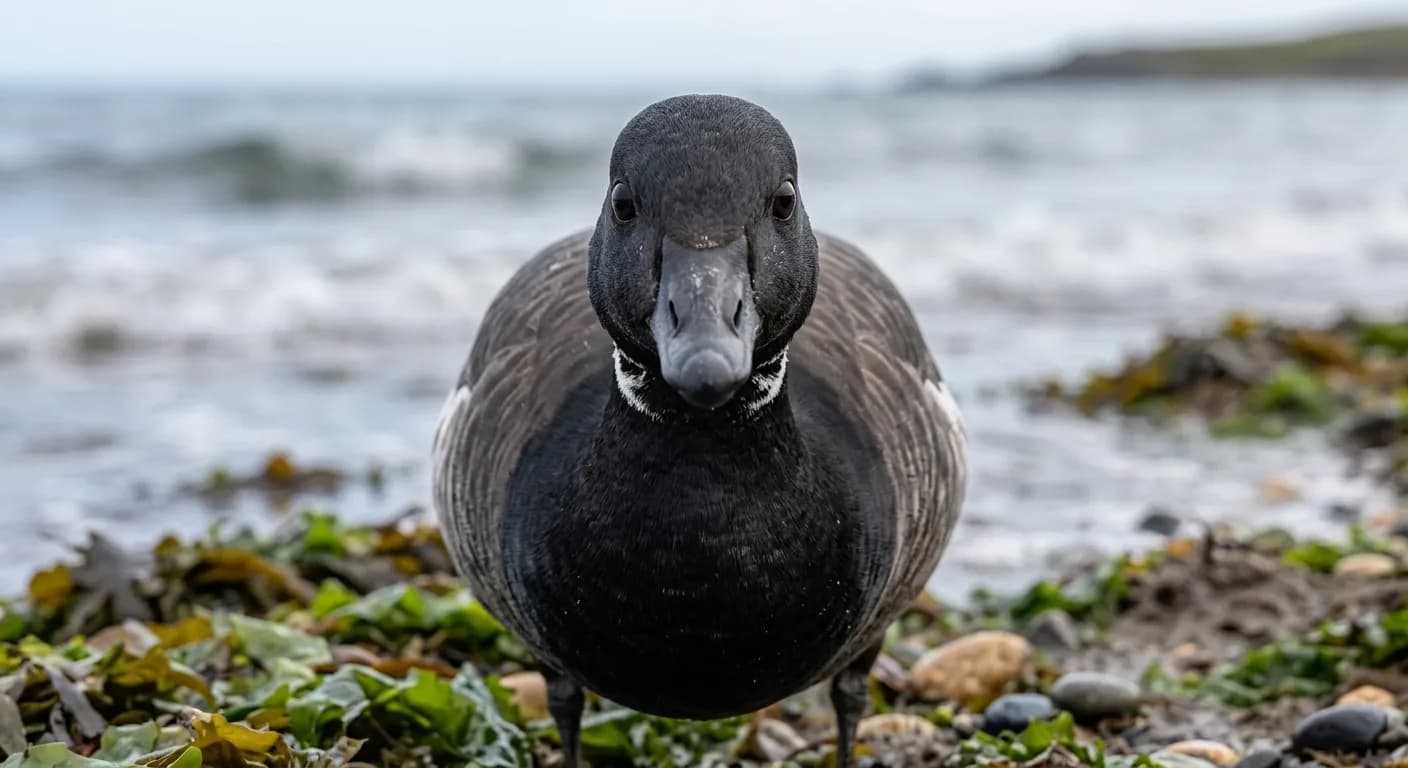
Brent Goose (Branta bernicla)

Birds · Anseriformes · Anatidae

Brent Goose

Branta bernicla

Least Concern

The species is abundant and widely distributed; it faces no significant short-term risk.

Spotted something wrong?

The brent goose is a small, dark goose that breeds on the northernmost Arctic tundra and spends the winter in temperate marshes and bays, where it feeds almost exclusively on Zostera, a marine plant. That specialisation almost wiped it out: when a disease destroyed the Atlantic Zostera beds in the 1930s, the European and American populations collapsed within a few years.

Weight

1.2 kg – 2.3 kg

Size

55 cm – 66 cm

Life expectancy

28 years
Diet

Herbivore

Feeds mainly on plants.

Activity

Diurnal

Active mainly during the day.

Sighting difficulty

Easy

TundraOceanFreshwaterGrasslandPolar
17countries27parks42same family1natural phenomena1featured routes

AI-generated images: illustrations, not photographs.

Fun facts

  • GeneralIn winter it depends almost entirely on eelgrass beds.
  • It is the type species of the genus Branta, created by Scopoli in 1769.
  • Its scientific name, bernicla, and the English name of its relative the barnacle goose both come from the same medieval myth about goose barnacles.
  • It is the most coastal of the black geese: it spends the winter hugging the sea and barely ventures inland.
  • Its dependence on a single plant almost finished it off: a disease that devastated the Atlantic Zostera beds in the 1930s brought its populations on both sides of the ocean crashing down within a few seasons.
  • Its European name comes from a medieval legend: it was believed to be born from the goose barnacles that grow on driftwood, because nobody had ever seen its nests, and that supposed shellfish nature made it acceptable to eat during Lent.
  • It breeds on the northernmost tundra on the planet and migrates to temperate latitudes, a journey the young make within a few weeks of hatching.

Life cycle and biology

Skeleton type
Vertebrate - internal bony skeleton (bird)
Habitat and environment
Coastal Arctic tundra for breeding; saltmarsh and bays with eelgrass beds in winter
Sexual maturity
2 years
Gestation / incubation
24 days
Litter / clutch size
4

Sources consulted: IUCN Red List; eBird; Wikipedia (Branta); Museum of Comparative Zoology (Harvard); Linnaeus 1758

Where to find it

Best time: In winter, in marshes, on rocky coasts, in sheltered bays and on beaches

Loading map…

Where to see it

Parks and dive sites where this species has been documented — showing 10 of 27.

Related species

Other species in the catalogue with the most in common with Brent Goose — same habitat, park, country, tags or family.

Same taxonomic family

Keep exploring

Based on what we already know about brent goose.

Comments

Share an experience, a fun fact or a tip for seeing the brent goose.

Be the first to comment.

See full glossary
This page in other languages: Español · Deutsch · Français · Português · Italiano

The pins mark the parks where its presence is documented.

See its range on the interactive map→
AuyuittuqCanada
Wadden Sea National ParkDenmark
Wadden SeaGermany
IvvavikCanada
Pembrokeshire CoastUnited Kingdom
NorthumberlandUnited Kingdom
Wrangel IslandRussia
Assateague IslandUnited States
Point ReyesUnited States
Cape CodUnited States
See all 27 parks
Least Concern

Gadwall

Mareca strepera

Barnacle GooseLeast Concern

Barnacle Goose

Branta leucopsis

Least Concern

Whooper Swan

Cygnus cygnus

Mute SwanLeast Concern

Mute Swan

Cygnus olor

Red-breasted MerganserLeast Concern

Red-breasted Merganser

Mergus serrator

Least Concern

Common Shelduck

Tadorna tadorna

CountriesCanada
ParksAuyuittuqCanada
TagsHerbivore
Herbivore
Diurnal
Bird
Tundra
Ocean
Freshwater
Grassland
Polar

Europe11

Asia3

North America3

Canada
Denmark
Germany
Norway
United Kingdom
United States
Denmark
Finland
France
Germany
Iceland
Ireland
Netherlands
Norway
Spain
Sweden
United Kingdom
China
Japan
Russia
Canada
Greenland
United States