 Not Evaluated
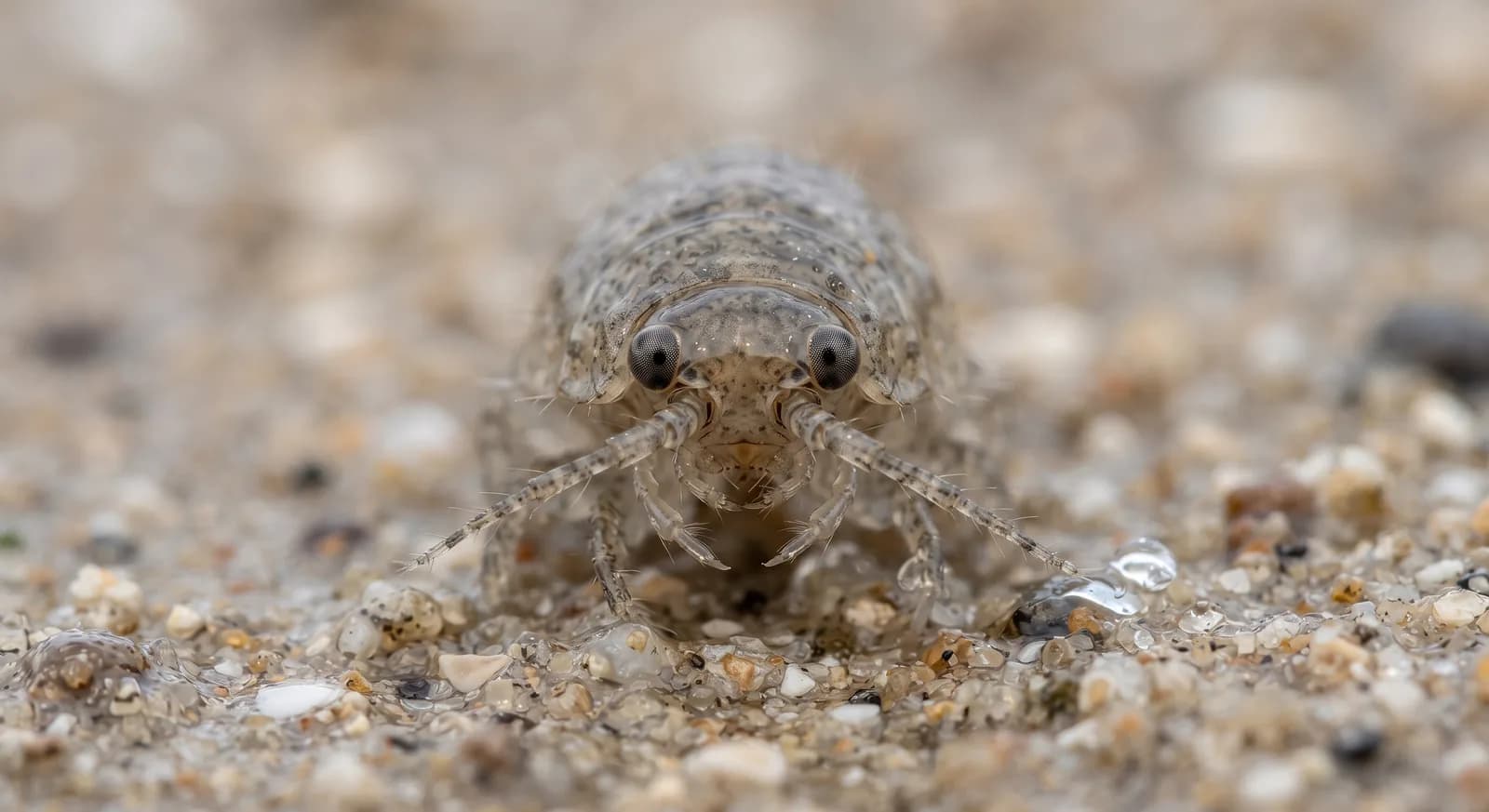
Speckled Sea Louse
Eurydice pulchra
13 countries30 parks33 dive sites
Species group · Malacostracans
WAnimals has 3 species of isopod, spread across 2 families (Cirolanidae, Sphaeromatidae).
Ranges calculated from the profiles that record the figure, not from all 3.
Each one has its own full profile. This group does not replace them: it brings them together.
No species documented in this group is genuinely at risk according to the IUCN, with the data available today.
Recorded in 51 countries. The ones with the most species in the group:
It keeps its activity rhythm every 12.4 hours even when isolated in a laboratory without tides: it is one of the classic models for studying the circatidal biological clock.
From
As well as the tidal clock, it changes colour according to the time of day thanks to an independent circadian rhythm.
From
It has a tidal clock of its own: an endogenous circatidal rhythm of about 12.4 hours that brings it out of the sand on the flooding tide, keeps it swimming for five or six hours and sends it back into the sand.
From
When threatened it rolls into a perfect ball, like a woodlouse, leaving only its armour exposed.
From
Its tolerance of salinity lets it live in seawater as readily as in brackish lagoons and salt pans.
From
Like the woodlouse on land, it rolls into a ball when disturbed, a trait that gives its family, the sphaeromatids, its name.
From
It can go several years without eating, on an extremely slow metabolism suited to how little food there is in deep water.
From
·
A scavenger up to 50 cm long; in captivity it can go years without eating.
From Giant Isopod