Skip to content
WAnimals
  • Map
  • Species
  • Parks
  • Diving
Log inCreate account
WAnimals

The guide for travellers and animal lovers: discover, plan and share your wild adventures around the world.

Discover wildlife

  • Species
  • Ecosystems
  • Glossary
  • Tags

Explore places

  • Map
  • Countries
  • Parks
  • Diving

Plan experiences

  • Guides

Learn

  • Blog

Resources

  • Help centre
  • Contact
  • Install the app

Follow us

Account

  • Log in
  • Create account

© 2026 WAnimals. All rights reserved.

About usHow we build our profilesTerms of servicePrivacyLegal notice
MapSpeciesParksDiving
  1. Home
  2. Species
  3. Northern Mockingbird
Northern Mockingbird (Mimus polyglottos)

Birds · Passeriformes · Mimidae

Northern Mockingbird

Mimus polyglottos

Least Concern

The species is abundant and widely distributed; it faces no significant short-term risk.

Spotted something wrong?

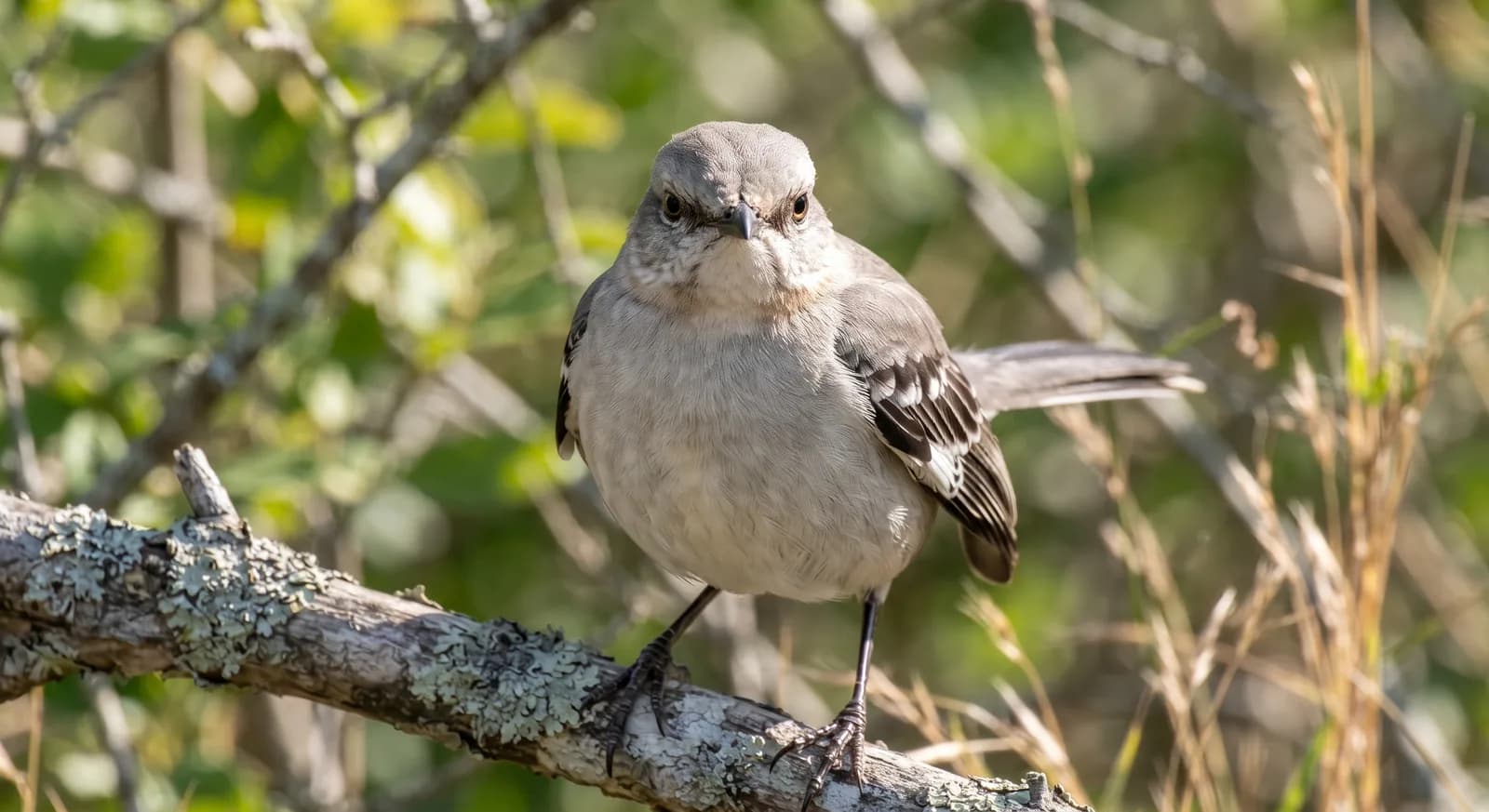
The northern mockingbird is a species of passerine bird of the family Mimidae native to North America, Central America and the Caribbean. Adults are grey on the upperparts, with pale yellow eyes and a slightly curved black bill. The tail is dark with white edges, and the legs are long and black. The wings show fine white lines, and in flight reveal white patches on the wings and two white lengthwise stripes on the tail. They are known for imitating the sounds of other animals.

Weight

40 g – 58 g

Size

21 cm – 26 cm

Life expectancy

20 years
Diet

Omnivore

Combines animal and plant food depending on availability.

Activity

Diurnal

Active mainly during the day.

Social structure

In pairs

Usually lives in pairs, sometimes for life.

Sighting difficulty

Easy

Temperate forestGrassland
35countries54parks

AI-generated images: illustrations, not photographs.

Fun facts

  • GeneralIt mimics over 200 different sounds, car alarms and other birds included.
  • comunicaciónIt can learn and take up the songs of dozens of other birds, along with man-made sounds, widening its repertoire all its life.
  • A male can build up two hundred different imitations over his life, and renews part of the repertoire every season: he takes in other birds, frogs, car alarms and doorbells.
  • It recognises people as individuals: in an experiment at the University of Florida, the mockingbirds selectively attacked the particular person who had approached their nest days earlier, ignoring others dressed the same way.
  • Unpaired males sing at night as well, and that nocturnal persistence is a common complaint in American residential neighbourhoods in spring.

Life cycle and biology

Skeleton type
Vertebrate - internal bony skeleton (bird)
Habitat and environment
Gardens, city parks, hedgerows, scrub and field margins of North America and the Caribbean
Sexual maturity
12 months
Gestation / incubation
12 days
Litter / clutch size
4

Sources consulted: https://es.wikipedia.org/wiki/Mimus_polyglottos

Where to find it

Loading map…

Where to see it

Parks and dive sites where this species has been documented — showing 10 of 54.

Related species

Other species in the catalogue with the most in common with Northern Mockingbird — same habitat, park, country, tags or family.

Shares a park
Shares a park
Shares a park
Shares a park
Shares a park
Shares a park

Keep exploring

Based on what we already know about northern mockingbird.

Comments

Share an experience, a fun fact or a tip for seeing the northern mockingbird.

Be the first to comment.

See full glossary
This page in other languages: Español · Deutsch · Français · Português · Italiano

The pins mark the parks where its presence is documented.

See its range on the interactive map→
Grand CanyonUnited States
EvergladesUnited States
Great Smoky MountainsUnited States
Death ValleyUnited States
ZionUnited States
AcadiaUnited States
Big BendUnited States
Mammoth CaveUnited States
Channel IslandsUnited States
Sian Ka'anMexico
See all 54 parks
Bald EagleLeast Concern

Bald Eagle

Haliaeetus leucocephalus

Least Concern

Wood Duck

Aix sponsa

Least Concern

Wild Turkey

Meleagris gallopavo

Least Concern

Mourning Dove

Zenaida macroura

Greater RoadrunnerLeast Concern

Greater Roadrunner

Geococcyx californianus

Sandhill CraneLeast Concern

Sandhill Crane

Antigone canadensis

CountriesUnited States
ParksGrand CanyonUnited States
TagsOmnivore
Omnivore
Diurnal
In pairs
Bird
Temperate forest
Grassland

North America33

South America2

United States
Mexico
Canada
Anguilla
Antigua and Barbuda
Aruba
Anguilla
Antigua and Barbuda
Aruba
Bahamas
Barbados
Belize
Bermuda
British Virgin Islands
Canada
Cayman Islands
Costa Rica
Cuba
Curaçao
Dominica
Dominican Republic
Grenada
Guadeloupe
Guatemala
Haiti
Honduras
Jamaica
Martinique
Mexico
Nicaragua
Panama
Puerto Rico
Saint Kitts and Nevis
Saint Lucia
Saint Vincent and Grenadines
Trinidad and Tobago
Turks and Caicos Islands
U.S. Virgin Islands
United States
Colombia
Venezuela