Bony fish · Anguilliformes · Ophichthidae
Harlequin Snake Eel
Myrichthys colubrinus
The species is abundant and widely distributed; it faces no significant short-term risk. See full glossary
A snake eel ringed in black and white that glides over the sandy bottoms of Indo-Pacific reefs. It searches for crustaceans and small fish by probing the sediment with its pointed snout, and usually buries itself leaving only its head exposed.
Size
60 cm – 97 cm
Diet
Carnivore
Feeds mainly on other animals.
Activity
Nocturnal
Active mainly at night.
Social structure
Solitary
Lives and hunts alone, joining others only to breed.
Sighting difficulty
Easy
Fun facts
- Its ringed livery mimics that of the highly venomous banded sea krait, which protects it from predators that avoid the snake: a case of Batesian mimicry.
- It buries itself tail first, backing into the sand with the hardened tip of its tail rather than digging with its head.
- Unlike the moray eels, with which it is confused, it has no tail fin.
- It mimics a venomous sea snake. Its black and white bands and its way of swimming copy the yellow-lipped sea krait, Laticauda colubrina, which is extremely venomous. The eel itself is completely harmless: it is a case of Batesian mimicry.
- The deception works even at close quarters. Researchers who have watched the two animals in the same area describe how hard it is to tell them apart at any distance.
- The mimicry changes its life: where it lives alongside the snake it feeds openly by day, whereas in areas where the snake is absent it becomes nocturnal.
- Its snout and tail are hard and pointed for digging in the sand. Hence a well-documented macabre story: mummified specimens have been found inside the body cavity of large fish, having been swallowed whole and having pierced the predator's stomach from within.
- It has between 190 and 202 vertebrae.
- In 2021 it was recorded for the first time in Hawaiian waters, extending its known range.
Life cycle & biology
- Skeleton type
- Vertebrate - internal bony skeleton (fish)
- Habitat & environment
- Sandy and coral-rubble bottoms of the Indo-Pacific, from 0 to 30 m
Sources consulted: FishBase (Froese & Pauly, eds.); Lista Roja de la UICN; Heemstra; Reef Life Survey
Where to find it
See its range on the interactive mapWhere to watch it
Parques y spots de buceo donde se ha documentado esta especie — se muestran 20 de 270 documentados.
Related species
Other species in the catalogue with the most in common with Harlequin Snake Eel — same habitat, park, country, tags or family.
 Least Concern
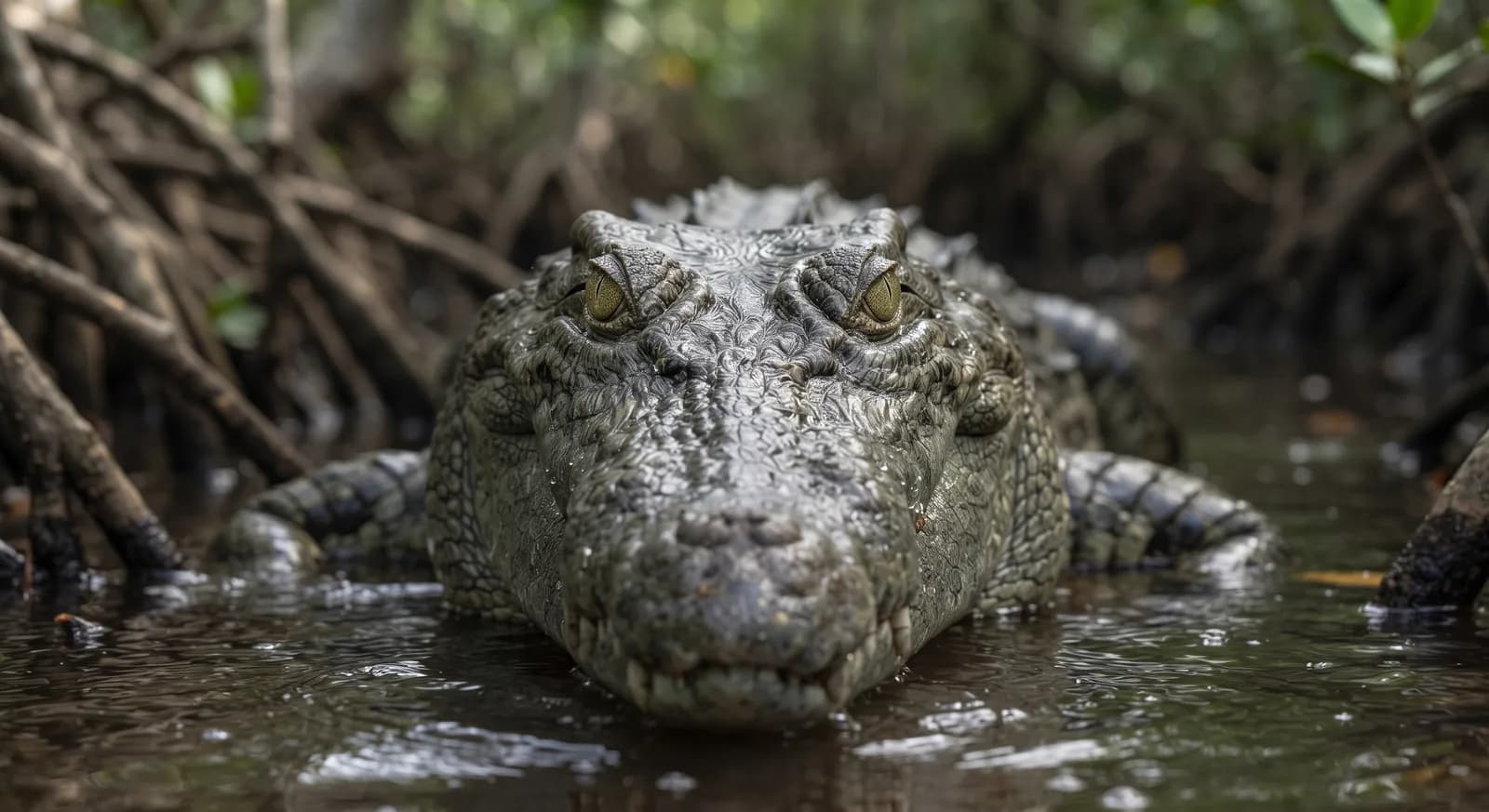
Saltwater Crocodile
Crocodylus porosus
Yellow-bellied Sea Snake
Hydrophis platurus
Red Lionfish
Pterois volitans
White-spotted Puffer
Arothron hispidus
Spot-fin Porcupinefish
Diodon hystrix
Clown Triggerfish
Balistoides conspicillum
Keep exploring
Based on what we already know about harlequin snake eel.
Comments
Share an experience, a fun fact or a tip for seeing the harlequin snake eel.
Be the first to comment.