One of the 2 prawns on WAnimals
Malacostracans · Decapoda · Palaemonidae
Giant River Prawn
Macrobrachium rosenbergii
The species is abundant and widely distributed; it faces no significant short-term risk. See full glossary
The giant freshwater prawn, also known as the Malaysian prawn or the blue prawn, is a prawn of the family Palaemonidae in the order Decapoda that lives in tropical Asia in the Indomalayan realm, from the Indian subcontinent to northern Australia and New Guinea. It is also found in several countries of Latin America and Africa through aquaculture. It feeds on parasites and dead tissue. Farming it can have a negative impact on waterways. It can grow to more than 30 cm. It is the largest farmed prawn in the world. It lives in fresh water, but in its larval stage it requires brackish water. It often lives in very turbid water.
Size
20 cm – 32 cm
Lifespan
3 years
Diet
Omnivore
Combines animal and plant food depending on availability.
Activity
Nocturnal
Active mainly at night.
Social structure
Colony
Lives in large concentrations, often for breeding reasons.
Sighting difficulty
Easy
Fun facts
- The males form three castes of different appearance and behaviour: the dominant blue-clawed males, the orange-clawed males and the small transparent ones, and an individual can change caste over its life.
- Its larvae die in pure fresh water: they need salinity to complete their metamorphosis, something that held back its farming for decades until it was discovered in the 1960s.
- Its males come in three distinct morphotypes that coexist in the same population, and they are not age stages but alternative strategies.
- The blue-claw male is the dominant one: huge, territorial, with extremely long chelae, he defends a territory and monopolises freshly moulted females.
- The orange-claw male is a contender in transition, and the small-claw male practises sneaking: he slips in and fertilises females while the dominant male is off guard.
- A male can change morphotype over the course of his life, and the presence of a dominant male holds back the development of the others.
- It is the most farmed freshwater prawn in the world, with major production in South-east Asia and Latin America.
- Its larvae do not survive in fresh water: they need brackish water, a requirement that means its farming demands hatcheries with controlled salinity.
- Its chelae can exceed the length of the entire body.
Life cycle & biology
- Skeleton type
- Invertebrate - chitin exoskeleton (crustacean)
- Habitat & environment
- Tropical rivers, lagoons and estuaries, with larvae that need brackish water
Sources consulted: https://es.wikipedia.org/wiki/Macrobrachium_rosenbergii
Where to find it
See its range on the interactive mapWhere to watch it
Parques y spots de buceo donde se ha documentado esta especie — se muestran 10 de 12 documentados.
Related species
Other species in the catalogue with the most in common with Giant River Prawn — same habitat, park, country, tags or family.
 Least Concern
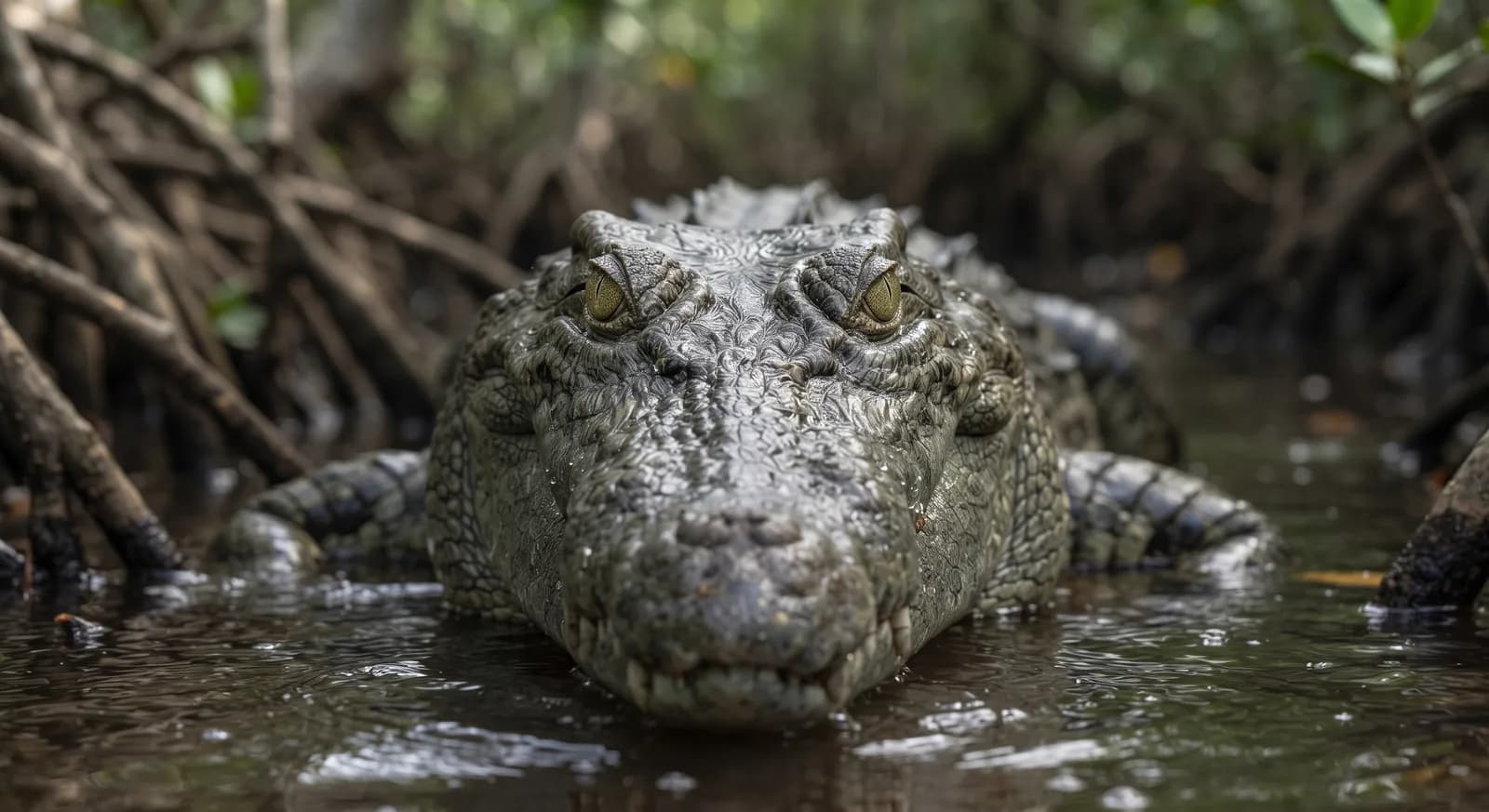
Saltwater Crocodile
Crocodylus porosus
Banded Krait
Bungarus fasciatus
Climbing Perch
Anabas testudineus
Sunbeam Snake
Xenopeltis unicolor
Giant River-catfish
Mystus seenghala
Banded Archerfish
Toxotes jaculatrix
Keep exploring
Based on what we already know about giant river prawn.
Comments
Share an experience, a fun fact or a tip for seeing the giant river prawn.
Be the first to comment.