Mammals · Artiodactyla · Bovidae
Oribi
Ourebia ourebi
The species is abundant and widely distributed; it faces no significant short-term risk. See full glossary
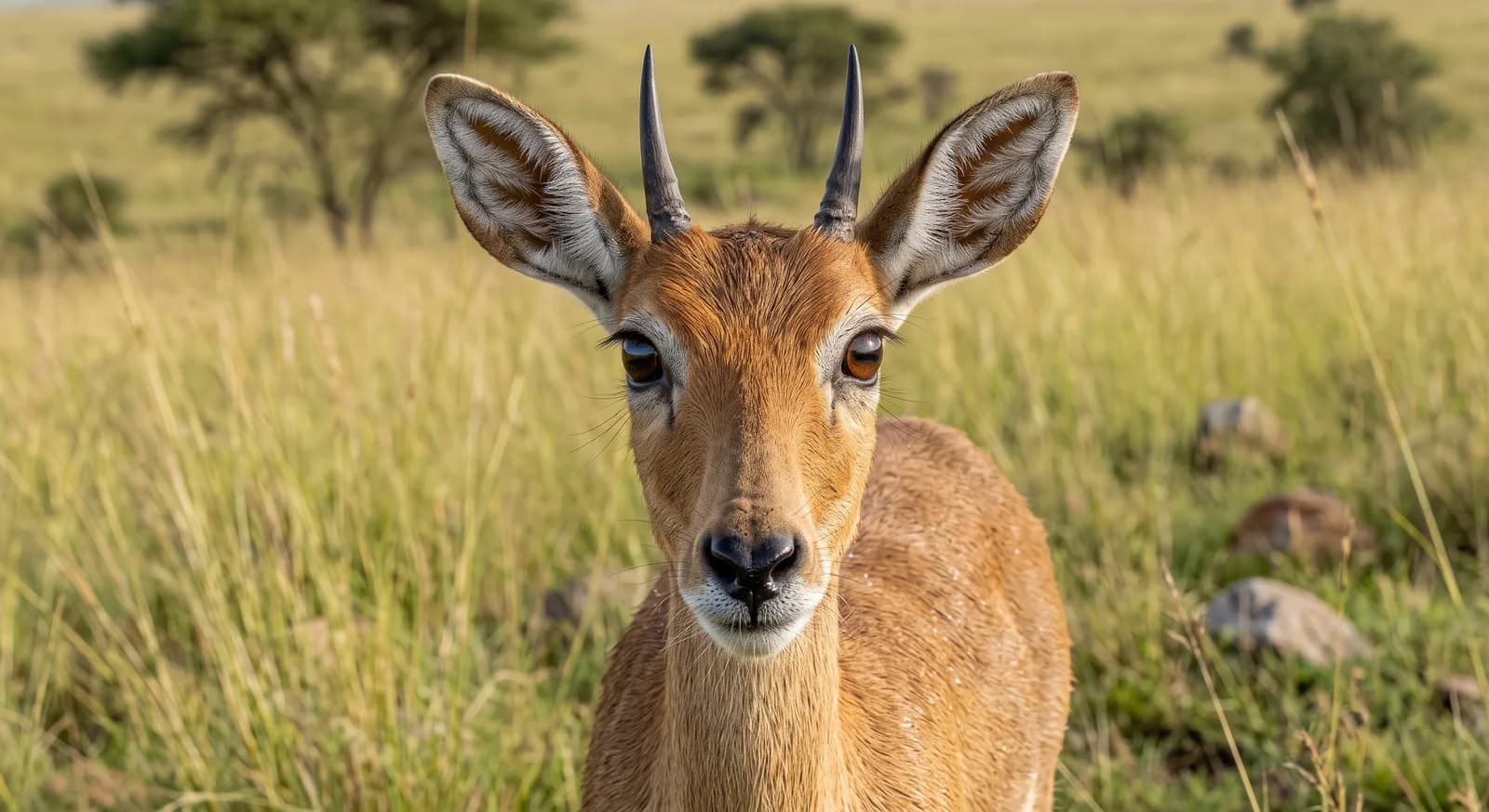
A small, slender antelope with a slightly arched back, long neck and legs and large, erect ears. The coat, yellowish to reddish brown and glossy, contrasts with the white of the chin, throat, belly and rump. Below each ear it has a bare black patch that is a gland.
Weight
12 kg – 22 kg
Size
50 cm – 1.1 m
Lifespan
14 years
Diet
Herbivore
Feeds mainly on plants.
Activity
Diurnal
Active mainly during the day.
Social structure
Herd
Lives in large groups as a strategy against predators.
Sighting difficulty
Easy
Estimated population
Around 750,000 individuals, half of them in protected areas
Fun facts
- GeneralIt marks its territory with a black secretion from a gland below the eye.
- Only the males have horns: thin, straight and ringed at the base, 8 to 18 cm long.
- It is one of the few mammals that benefits from fire: it returns to burnt ground as soon as the flames die down, to take advantage of the tender regrowth.
- Its defence combines two opposite strategies: it crouches motionless in the grass, or bounds away and stops upright on a termite mound to scan for danger.
Life cycle & biology
- Skeleton type
- Vertebrate - internal bony skeleton (mammal)
- Habitat & environment
- Open grassland and short-grass savannah
- Sexual maturity
- Females can conceive at ten months; males are active at fourteen
- Gestation / incubation
- 6 - 7 months
- Litter / clutch size
- A single young per birth
- Lifespan in captivity
- Up to 14 years
Sources consulted: IUCN Red List; Estes 1991, The Behavior Guide to African Mammals; Kingdon 2015, The Kingdon Field Guide to African Mammals; Brashares y Arcese 2002, Journal of Animal Ecology 71; Animal Diversity Web; SANBI (Sudáfrica)
Where to find it
See its range on the interactive mapBest time: All year round; births are concentrated between October and December
Where to watch it
Parques y spots de buceo donde se ha documentado esta especie — se muestran 10 de 23 documentados.
Related species
Other species in the catalogue with the most in common with Oribi — same habitat, park, country, tags or family.
Waterbuck
Kobus ellipsiprymnus
Klipspringer
Oreotragus oreotragus
Kob
Kobus kob
Hartebeest
Alcelaphus buselaphus
Blesbok
Damaliscus pygargus phillipsi
Steenbok
Raphicerus campestris
Keep exploring
Based on what we already know about oribi.
Comments
Share an experience, a fun fact or a tip for seeing the oribi.
Be the first to comment.