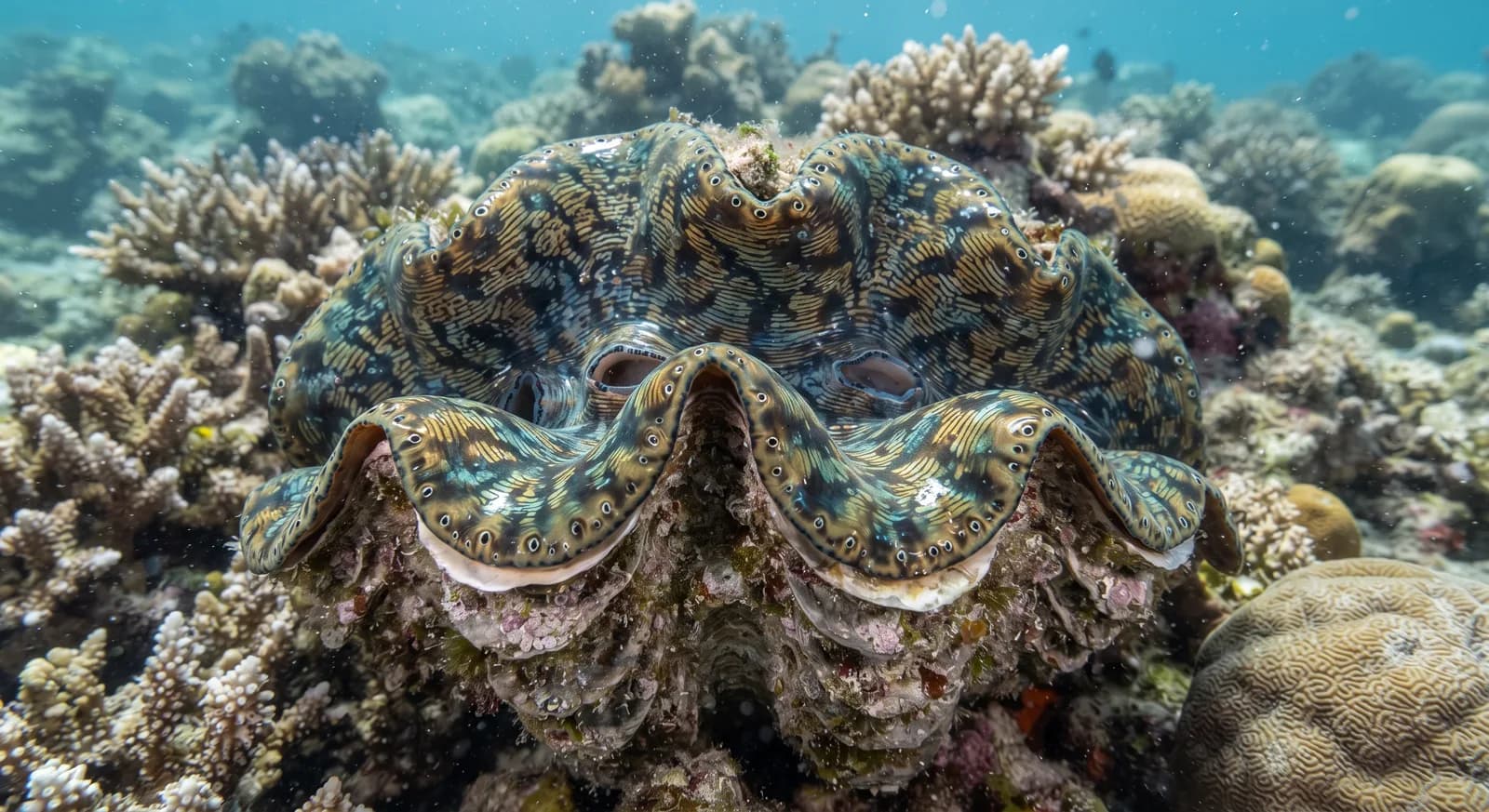
 Critically Endangered
Giant Clam
Tridacna gigas
58 countries35 parks236 dive sites
Species group · Bivalves
WAnimals has 6 species of clam, spread across 6 families (Arcticidae, Cardiidae, Mactridae, Myidae, Nuculanidae, Veneridae).
Each one has its own full profile. This group does not replace them: it brings them together.
1 species in this group is in a threatened category according to the IUCN.
Recorded in 98 countries. The ones with the most species in the group:
It is the largest living bivalve mollusc in the world, with shells up to 137 cm across.
From
It can close its shells with considerable force, though contrary to popular legend it poses no real risk of trapping a diver.
From
Contrary to the popular myth, it closes far too slowly to trap a diver.
From
It is told from the introduced Manila clam (Ruditapes philippinarum) by having its two siphons separate right to the base, whereas in the Manila clam they are fused for much of their length.
From
It is the native European clam and the most prized in the kitchen; in Spain it is the almeja fina, the one used for almejas a la marinera.
From
Its production has been declining for decades for two reasons that go together: the parasite Perkinsus olseni, which causes perkinsosis, and competition from the introduced Manila clam, Ruditapes philippinarum.
From
Archaeological shell remains in Denmark dated to the thirteenth century indicate that it reached Europe from America several centuries before Columbus's voyages.
From
·
Ranges calculated from the profiles that record the figure, not from all 6.
Its siphon is so long that it does not fit inside the shell, a trait that gives its family its name (Myidae).
From Sand Gaper