Skip to content
WAnimals
  • Map
  • Species
  • Parks
  • Diving
Log inCreate account
WAnimals

The guide for travellers and animal lovers: discover, plan and share your wild adventures around the world.

Discover wildlife

  • Species
  • Ecosystems
  • Glossary
  • Tags

Explore places

  • Map
  • Countries
  • Parks
  • Diving

Plan experiences

  • Guides

Learn

  • Blog

Resources

  • About us
  • How we build our profiles
  • Help centre
  • Contact
  • Install the app

Follow us

Account

  • Log in
  • Create account

© 2026 WAnimals. All rights reserved.

Terms of servicePrivacyCookiesLegal notice
MapSpeciesParksDiving
  1. Home
  2. Species
  3. Ocean Quahog

One of the 6 clams on WAnimals

Bivalves · Venerida · Arcticidae

Ocean Quahog

Arctica islandica

Not Evaluated

It has not yet been assessed against the IUCN criteria.

Spotted something wrong?

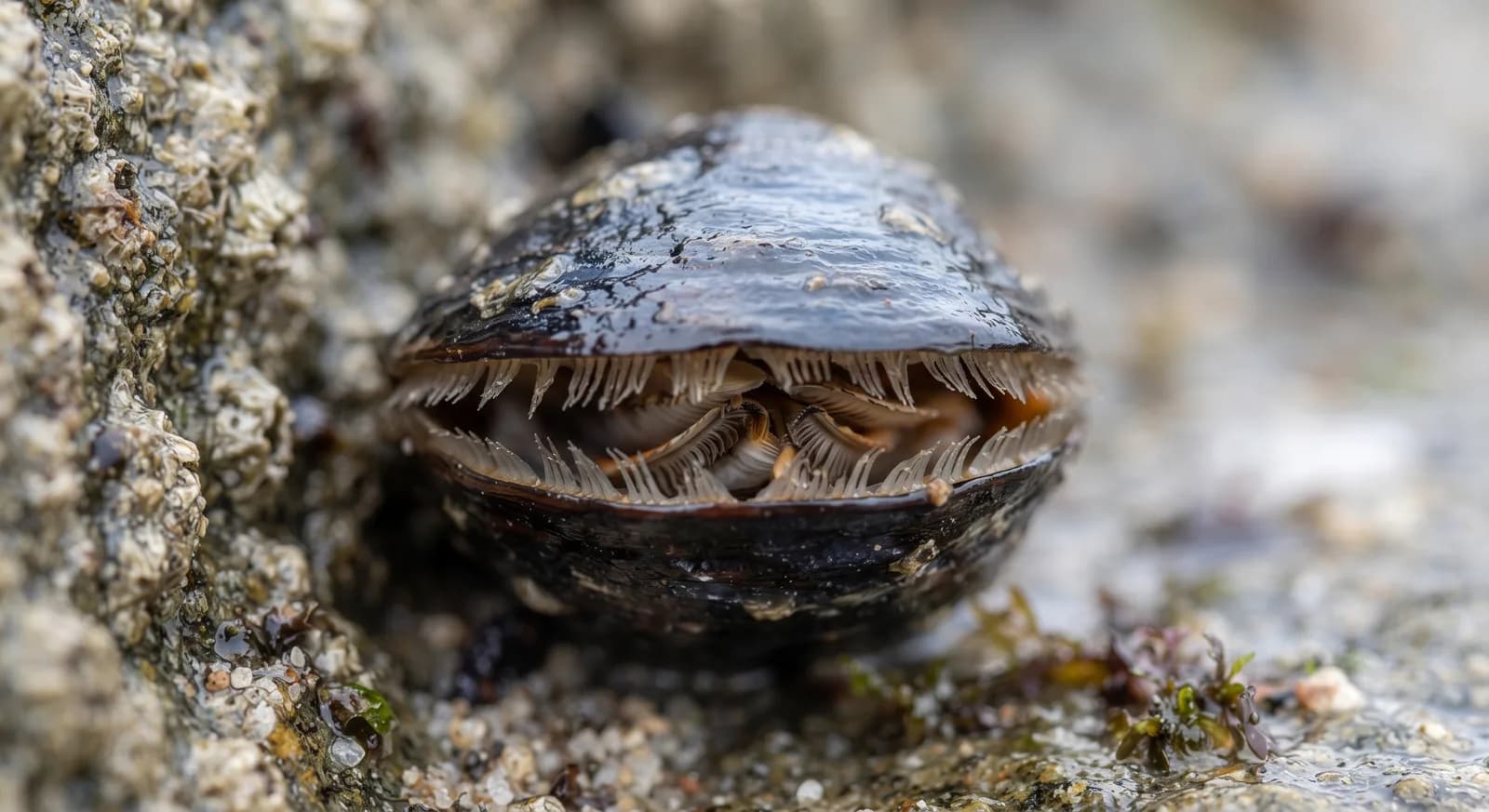
A clam with a thick shell and a dark brown periostracum that lives buried in soft bottoms of the North Atlantic. Its extremely slow metabolism and its ability to shut down for long periods make it the longest-lived non-colonial animal known. It supports an important fishery in the United States, where it is sold as ocean quahog.

Size

5 cm – 13 cm

Life expectancy

400 years

Diet

Omnivore

Combines animal and plant food depending on availability.

Social structure

Colony

Lives in large concentrations, often for breeding reasons.

Ocean
22countries35parks23dive sites

Fun facts

  • GeneralThe longest-lived animal known: one individual reached 507 years, counted from the rings of its shell.
  • The 507-year-old individual, nicknamed Ming, had been born around the year 1499.
  • Its annual growth rings work as a climate archive and make it possible to reconstruct North Atlantic temperatures over the past centuries at annual resolution.
  • It can spend days with its metabolism practically at a standstill, using hardly any oxygen.
  • It is the longest-lived non-colonial animal known. A specimen dredged off Iceland in 2006, nicknamed Ming, was dated at 507 years old: it was born around 1499, during the Ming dynasty.
  • The first estimate was 405 to 410 years, counting the rings of the internal hinge ligament. A later recount, in 2013, used the external rings of the shell and raised the figure to 507.
  • And it died when it was opened for the count, which turned the discovery into an awkward anecdote: the oldest known animal was killed in order to find out its age.
  • It is no isolated case: the species' average longevity exceeds 225 years, and as far back as 1868 a live specimen of 374 was collected.
  • Its growth rings are a climate archive: shells of this species have been used to reconstruct the sea temperature on the Icelandic shelf across 1,357 years.
  • Its secret seems to lie in the mitochondria: it has a lower membrane peroxidation index and less free-radical leakage than related bivalves.
  • It is fished commercially in the United States, where it is marketed as the ocean quahog.

Life cycle and biology

Skeleton type
Invertebrate - external calcareous shell (mollusc)
Habitat and environment
Sandy and muddy bottoms of the North Atlantic
Sexual maturity
12.5 years

Sources consulted: Wikipedia (es): Arctica islandica

Where to find it

Loading map…

Where to see it

Parks and dive sites where this species has been documented — showing 20 of 58.

Related species

Other species in the catalogue with the most in common with Ocean Quahog — same habitat, park, country, tags or family.

Shares a park
Shares a park
Shares a park
Shares a park
Shares a park
Shares a park

Keep exploring

Based on what we already know about ocean quahog.

Share an experience, a fun fact or a tip for seeing the ocean quahog.
See full glossary
This page in other languages: Español · Deutsch · Français · Português · Italiano

The pins mark the parks and dive sites where its presence is documented.
See its range on the interactive map→
VatnajökullIceland
Gros MorneCanada
AuyuittuqCanada
Wadden Sea National ParkDenmark
Wadden SeaGermany
Pembrokeshire CoastUnited Kingdom
NorthumberlandUnited Kingdom
Wrangel IslandRussia
Cíes IslandsSpain
Ria FormosaPortugal
Scapa FlowUnited Kingdom
Farne IslandsUnited Kingdom
Lofoten (orcas)Norway
SaltstraumenNorway
Svalbard (ice diving)Norway
St AbbsUnited Kingdom
Malin HeadIreland
Block Island (Mohawk wreck)United States
Strýtan (hydrothermal chimney)Iceland
Andrea DoriaUnited States
See all 35 parks
See all 23 dive sites
Mediterranean MusselNot Evaluated

Mediterranean Mussel

Mytilus galloprovincialis

Not Evaluated

Chequered Carpet Shell

Ruditapes decussatus

Not Evaluated

Pod Razor Shell

Ensis siliqua

Not Evaluated

Atlantic Surf Clam

Spisula solidissima

Common CockleNot Evaluated

Common Cockle

Cerastoderma edule

Not Evaluated

Variegated Scallop

Mimachlamys varia

CountriesUnited Kingdom
ParksVatnajökullIceland
TagsOmnivore
Omnivore
Colonial
Ocean
Mollusc

Europe17

North America3

Africa1

Asia1

United Kingdom
Canada
Norway
Germany
Iceland
Ireland
Belgium
Denmark
Estonia
Finland
France
Germany
Iceland
Ireland
Latvia
Lithuania
Netherlands
Norway
Poland
Portugal
Spain
Sweden
United Kingdom
Canada
Greenland
United States
Morocco
Russia