Skip to content
WAnimals
  • Map
  • Species
  • Parks
  • Diving
Log inCreate account
WAnimals

The guide for travellers and animal lovers: discover, plan and share your wild adventures around the world.

Discover wildlife

  • Species
  • Ecosystems
  • Glossary
  • Tags

Explore places

  • Map
  • Countries
  • Parks
  • Diving

Plan experiences

  • Guides

Learn

  • Blog

Resources

  • Help centre
  • Contact
  • Install the app

Follow us

Account

  • Log in
  • Create account

© 2026 WAnimals. All rights reserved.

About usHow we build our profilesTerms of servicePrivacyLegal notice
MapSpeciesParksDiving
  1. Home
  2. Species
  3. Common Cockle
Common Cockle (Cerastoderma edule)

Bivalves · Cardiida · Cardiidae

Common Cockle

Cerastoderma edule

Not Evaluated

It has not yet been assessed against the IUCN criteria.

Spotted something wrong?

The common cockle is a bivalve mollusc of the family Cardiidae. No subspecies are recognised.

Size

2 cm – 5 cm

Life expectancy

4 years

Diet

Omnivore

Combines animal and plant food depending on availability.
Social structure

Colony

Lives in large concentrations, often for breeding reasons.

Sighting difficulty

Unknown

OceanFreshwater
21countries21parks37dive sites1same family

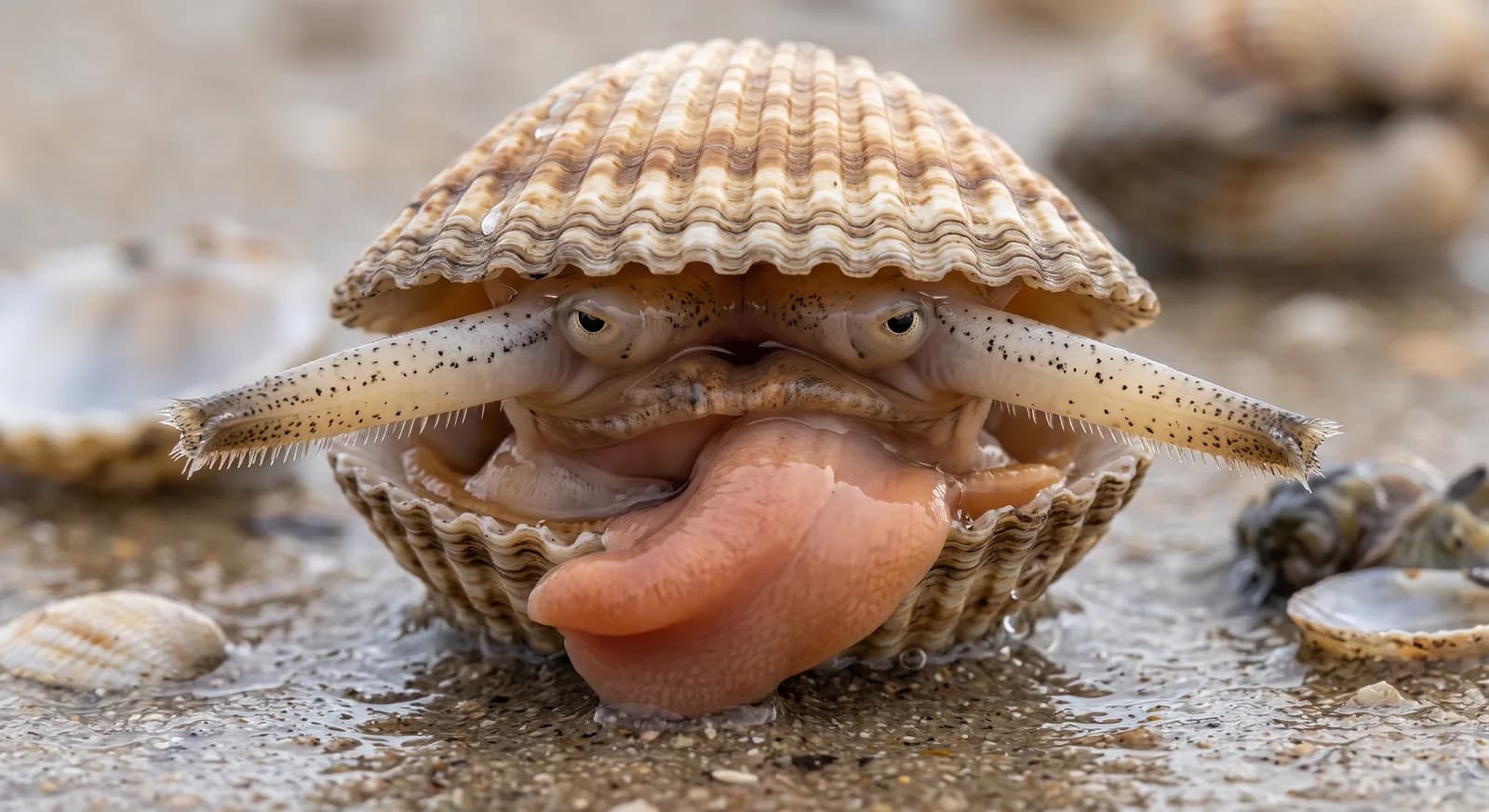
AI-generated images: illustrations, not photographs.

Fun facts

  • GeneralIt buries itself a few centimetres down in the sand and filters the water through two short siphons.
  • Its muscular, sickle-shaped foot lets it leap across the sediment to escape starfish and crabs.
  • Cockle beds are the main food of thousands of wintering waders, which depend on them during migration.
  • The rings on the shell mark the winters and make it possible to tell the animal's age.
  • It lives very close to the surface, with short siphons, and that is why it can leap: it folds its muscular foot and pushes off to escape a predator or reposition itself.
  • How deep it buries depends on fear: in the presence of the green crab it buries less, because it changes its vertical orientation and performs a water-expulsion response.
  • Its growth bands tell its story: the annual winter ones allow its age to be dated, and the internal ones are laid down to the rhythm of the semidiurnal tides.
  • It is essential prey for waders and crabs. On one Welsh beach green crabs were estimated to consume 236,000 cockles a year for every linear metre of shore.
  • It suffers normal winter mortality of between 30 and 90%, depending on size.
  • The Burry Inlet fishery in Wales is certified as sustainable by the Marine Stewardship Council.

Life cycle and biology

Habitat and environment
Intertidal sand and mud of rias and estuaries
Sexual maturity
1 year

Sources consulted: https://es.wikipedia.org/wiki/Cerastoderma_edule

Where to find it

Loading map…

Where to see it

Parks and dive sites where this species has been documented — showing 20 of 58.

Related species

Other species in the catalogue with the most in common with Common Cockle — same habitat, park, country, tags or family.

Shares a park
Shares a park
Shares a park
Shares a park
Shares a park
Shares a park

Keep exploring

Based on what we already know about common cockle.

Comments

Share an experience, a fun fact or a tip for seeing the common cockle.

Be the first to comment.

See full glossary
This page in other languages: Español · Deutsch · Français · Português · Italiano

The pins mark the parks and dive sites where its presence is documented.

See its range on the interactive map→
Doñana National ParkSpain
Pembrokeshire CoastUnited Kingdom
NorthumberlandUnited Kingdom
Cíes IslandsSpain
Ria FormosaPortugal
KosterhavetSweden
Fragas do EumeSpain
UrdaibaiSpain
ArrábidaPortugal
Sudoeste Alentejano e Costa VicentinaPortugal
Scapa FlowUnited Kingdom
Medes IslandsSpain
Cap de CreusSpain
Calanques of MarseilleFrance
Scandola Reserve (Corsica)France
Farne IslandsUnited Kingdom
Lofoten (orcas)Norway
SaltstraumenNorway
Columbretes IslandsSpain
Formentera (Es Freus)Spain
See all 21 parks
See all 37 dive sites
Mediterranean MusselNot Evaluated

Mediterranean Mussel

Mytilus galloprovincialis

Not Evaluated

Chequered Carpet Shell

Ruditapes decussatus

Not Evaluated

Pod Razor Shell

Ensis siliqua

Not Evaluated

Noah's Ark

Arca noae

Not Evaluated

Variegated Scallop

Mimachlamys varia

Not Evaluated

Chicken Venus

Chamelea gallina

CountriesSpain
ParksDoñana National ParkSpain
TagsOmnivore
Omnivore
Colonial
Ocean
Freshwater
Mollusc

Europe17

Africa3

Asia1

Spain
United Kingdom
Portugal
France
Ireland
Germany
Belgium
Denmark
Estonia
Finland
France
Germany
Iceland
Ireland
Latvia
Lithuania
Netherlands
Norway
Poland
Portugal
Spain
Sweden
United Kingdom
Mauritania
Morocco
Senegal
Russia