Skip to content
WAnimals
  • Map
  • Species
  • Parks
  • Diving
Log inCreate account
WAnimals

The guide for travellers and animal lovers: discover, plan and share your wild adventures around the world.

Discover wildlife

  • Species
  • Ecosystems
  • Glossary
  • Tags

Explore places

  • Map
  • Countries
  • Parks
  • Diving

Plan experiences

  • Guides

Learn

  • Blog

Resources

  • About us
  • How we build our profiles
  • Help centre
  • Contact
  • Install the app

Follow us

Account

  • Log in
  • Create account

© 2026 WAnimals. All rights reserved.

Terms of servicePrivacyCookiesLegal notice
MapSpeciesParksDiving
  1. Home
  2. Species
  3. Great Frigatebird
Great Frigatebird (Fregata minor)

Birds · Suliformes · Fregatidae

Great Frigatebird

Fregata minor

Least Concern

The species is abundant and widely distributed; it faces no significant short-term risk.

Spotted something wrong?

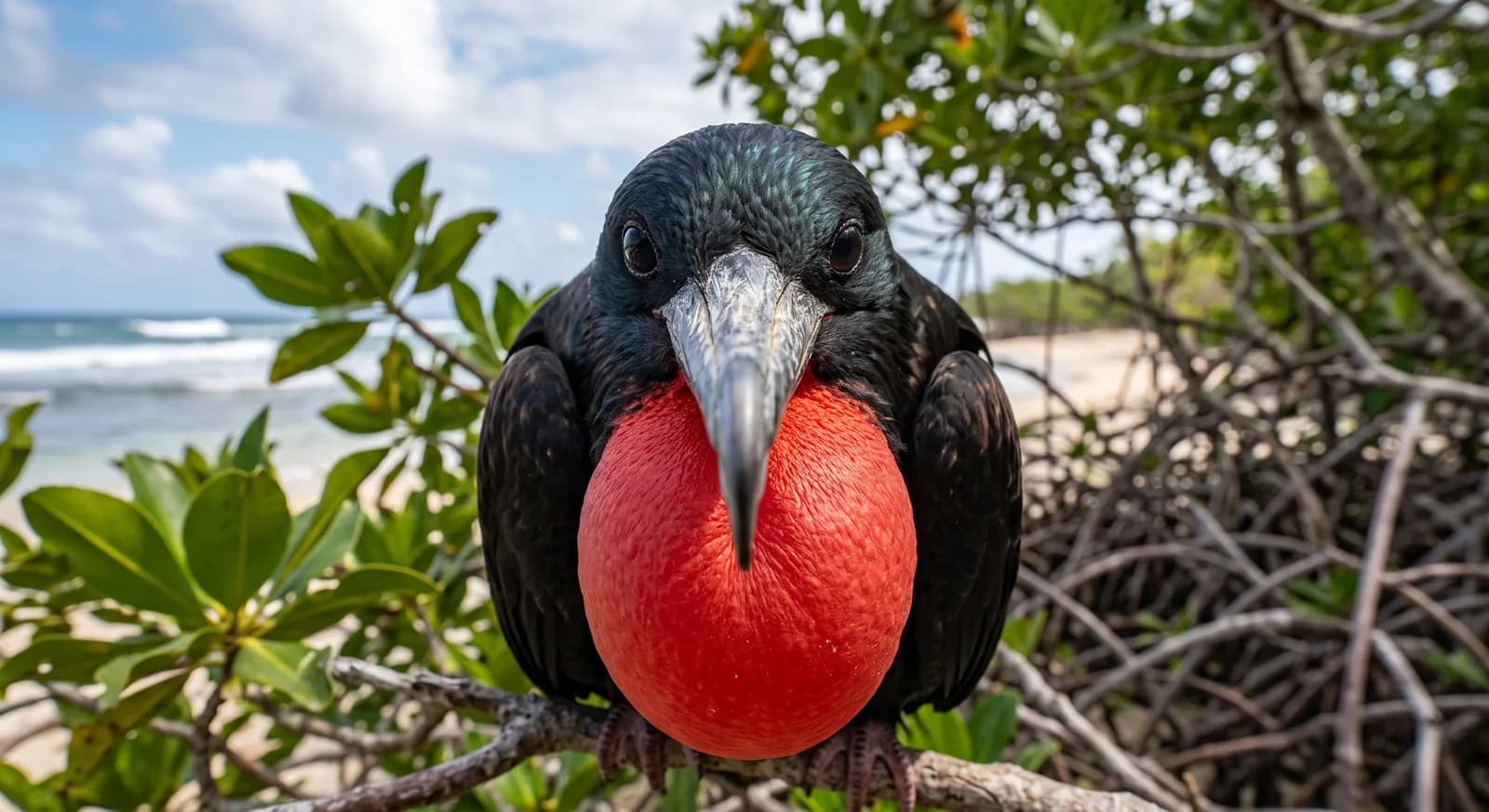
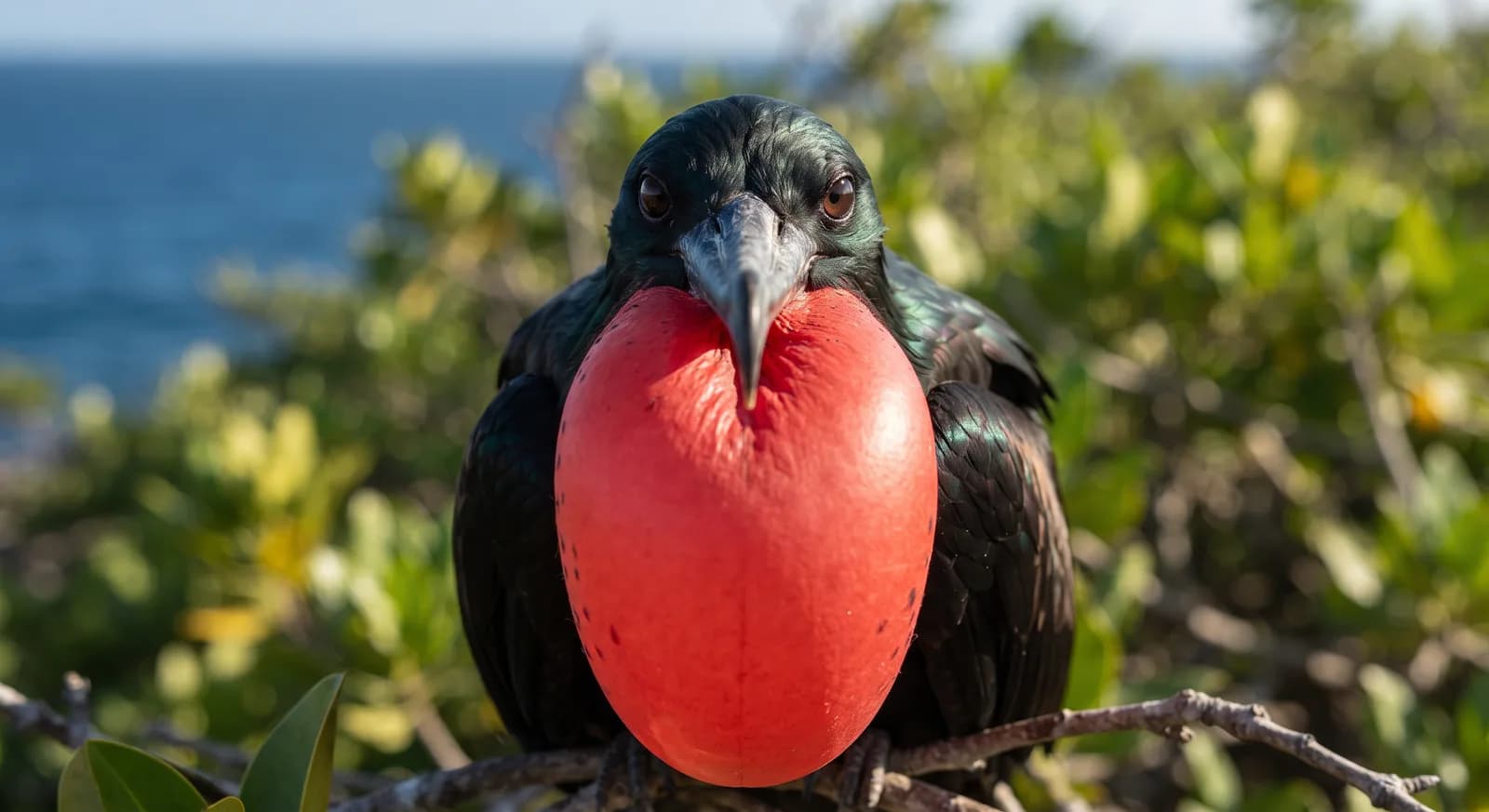
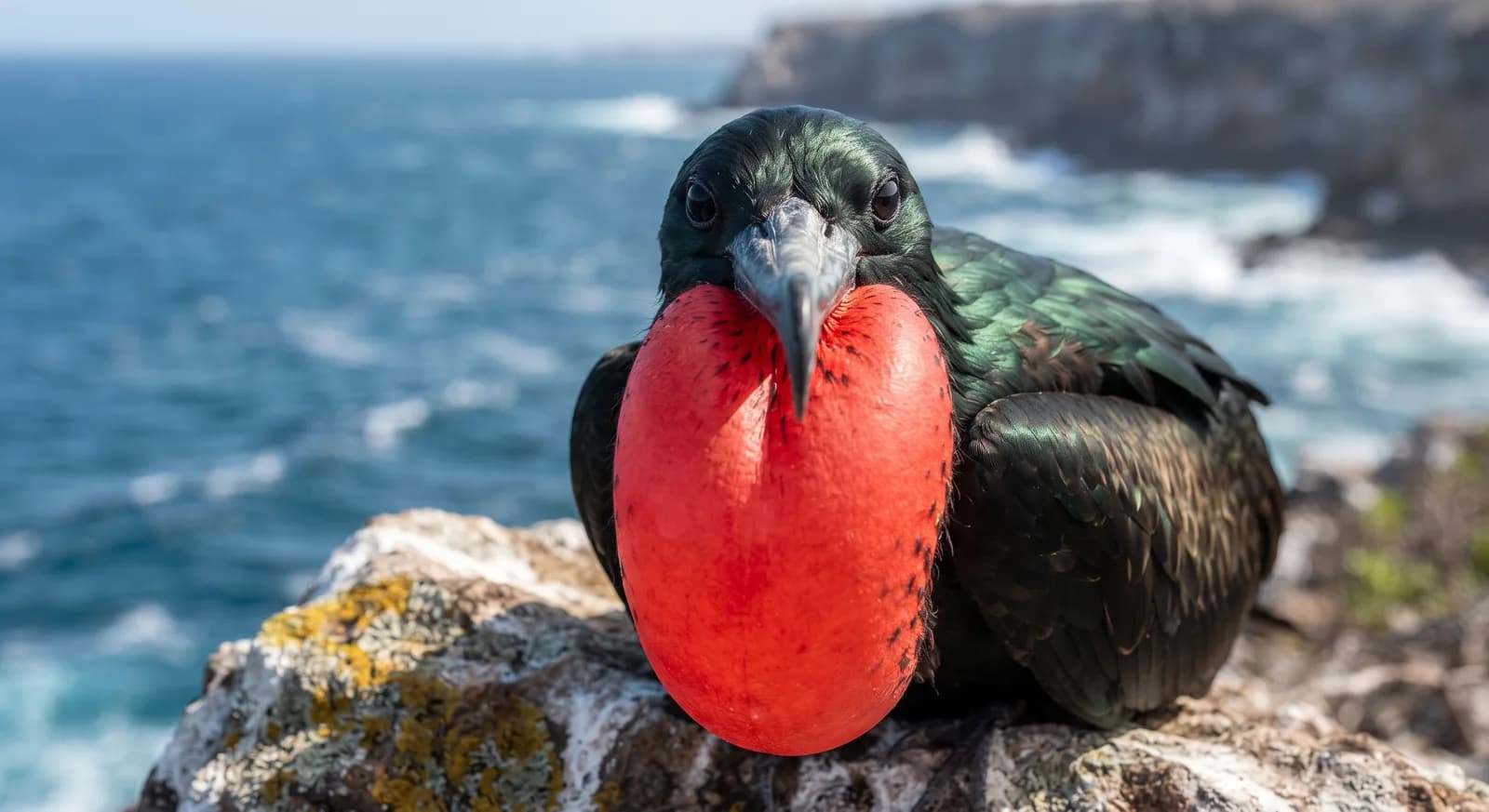
A large black seabird that holds its wings in a characteristic curve and spreads a long, deeply forked tail, which looks pointed when closed. The male is entirely black with green and purple sheens and a bright red gular pouch that he inflates in courtship; his feet are red. The female is black with a white throat, neck and breast, and pink legs.

Weight

1.4 kg on average

Size

1 m on average

Diet

Piscivore

Feeds mainly on fish.
Activity

Diurnal

Active mainly during the day.

Social structure

Colony

Lives in large concentrations, often for breeding reasons.

52countries9parks1dive sites2same family

AI-generated images: illustrations, not photographs.

Fun facts

  • Its reputation as a pirate is qualified by the data: a study of frigatebirds robbing masked boobies calculated that at most they could obtain 40% of the food they needed, and on average only 5%. Kleptoparasitism is a supplement, not a way of life.
  • It cannot settle on the water: if it falls in by accident, it generally cannot take off again.
  • It takes advantage of tuna shoals and dolphin pods, which drive fish towards the surface, and catches flying fish in mid-air.

Life cycle and biology

Skeleton type
Vertebrate - internal bony skeleton (bird)
Habitat and environment
Pelagic waters within about 80 km of the breeding colony. It nests on the coasts and islands of the Pacific, Indian and Atlantic oceans, in shrubs and trees, or on the ground where there is no vegetation, in colonies of up to several thousand birds and often shared with red-footed boobies and other frigatebirds
Sexual maturity
5 years
Gestation / incubation
56 days
Litter / clutch size
A single egg per season. It is seasonally monogamous and its breeding season, from mating to the end of parental care, can last up to two years: the duration of parental care is among the longest of any bird

Sources consulted: IUCN Red List (BirdLife International 2020) · Ministerio del Medio Ambiente de Chile (RCE, 14.º proceso) · Orta 1992 · Vickery y Brooke 1994 · Couve et al. 2016 · Jaramillo 2005 · Animalia.bio · Gmelin 1789

Where to find it

Best time: All year round in tropical waters; the male inflates his gular pouch in the breeding season

Loading map…

Where to see it

Parks and dive sites where this species has been documented.

Related species

Other species in the catalogue with the most in common with Great Frigatebird — same habitat, park, country, tags or family.

Same taxonomic family
Shares a park
Shares a park
Shares a park
Shares a park

Keep exploring

Based on what we already know about great frigatebird.

Share an experience, a fun fact or a tip for seeing the great frigatebird.
See full glossary
This page in other languages: Español · Deutsch · Français · Português · Italiano

The pins mark the parks and dive sites where its presence is documented.

See its range on the interactive map→
Revillagigedo ArchipelagoMexico
Cocos IslandCosta Rica
Tobago Main RidgeTrinidad and Tobago
Los RoquesVenezuela
AldabraSeychelles
Rock Islands of PalauPalau
Isla ContoyMexico
Marietas IslandsMexico
MalpeloColombia
Aldabra AtollSeychelles
Lesser FrigatebirdLeast Concern

Lesser Frigatebird

Fregata ariel

Magnificent FrigatebirdLeast Concern

Magnificent Frigatebird

Fregata magnificens

Banded HumbugLeast Concern

Banded Humbug

Dascyllus aruanus

Spotted Garden EelLeast Concern

Spotted Garden Eel

Heteroconger hassi

White-spotted PufferLeast Concern

White-spotted Puffer

Arothron hispidus

Clown TriggerfishLeast Concern

Clown Triggerfish

Balistoides conspicillum

CountriesMexico
ParksRevillagigedo ArchipelagoMexico
TagsPiscivore
Piscivore
Diurnal
Colonial
Bird

North America31

Oceania19

South America2

Mexico
Colombia
Costa Rica
Palau
Trinidad and Tobago
Venezuela
Anguilla
Antigua and Barbuda
Aruba
Bahamas
Barbados
Belize
Bermuda
British Virgin Islands
Cayman Islands
Costa Rica
Cuba
Curaçao
Dominica
Dominican Republic
Grenada
Guadeloupe
Guatemala
Haiti
Honduras
Jamaica
Martinique
Mexico
Nicaragua
Panama
Puerto Rico
Saint Kitts and Nevis
Saint Lucia
Saint Vincent and Grenadines
Trinidad and Tobago
Turks and Caicos Islands
U.S. Virgin Islands
American Samoa
Cook Islands
Fiji
French Polynesia
Guam
Kiribati
Marshall Islands
Micronesia
Nauru
New Caledonia
Niue
Northern Mariana Islands
Palau
Papua New Guinea
Samoa
Solomon Islands
Tonga
Tuvalu
Vanuatu
Colombia
Venezuela