Skip to content
WAnimals
  • Map
  • Species
  • Parks
  • Diving
Log inCreate account
WAnimals

The guide for travellers and animal lovers: discover, plan and share your wild adventures around the world.

Discover wildlife

  • Species
  • Ecosystems
  • Glossary
  • Tags

Explore places

  • Map
  • Countries
  • Parks
  • Diving

Plan experiences

  • Guides

Learn

  • Blog

Resources

  • Help centre
  • Contact
  • Install the app

Follow us

Account

  • Log in
  • Create account

© 2026 WAnimals. All rights reserved.

About usHow we build our profilesTerms of servicePrivacyLegal notice
MapSpeciesParksDiving
  1. Home
  2. Species
  3. Yellow Baboon

One of the 2 baboons on WAnimals
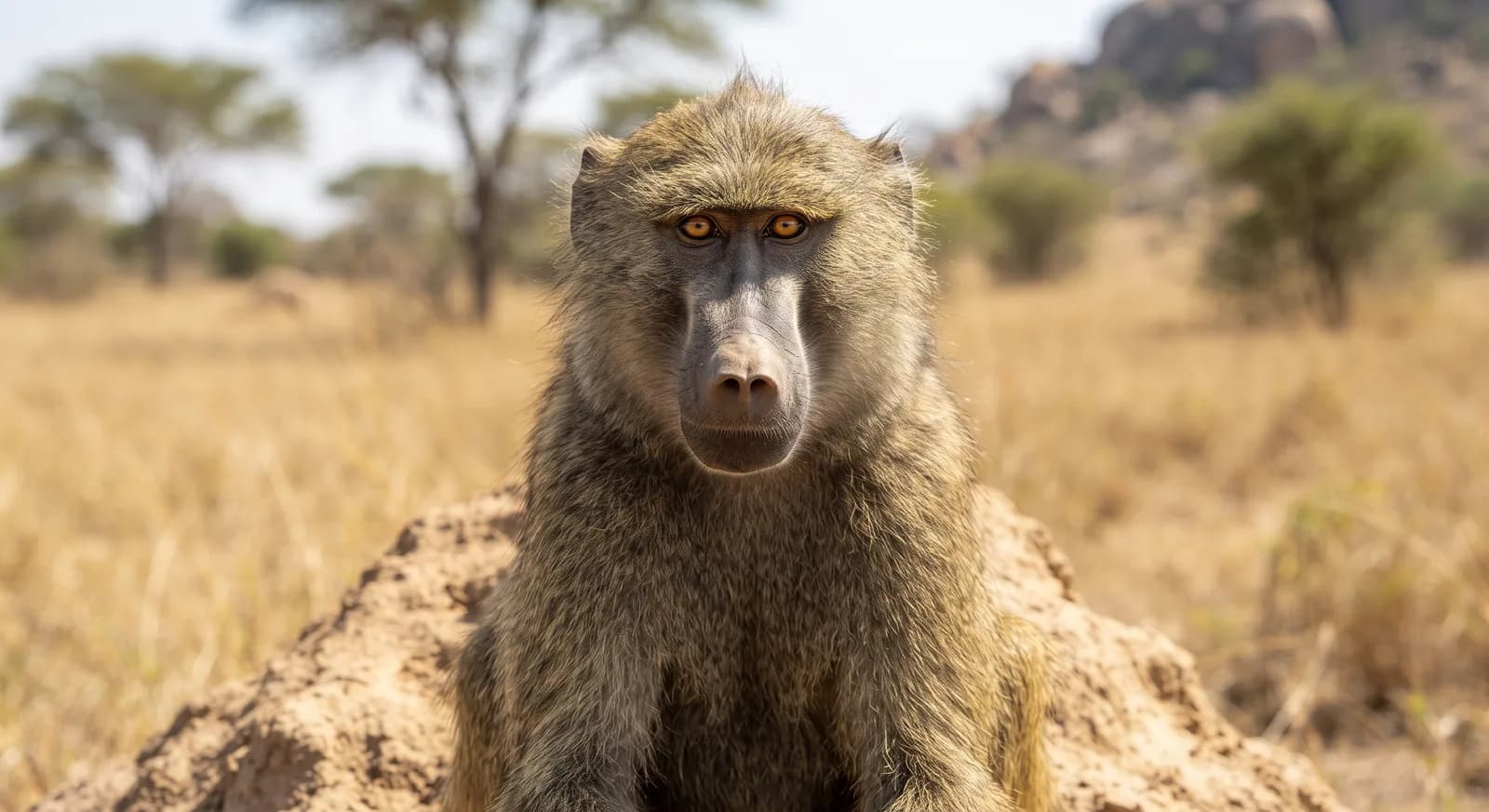
Yellow Baboon (Papio cynocephalus)

Mammals · Primates · Cercopithecidae

Yellow Baboon

Papio cynocephalus

Least Concern

The species is abundant and widely distributed; it faces no significant short-term risk.

Spotted something wrong?

The yellow baboon is the baboon of the East African savannahs, more slender and longer-legged than the chacma, with a yellowish coat and an elongated face. It lives in troops of several dozen animals with adult males and females, structured by stable matrilineal hierarchies. It is omnivorous and highly adaptable: grasses, seeds, roots, fruit, insects and occasionally antelope calves. Its combination of abundance, visibility and social complexity has made it one of the best-studied primates in the world.

Weight

11 kg – 26 kg

Size

60 cm – 1 m

Life expectancy

30 years
Diet

Omnivore

Combines animal and plant food depending on availability.

Activity

Diurnal

Active mainly during the day.

Sighting difficulty

Easy

SavannaTemperate forestGrassland
43countries30parks44same family

AI-generated images: illustrations, not photographs.

Fun facts

  • GeneralThe subject of over 50 years of social-behaviour research at Amboseli, in Kenya.
  • The population of the Amboseli basin in Kenya has been followed continuously since 1971 and is one of the longest-running studies of wild primates in existence, with individual pedigrees spanning more than half a century.
  • Females inherit their mother's social rank: the daughter of a dominant female will hold a high position from a young age, and the hierarchy is thus passed down the female line for generations.

Life cycle and biology

Skeleton type
Vertebrate - internal bony skeleton (mammal)
Habitat and environment
Wooded savannah, open forest and scrub of eastern and south-central Africa
Sexual maturity
5 years
Gestation / incubation
6 months
Litter / clutch size
1

Sources consulted: https://es.wikipedia.org/wiki/Papio_cynocephalus

Where to find it

Loading map…

Where to see it

Parks and dive sites where this species has been documented — showing 10 of 30.

Related species

Other species in the catalogue with the most in common with Yellow Baboon — same habitat, park, country, tags or family.

Same taxonomic family

Keep exploring

Based on what we already know about yellow baboon.

Comments

Share an experience, a fun fact or a tip for seeing the yellow baboon.

Be the first to comment.

See full glossary
This page in other languages: Español · Deutsch · Français · Português · Italiano

The pins mark the parks where its presence is documented.

See its range on the interactive map→
Serengeti National ParkTanzania
Maasai Mara National ReserveKenya
NgorongoroTanzania
AmboseliKenya
TsavoKenya
Lake NakuruKenya
South LuangwaZambia
GorongosaMozambique
Liwonde National ParkMalawi
Nyerere (formerly Selous)Tanzania
See all 30 parks
Least Concern

Olive Baboon

Papio anubis

Least Concern

Patas Monkey

Erythrocebus patas

Chacma BaboonLeast Concern

Chacma Baboon

Papio ursinus

Not Evaluated

Vervet Monkey

Chlorocebus pygerythrus

Red-tailed MonkeyLeast Concern

Red-tailed Monkey

Cercopithecus ascanius

GuerezaLeast Concern

Guereza

Colobus guereza

CountriesTanzania
ParksSerengeti National ParkTanzania
TagsOmnivore
Omnivore
Diurnal
Savanna
Temperate forest
Grassland
Mammal
Tanzania
Kenya
Uganda
Mozambique
Zambia
Malawi
Angola
Benin
Botswana
Burkina Faso
Burundi
Cameroon
Central African Republic
Chad
Côte d’Ivoire
Democratic Republic of the Congo
Djibouti
Equatorial Guinea
Eritrea
Eswatini
Ethiopia
Gabon
Gambia
Ghana
Guinea
Guinea-Bissau
Kenya
Lesotho
Liberia
Malawi
Mali
Mauritania
Mozambique
Namibia
Niger
Nigeria
Republic of the Congo
Rwanda
Senegal
Sierra Leone
Somalia
South Africa
South Sudan
Sudan
Tanzania
Togo
Uganda
Zambia
Zimbabwe