One of the 22 crabs on WAnimals
Malacostracans · Decapoda · Raninidae
Spanner Crab
Ranina ranina
It has not yet been assessed against the IUCN criteria. See full glossary
An unmistakable crab, its carapace drawn out into a wedge and its legs flattened into paddles adapted for digging. It spends the day buried in the sand with only its eyes and antennae showing and hunts at night. It is a highly prized shellfish in Hawaii, Japan, Australia and the Philippines.
Size
8 cm – 15 cm
Diet
Carnivore
Feeds mainly on other animals.
Activity
Nocturnal
Active mainly at night.
Social structure
Solitary
Lives and hunts alone, joining others only to breed.
Sighting difficulty
Unknown
Fun facts
- Unlike almost all crabs, it walks and swims forwards and backwards rather than sideways.
- It buries itself backwards into the sand within seconds using its paddle-shaped hind legs.
- Its shape is unique among crabs: the body is elongated and tapers towards the rear, not broad and flattened, and the abdomen remains partly extended instead of folded beneath the body.
- That anatomy is an adaptation for digging: it buries itself backwards in the sand in a matter of seconds, pushing with legs transformed into shovels.
- It walks and swims forwards, not sideways like almost all crabs.
- It is a prized delicacy in Japan, the Philippines, Australia and Hawaii, with dedicated fisheries in several of those regions.
- It hunts by ambush: buried, with its eyes poking out, it seizes fish and crustaceans passing nearby.
- Its name, ranina, alludes to the resemblance of its head to a frog's.
Life cycle & biology
- Skeleton type
- Invertebrate - chitin exoskeleton (crustacean)
- Habitat & environment
- Shallow sandy bottoms of the Indo-Pacific
Sources consulted: FAO Species Catalogue; Museo Australiano; Skinner y Hill, trabajos sobre Ranina ranina
Where to find it
See its range on the interactive mapWhere to watch it
Parques y spots de buceo donde se ha documentado esta especie — se muestran 20 de 140 documentados.
Related species
Other species in the catalogue with the most in common with Spanner Crab — same habitat, park, country, tags or family.
Flatback
Natator depressus
 Least Concern
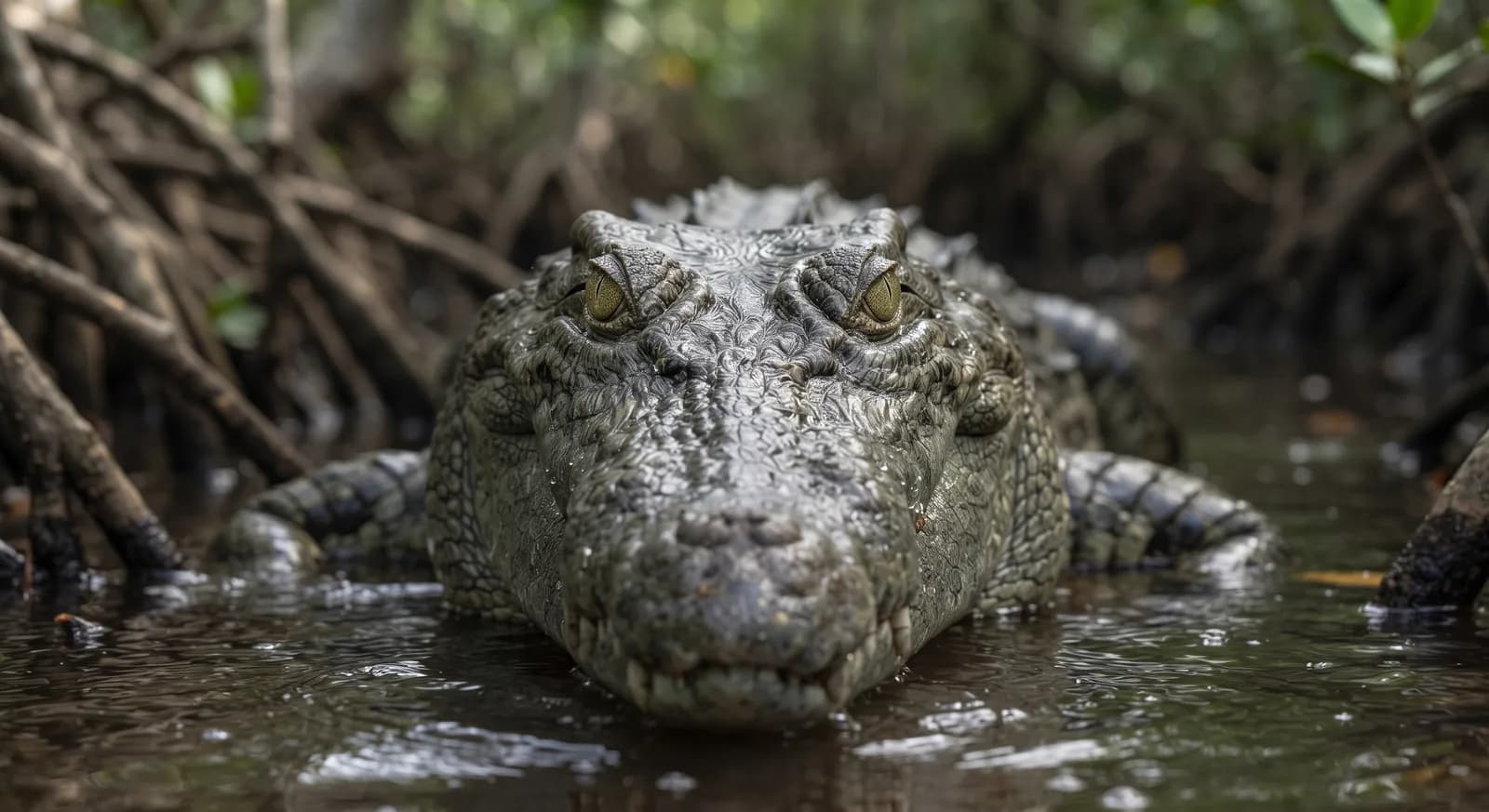
Saltwater Crocodile
Crocodylus porosus
Yellow-bellied Sea Snake
Hydrophis platurus
Red Lionfish
Pterois volitans
Spot-fin Porcupinefish
Diodon hystrix
Asian Tiger Shrimp
Penaeus monodon
Keep exploring
Based on what we already know about spanner crab.
Comments
Share an experience, a fun fact or a tip for seeing the spanner crab.
Be the first to comment.