One of the 9 corals on WAnimals
Anthozoans · Scleractinia · Faviidae
Head Coral
Favia favus
It has not yet been assessed against the IUCN criteria. See full glossary
A brain coral that forms massive, rounded colonies in which each polyp occupies its own calcareous cup, separated from its neighbours by well-defined walls, giving the whole the look of convolutions. It is one of the commonest reef-building corals of the Indo-Pacific.
Size
20 cm – 1 m
Diet
Carnivore
Feeds mainly on other animals.
Activity
Nocturnal
Active mainly at night.
Social structure
Colony
Lives in large concentrations, often for breeding reasons.
Sighting difficulty
Unknown
Fun facts
- At night it unfurls sweeper tentacles far longer than the ordinary ones, with which it attacks neighbouring corals and takes ground from them, a chemical and physical war that decides the final shape of the reef.
- Its skeleton grows in annual layers, like the rings of a tree, allowing the colony to be dated and past sea conditions to be reconstructed.
- It depends on symbiotic algae to feed, and expels them when the water grows too warm: that is when the coral bleaches.
- Each polygon on its surface is a polyp with its own mouth and its own ring of tentacles, housed in a calcareous cup called a corallite.
- At night it extends long tentacles with which it captures zooplankton, so it does not live on the photosynthesis of its zooxanthellae alone.
- And it has tentacles for war: mesenterial filaments and specialised sweeper tentacles with which it attacks neighbouring corals to defend space. Competition for substrate on a reef is a constant chemical and physical war.
- It is one of the best-studied species in the analysis of inter-coral aggression and of the competitive hierarchy among stony corals.
- Its tolerance of turbid, variable environments makes it hardier than many branching corals, and it is a regular presence on degraded reefs.
- Like all stony corals, it is listed in Appendix II of CITES.
Life cycle & biology
- Skeleton type
- Invertebrate - calcareous skeleton (coral)
- Habitat & environment
- Coral reefs of the Indo-Pacific and the Red Sea, from 1 to 30 m
Sources consulted: Veron, Corals of the World; Lista Roja de la UICN; CITES; Chadwick, trabajos sobre agresión entre corales
Where to find it
See its range on the interactive mapWhere to watch it
Parks and dive sites where this species has been documented.
Related species
Other species in the catalogue with the most in common with Head Coral — same habitat, park, country, tags or family.
 Least Concern
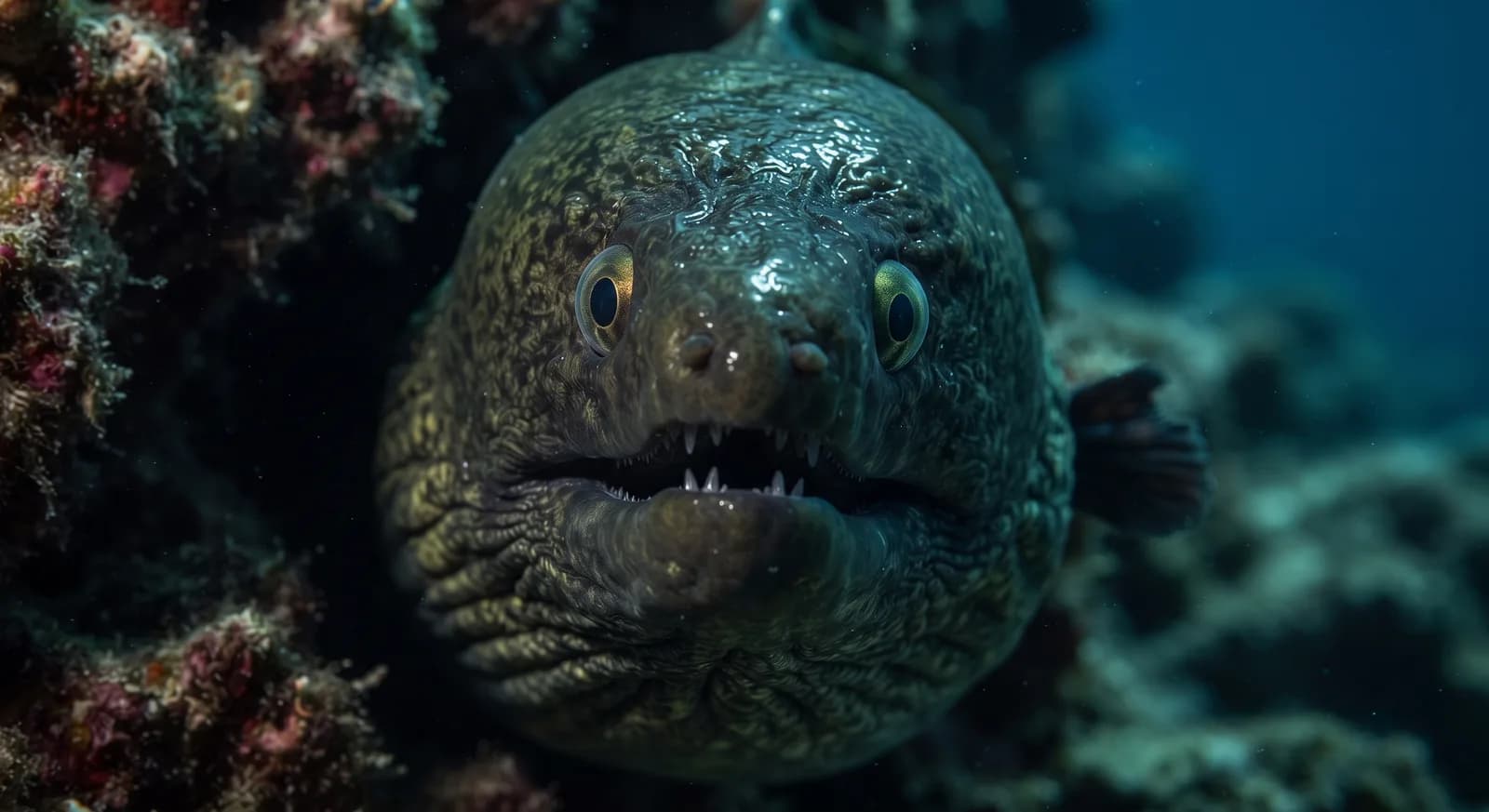
Green Moray
Gymnothorax funebris
Red Lionfish
Pterois volitans
Spot-fin Porcupinefish
Diodon hystrix
Portuguese Man-of-war
Physalia physalis
Long-spined Urchin
Diadema antillarum
Grooved Brain Coral
Diploria labyrinthiformis
Keep exploring
Based on what we already know about head coral.
Comments
Share an experience, a fun fact or a tip for seeing the head coral.
Be the first to comment.