Hydrozoans · Anthoathecata · Hydridae
Common Hydra
Hydra vulgaris
It has not yet been assessed against the IUCN criteria. See full glossary
The hydra, a tiny freshwater polyp shaped like a tube, attached by its base to a plant or a stone and crowned by stinging tentacles with which it captures water fleas and other small invertebrates. It reproduces mainly by budding.
Size
up to 3 cm
Diet
Carnivore
Feeds mainly on other animals.
Social structure
Solitary
Lives and hunts alone, joining others only to breed.
Sighting difficulty
Unknown
Fun facts
- biologíaIt shows no detectable biological sign of ageing and can regrow its whole body from a small fragment of tissue.
- It regenerates a complete individual from a minute fragment of its body, a capacity Abraham Trembley demonstrated in 1744, causing a philosophical shock in Enlightenment Europe.
- It moves by somersaulting: it bends over, fixes its tentacles, releases its base and plants it again further on.
- It appears not to age. Under laboratory conditions its mortality and reproduction rates do not rise over time: an eight-year study found no sign of senescence, and it has been estimated that 5 % of a cohort would still be alive after 1,400 years.
- The reason lies in its stem cells: it renews its entire body continuously, so that no tissue ever grows old.
- It regenerates a complete individual from a tiny fragment, something Abraham Trembley demonstrated as early as 1744 by cutting it to pieces, one of the founding experiments of developmental biology.
- It reproduces mainly by budding: a daughter hydra sprouts from its side, detaches and goes on alone.
- It has neither a brain nor a centralised nervous system, only a diffuse nerve net, and yet it actively hunts small crustaceans with its tentacles.
Life cycle & biology
- Habitat & environment
- Submerged vegetation of freshwater ponds, lakes and backwaters
Sources consulted: Pallas (1766); Trembley (1744); Schaible et al. (2015), PNAS; Martínez (1998)
Where to find it
See its range on the interactive mapWhere to watch it
Parks and dive sites where this species has been documented.
Related species
Other species in the catalogue with the most in common with Common Hydra — same habitat, park, country, tags or family.
Alligator Snapping Turtle
Macrochelys temminckii
Spiny Softshell Turtle
Apalone spinifera
 Least Concern
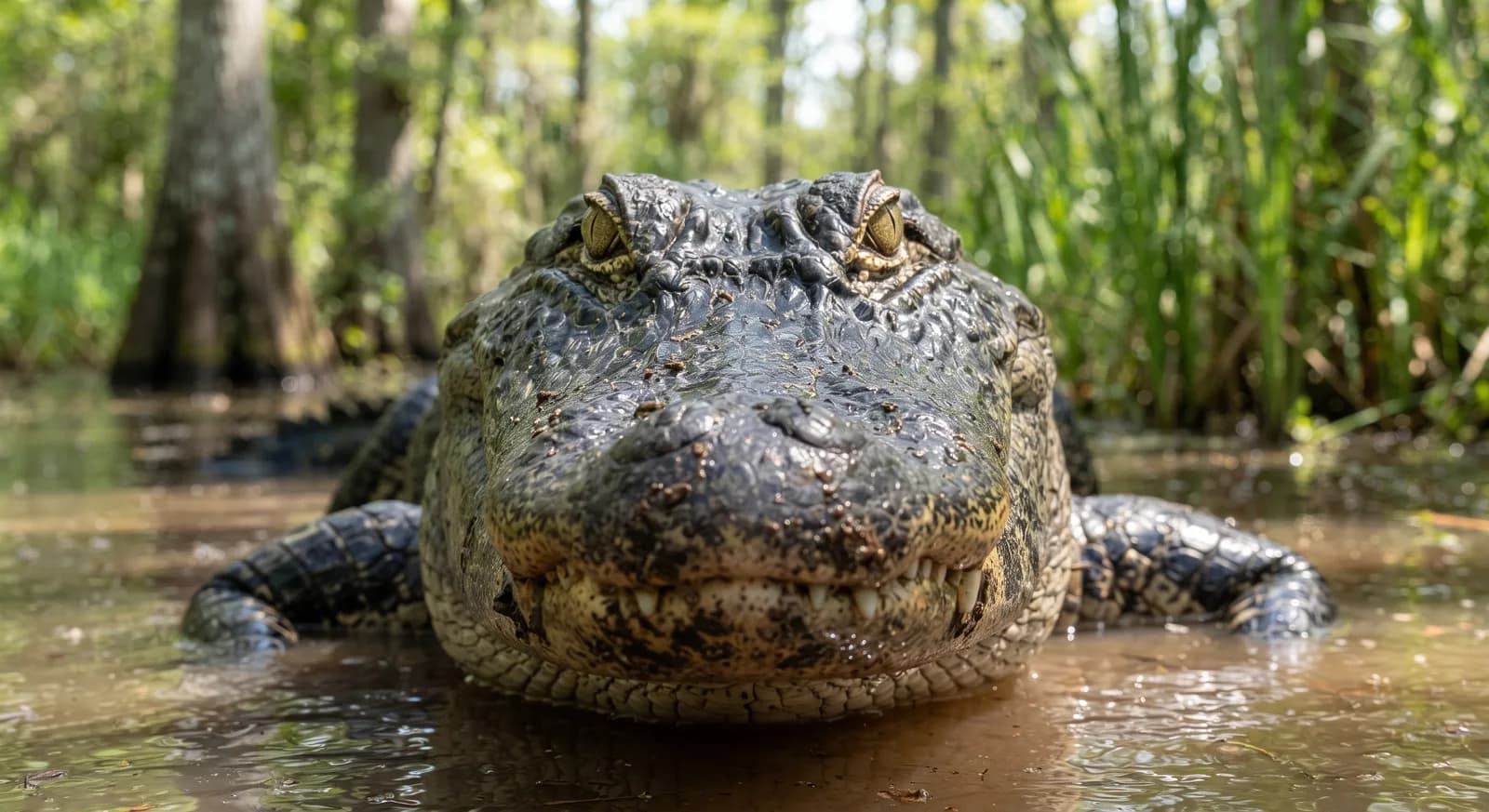
American Alligator
Alligator mississippiensis
American Bullfrog
Lithobates catesbeianus
Eastern Newt
Notophthalmus viridescens
Greater Siren
Siren lacertina
Keep exploring
Based on what we already know about common hydra.
Comments
Share an experience, a fun fact or a tip for seeing the common hydra.
Be the first to comment.