Skip to content
WAnimals
  • Map
  • Species
  • Parks
  • Diving
Log inCreate account
WAnimals

The guide for travellers and animal lovers: discover, plan and share your wild adventures around the world.

Discover wildlife

  • Species
  • Ecosystems
  • Glossary
  • Tags

Explore places

  • Map
  • Countries
  • Parks
  • Diving

Plan experiences

  • Guides

Learn

  • Blog

Resources

  • Help centre
  • Contact
  • Install the app

Follow us

Account

  • Log in
  • Create account

© 2026 WAnimals. All rights reserved.

About usHow we build our profilesTerms of servicePrivacyLegal notice
MapSpeciesParksDiving
  1. Home
  2. Species
  3. American Eel

One of the 6 eels on WAnimals

American Eel (Anguilla rostrata)

Bony fish · Anguilliformes · Anguillidae

American Eel

Anguilla rostrata

Endangered

At very high risk of extinction in the wild in the near future.

Spotted something wrong?

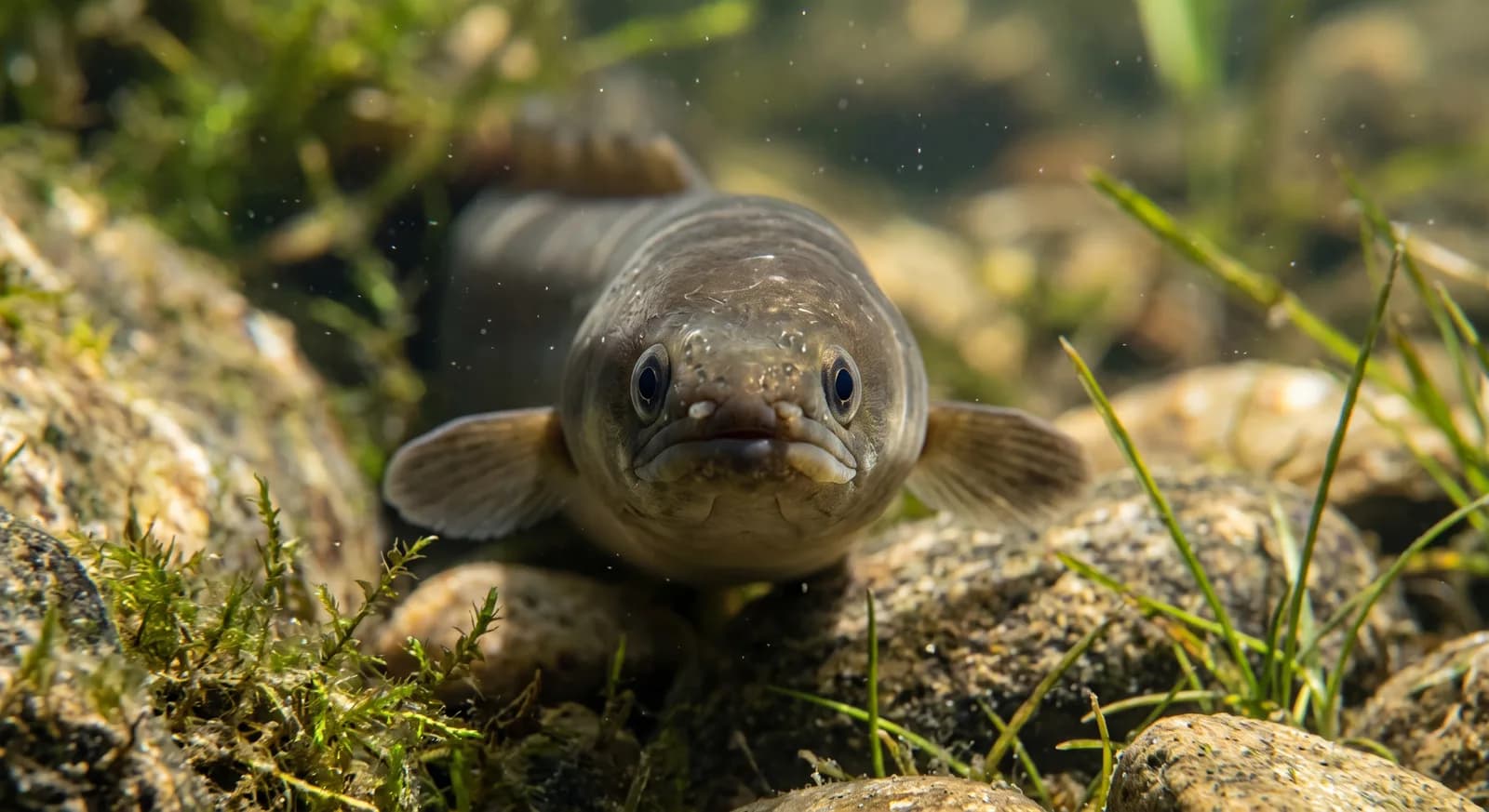
The American eel is a migratory fish found on the eastern coast of North America. The American eel has a slender, snake-like body and is covered by a layer of mucus, which makes the eel appear slimy despite the presence of very small scales. A long dorsal fin runs from the middle of the back and continues into a similar ventral fin. The pelvic fins are absent, and the pectoral fin is relatively small and can be found near the midline, followed by the head and the gills, which are covered. There is variation in colouring, from olive green and brown to a yellowish-green shading and pale grey or white on the belly. Eels living in clear water are paler than those from dark streams.

Weight

4 kg on average

Size

up to 1.5 m

Life expectancy

50 years

Activity

Nocturnal

Active mainly at night.

Social structure

Solitary

Lives and hunts alone, joining others only to breed.

Sighting difficulty

Hard

Freshwater
38countries35parks9dive sites1same family

AI-generated images: illustrations, not photographs.

Fun facts

  • reproducciónLike its European relative, it travels thousands of kilometres to the Sargasso Sea to breed once and then die.
  • The entire species breeds in a single place: the Sargasso Sea. It is panmictic — that is, it functions as a single breeding population in which any individual can mate with any other, whether from Greenland or from Venezuela.
  • The larvae, called leptocephali, are transparent and shaped like a willow leaf, and drift with the currents for up to a year before reaching the coast.
  • It is semelparous: it breeds only once and dies afterwards.
  • The age of maturity is set not by the clock but by size, and size depends on the water: freshwater individuals grow more slowly and take far longer to mature than those in brackish water.
  • Its decline has three mutually reinforcing causes: the dams that block its way upstream, the glass-eel fishery and changes in ocean currents.
  • Asian demand for eel is a global factor: when one species in the genus is overexploited, the pressure shifts to the next.

Life cycle and biology

Skeleton type
Vertebrate - internal bony skeleton (bony fish)
Habitat and environment
Catadromous: it lives in rivers, estuaries and lakes on the Atlantic side of the Americas and migrates to the Sargasso Sea to spawn and die
Sexual maturity
4.5 years

Sources consulted: https://es.wikipedia.org/wiki/Anguilla_rostrata

Where to find it

Loading map…

Where to see it

Parks and dive sites where this species has been documented — showing 19 of 44.

Related species

Other species in the catalogue with the most in common with American Eel — same habitat, park, country, tags or family.

Shares a park
Shares a park
Shares a park
Shares a park
Shares a park
Shares a park

How to help

The american eel is classified as endangered. Organisations such as the IUCN, WWF and the Wildlife Conservation Society work specifically on its conservation and that of its habitat; looking into their programmes is a good starting point if you want to get involved.

It's documented in 9 protected areas — one reason why protecting these places matters for its conservation.

Keep exploring

Based on what we already know about american eel.

Comments

Share an experience, a fun fact or a tip for seeing the american eel.

Be the first to comment.

See full glossary
This page in other languages: Español · Deutsch · Français · Português · Italiano

The pins mark the parks and dive sites where its presence is documented.

See its range on the interactive map→
EvergladesUnited States
Great Smoky MountainsUnited States
AcadiaUnited States
Mammoth CaveUnited States
Gros MorneCanada
FundyCanada
Point PeleeCanada
El YunquePuerto Rico
GuanicaPuerto Rico
Ciénaga de ZapataCuba
Devil's DenUnited States
Crystal River (manatees)United States
Blue Heron BridgeUnited States
Ginnie SpringsUnited States
Block Island (Mohawk wreck)United States
Andrea DoriaUnited States
Bay of FundyCanada
Saguenay Fjord (belugas)Canada
Bell Island WrecksCanada
See all 35 parks
Least Concern

Longnose Gar

Lepisosteus osseus

Channel CatfishLeast Concern

Channel Catfish

Ictalurus punctatus

Common Snapping TurtleLeast Concern

Common Snapping Turtle

Chelydra serpentina

Vulnerable

Alligator Snapping Turtle

Macrochelys temminckii

Least Concern

American Bullfrog

Lithobates catesbeianus

Least Concern

Greater Siren

Siren lacertina

CountriesCanada
ParksEvergladesUnited States
TagsNocturnal
Nocturnal
Solitary
Endangered
Fish
Freshwater

North America33

South America5

Canada
United States
Dominican Republic
Puerto Rico
Cuba
U.S. Virgin Islands
Anguilla
Antigua and Barbuda
Aruba
Bahamas
Barbados
Belize
Bermuda
British Virgin Islands
Canada
Cayman Islands
Costa Rica
Cuba
Curaçao
Dominica
Dominican Republic
Greenland
Grenada
Guadeloupe
Haiti
Honduras
Jamaica
Martinique
Mexico
Nicaragua
Panama
Puerto Rico
Saint Kitts and Nevis
Saint Lucia
Saint Vincent and Grenadines
Trinidad and Tobago
Turks and Caicos Islands
U.S. Virgin Islands
United States
Brazil
Colombia
Guyana
Suriname
Venezuela