One of the 3 harriers on WAnimals
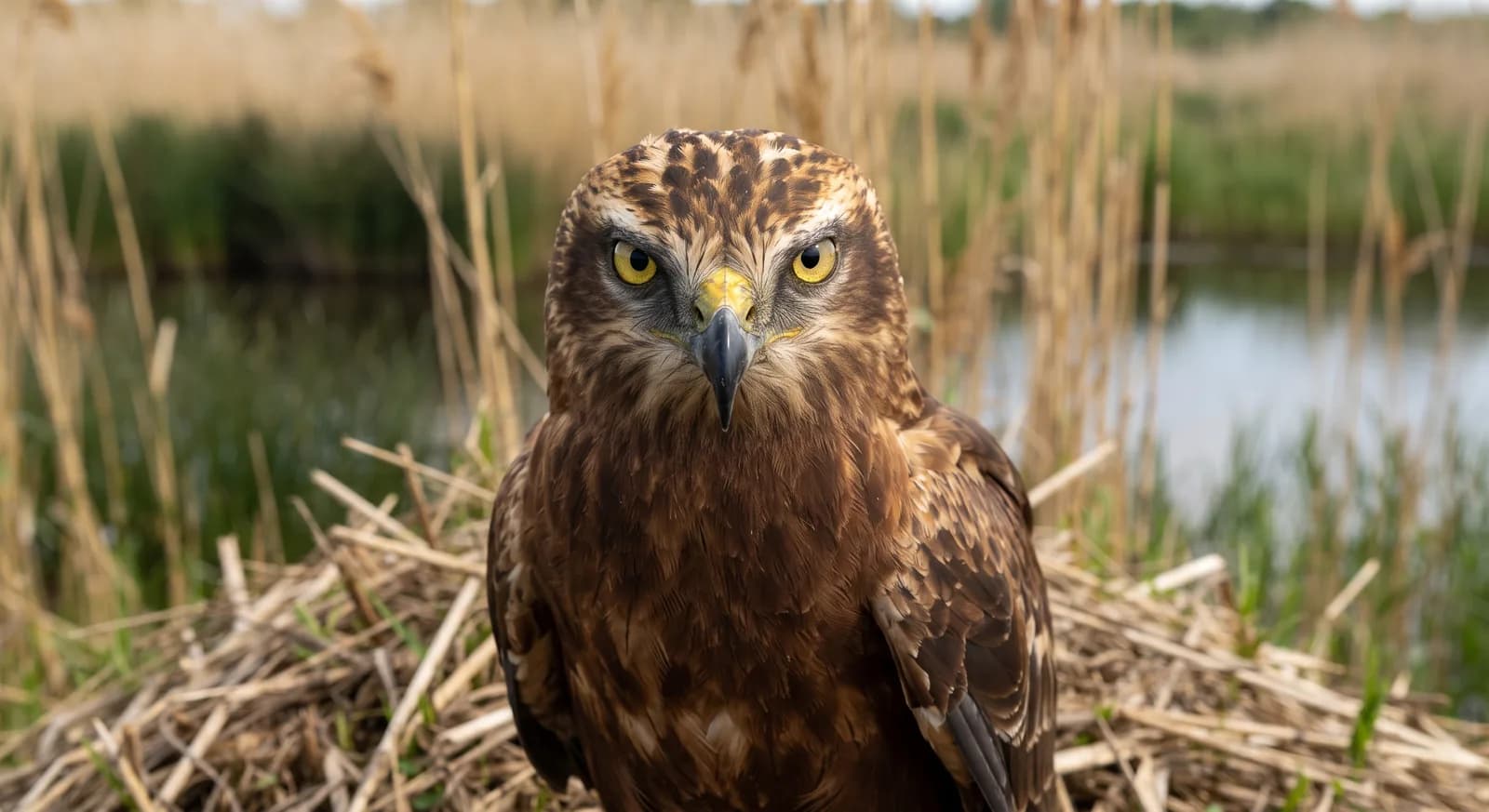
Birds · Accipitriformes · Accipitridae
Western Marsh Harrier
Circus aeruginosus
The species is abundant and widely distributed; it faces no significant short-term risk. See full glossary
It practises obligate siblicide: because the eggs hatch at intervals, a sharp size hierarchy develops among the chicks, and the smallest usually starve when food is short.
Weight
580 g – 1.1 kg
Size
48 cm – 62 cm
Lifespan
6 years
Diet
Carnivore
Feeds mainly on other animals.
Activity
Diurnal
Active mainly during the day.
Social structure
Solitary
Lives and hunts alone, joining others only to breed.
Sighting difficulty
Easy
Estimated population
1,149-1,494 breeding pairs in Spain according to the 2006 national survey, against 481-522 in 1990; Castilla-La Mancha, Castile and León, Navarre and Andalusia hold 68% of them. In Europe an estimated 303,000-485,000 mature individuals
Fun facts
- It hunts in slow, low flight over the vegetation, taking small mammals, waterbirds, amphibians and fish.
- It lives in marshes, wetlands and reedbeds of Europe, western Asia and North Africa.
- The female is noticeably heavier than the male.
Life cycle & biology
- Skeleton type
- Vertebrate - pneumatised bony skeleton (bird)
- Habitat & environment
- Marshes, wetlands and reedbeds of Europe, western Asia and North Africa
- Birth weight
- Weight at hatching not found as a precise figure
- Size at birth
- Blind, downy and wholly dependent on hatching
- Sexual maturity
- 3 years
- Gestation / incubation
- 31-38 days
- Litter / clutch size
- 3 to 8 eggs per clutch (most commonly 3-5)
- Lifespan in captivity
- Documented record of 16.5-20.1 years
Sources consulted: AnAge (genomics.senescence.info); EBSCO Research Starters; Les-Oiseaux.com; Oiseaux-birds.com; eBird; Animalia.bio; PMC (haematological values nestlings study); Lista Roja Europea de Aves 2021: población reproductora europea estimada en 303.000-485.000 individuos maduros y considerada estable; en España pasó de 481-522 parejas en 1990 a 1.149-1.494 en 2006 || Molina y Martínez 2008, El aguilucho lagunero en España, población en 2006, SEO/BirdLife; Lista Roja Europea de Aves 2021 || SEO/BirdLife, ficha del aguilucho lagunero occidental y III Atlas de las aves en época de reproducción en España
Where to find it
See its range on the interactive mapBest time: From April to July on the breeding wetlands, after the spring passage through the Strait in March; in winter it gathers at dusk in communal roosts among the marsh vegetation, which makes it far easier to see
Where to watch it
Parks and dive sites where this species has been documented.
Related species
Other species in the catalogue with the most in common with Western Marsh Harrier — same habitat, park, country, tags or family.
Eurasian Sparrowhawk
Accipiter nisus
Northern Goshawk
Accipiter gentilis
 Least Concern
Short-toed Eagle
Circaetus gallicus
Common Buzzard
Buteo buteo
Black-winged Kite
Elanus caeruleus
Lesser Spotted Eagle
Clanga pomarina
Keep exploring
Based on what we already know about western marsh harrier.
Comments
Share an experience, a fun fact or a tip for seeing the western marsh harrier.
Be the first to comment.