One of the 4 oysters on WAnimals
Bivalves · Pterioida · Pteriidae
Pacific Pearl-oyster
Pinctada margaritifera
It has not yet been assessed against the IUCN criteria. See full glossary
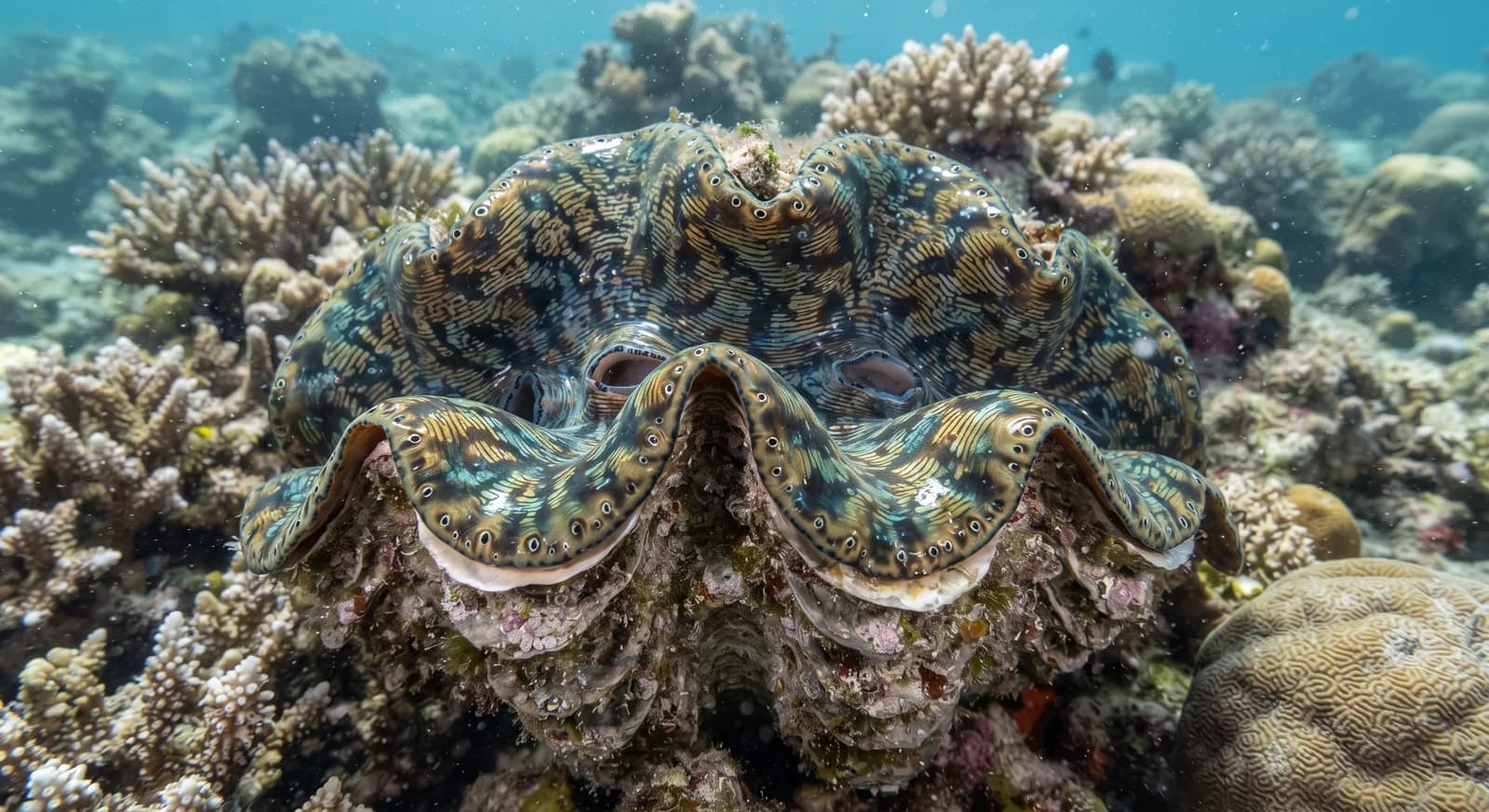
Pinctada margaritifera, commonly known as the black-lipped pearl oyster, is a pearl oyster, a marine bivalve mollusc of the family Pteriidae. This species is common in the Indo-Pacific on tropical coral reefs.
Weight
up to 9 kg
Size
15 cm – 30 cm
Lifespan
30 years
Diet
Omnivore
Combines animal and plant food depending on availability.
Social structure
Colony
Lives in large concentrations, often for breeding reasons.
Sighting difficulty
Unknown
Fun facts
- It is the source of Tahitian black pearls, the economic mainstay of much of French Polynesia.
- The dark border of the nacre, from which it takes its name, is what gives the pearls their green, grey and aubergine tones.
- Before pearl farming it was harvested on a huge scale for its shell, the raw material for buttons and marquetry.
- This is the oyster of the Tahitian black pearl. The dark rim of its shell carries the same pigment as the nacre, so the colour of the pearl forms inside the animal and is never dyed.
- The pearl is obtained by grafting in a nacre nucleus and a piece of donor mantle; the oyster coats it over twelve to twenty-four months.
- It is one of the giant shells of tropical seas: an adult reaches 30 cm and weighs more than 5 kg, and there are individuals of up to 9.
- Together with Pinctada maxima it produces around half the world market in cultured pearls.
- Its farming has been an economic mainstay of French Polynesia and the Cook Islands since the 1990s; in 2000 the Cooks exported 18 million dollars' worth of pearls, a figure that later fell because of the international price and an epidemic in Manihiki.
- The larva lives between sixteen and thirty days in the plankton before settling.
Life cycle & biology
- Habitat & environment
- Indo-Pacific reefs and coral lagoons, from 0 to 40 m
Sources consulted: https://es.wikipedia.org/wiki/Pinctada_margaritifera
Where to find it
See its range on the interactive mapWhere to watch it
Parques y spots de buceo donde se ha documentado esta especie — se muestran 20 de 265 documentados.
Related species
Other species in the catalogue with the most in common with Pacific Pearl-oyster — same habitat, park, country, tags or family.
Banded Humbug
Dascyllus aruanus
 Critically Endangered
Giant Clam
Tridacna gigas
Warty Slug
Onchidium verruculatum
Disc Anemone
Discosoma nummiforme
Upside-down Jellyfish
Cassiopea andromeda
Tiger Cowrie
Cypraea tigris
Keep exploring
Based on what we already know about pacific pearl-oyster.
Comments
Share an experience, a fun fact or a tip for seeing the pacific pearl-oyster.
Be the first to comment.