Skip to content
WAnimals
  • Map
  • Species
  • Parks
  • Diving
Log inCreate account
WAnimals

The guide for travellers and animal lovers: discover, plan and share your wild adventures around the world.

Discover wildlife

  • Species
  • Ecosystems
  • Glossary
  • Tags

Explore places

  • Map
  • Countries
  • Parks
  • Diving

Plan experiences

  • Guides

Learn

  • Blog

Resources

  • About us
  • How we build our profiles
  • Help centre
  • Contact
  • Install the app

Follow us

Account

  • Log in
  • Create account

© 2026 WAnimals. All rights reserved.

Terms of servicePrivacyCookiesLegal notice
MapSpeciesParksDiving
  1. Home
  2. Species
  3. Egyptian Goose

One of the 4 geese on WAnimals
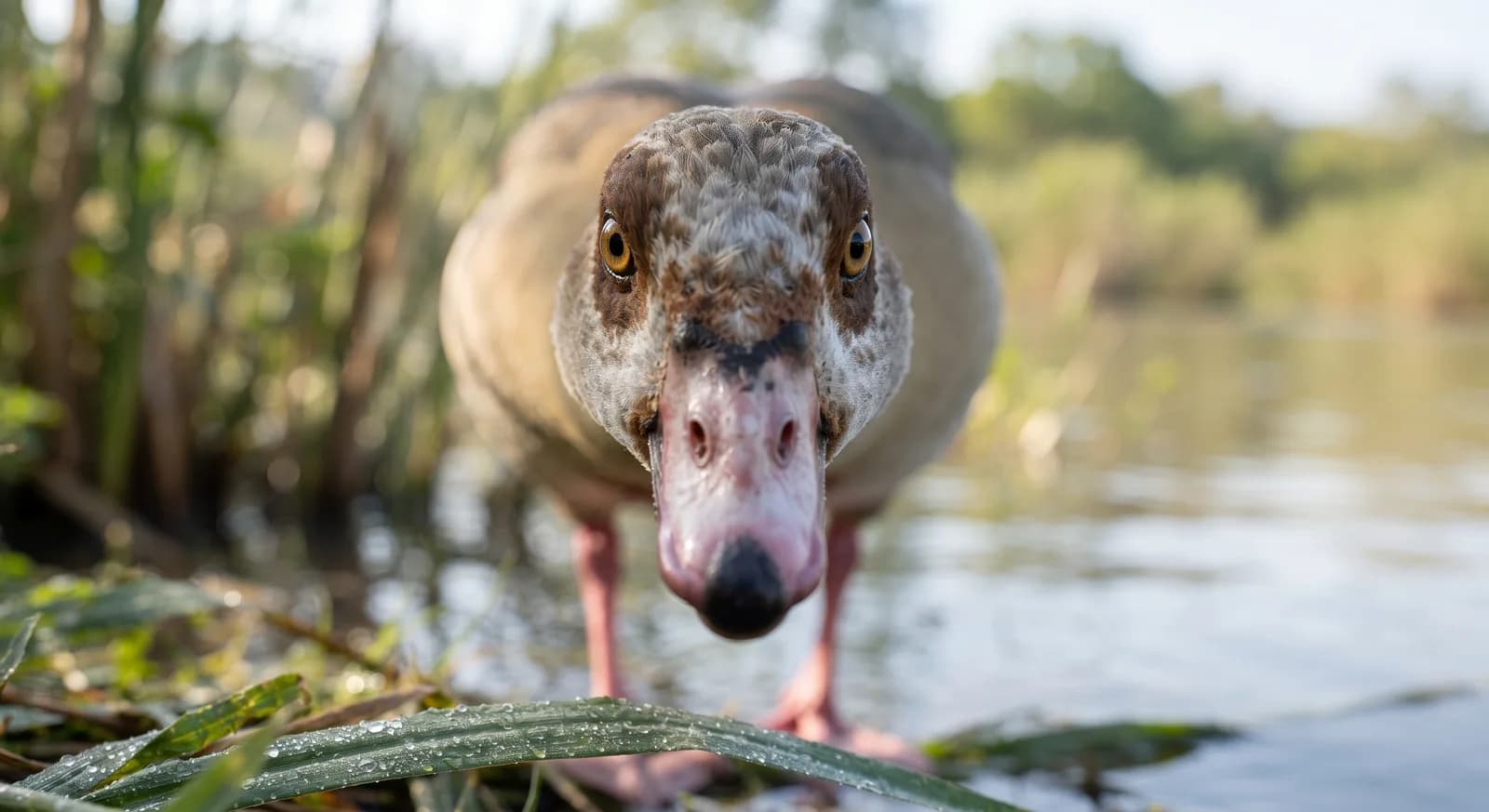
Egyptian Goose (Alopochen aegyptiaca)

Birds · Anseriformes · Anatidae

Egyptian Goose

Alopochen aegyptiaca

Least Concern

The species is abundant and widely distributed; it faces no significant short-term risk.

Spotted something wrong?

A waterfowl intermediate in size between a goose and a duck, predominantly brown, with chestnut patches around the eyes and on the lower breast that give it the look of wearing a mask. Long pinkish legs, an upright bearing and, in flight, white wing coverts like those of the shelducks.

Weight

1.5 kg – 2.3 kg

Diet

Herbivore

Feeds mainly on plants.

Activity

Diurnal

Active mainly during the day.
Social structure

In pairs

Usually lives in pairs, sometimes for life.

Estimated population

26,000 pairs in central Europe in 2010. In Extremadura the records went from 15 geese between 1998 and 2008 to a sizeable breeding nucleus, with a population that appears to double every year

Freshwater
44countries27parks42same family

AI-generated images: illustrations, not photographs.

Fun facts

  • GeneralIt appears in ancient Egyptian paintings; today it is invasive in several European countries.
  • Its scientific name means "fox-goose", from the Greek alopex, fox, and chen, goose, for the reddish tone of its back.
  • In ancient Egypt it was considered sacred and it appears in papyri and illustrations; the Greeks and Romans also kept it in their domestic flocks.
  • Technically it is not a goose but a shelduck, a group intermediate between ducks and geese.

Life cycle and biology

Skeleton type
Vertebrate - internal bony skeleton (bird)
Habitat and environment
River banks, lakes and reservoirs
Sexual maturity
2 years
Gestation / incubation
29 days
Litter / clutch size
It is monogamous and both parents care for the young

Sources consulted: IUCN Red List · SEO/BirdLife (ficha y III Atlas: Prieta Díaz 2022) · Catálogo Español de Especies Exóticas Invasoras (RD 630/2013) · MITECO (ficha de especie invasora) · Keller et al. 2020, European Breeding Bird Atlas 2 · Mazurska y Solarz 2016 (evaluación de riesgo para la UE) · Kear 2005 · Fischer et al. 2023, Animals 13 · Linnaeus 1766

Where to find it

Best time: All year round on reservoirs and lagoons and in urban parks with open water

Loading map…

Where to see it

Parks and dive sites where this species has been documented — showing 10 of 27.

Related species

Other species in the catalogue with the most in common with Egyptian Goose — same habitat, park, country, tags or family.

Same taxonomic family
Shares a park
Shares a park

Keep exploring

Based on what we already know about egyptian goose.

Share an experience, a fun fact or a tip for seeing the egyptian goose.
See full glossary
This page in other languages: Español · Deutsch · Français · Português · Italiano

The pins mark the parks where its presence is documented.

See its range on the interactive map→
Serengeti National ParkTanzania
Kruger National ParkSouth Africa
Okavango DeltaBotswana
NgorongoroTanzania
TsavoKenya
Lake NakuruKenya
Moremi (Okavango Delta)Botswana
ChobeBotswana
EtoshaNamibia
HwangeZimbabwe
See all 27 parks
Least Concern

Northern Pintail

Anas acuta

White-faced Whistling-DuckLeast Concern

White-faced Whistling-Duck

Dendrocygna viduata

Least Concern

Knob-billed Duck

Sarkidiornis melanotos

Ruddy ShelduckLeast Concern

Ruddy Shelduck

Tadorna ferruginea

Red-knobbed CootLeast Concern

Red-knobbed Coot

Fulica cristata

Kentish PloverLeast Concern

Kentish Plover

Charadrius alexandrinus

CountriesSouth Africa
ParksSerengeti National ParkTanzania
TagsHerbivore
Herbivore
Diurnal
In pairs
Bird
Freshwater
South Africa
Botswana
Kenya
Tanzania
Uganda
Ethiopia
Angola
Benin
Botswana
Burkina Faso
Burundi
Cameroon
Central African Republic
Chad
Côte d’Ivoire
Democratic Republic of the Congo
Djibouti
Egypt
Equatorial Guinea
Eritrea
Eswatini
Ethiopia
Gabon
Gambia
Ghana
Guinea
Guinea-Bissau
Kenya
Lesotho
Liberia
Malawi
Mali
Mauritania
Mozambique
Namibia
Niger
Nigeria
Republic of the Congo
Rwanda
Senegal
Sierra Leone
Somalia
South Africa
South Sudan
Sudan
Tanzania
Togo
Uganda
Zambia
Zimbabwe