One of the 2 bee-eaters on WAnimals
Birds · Coraciiformes · Meropidae
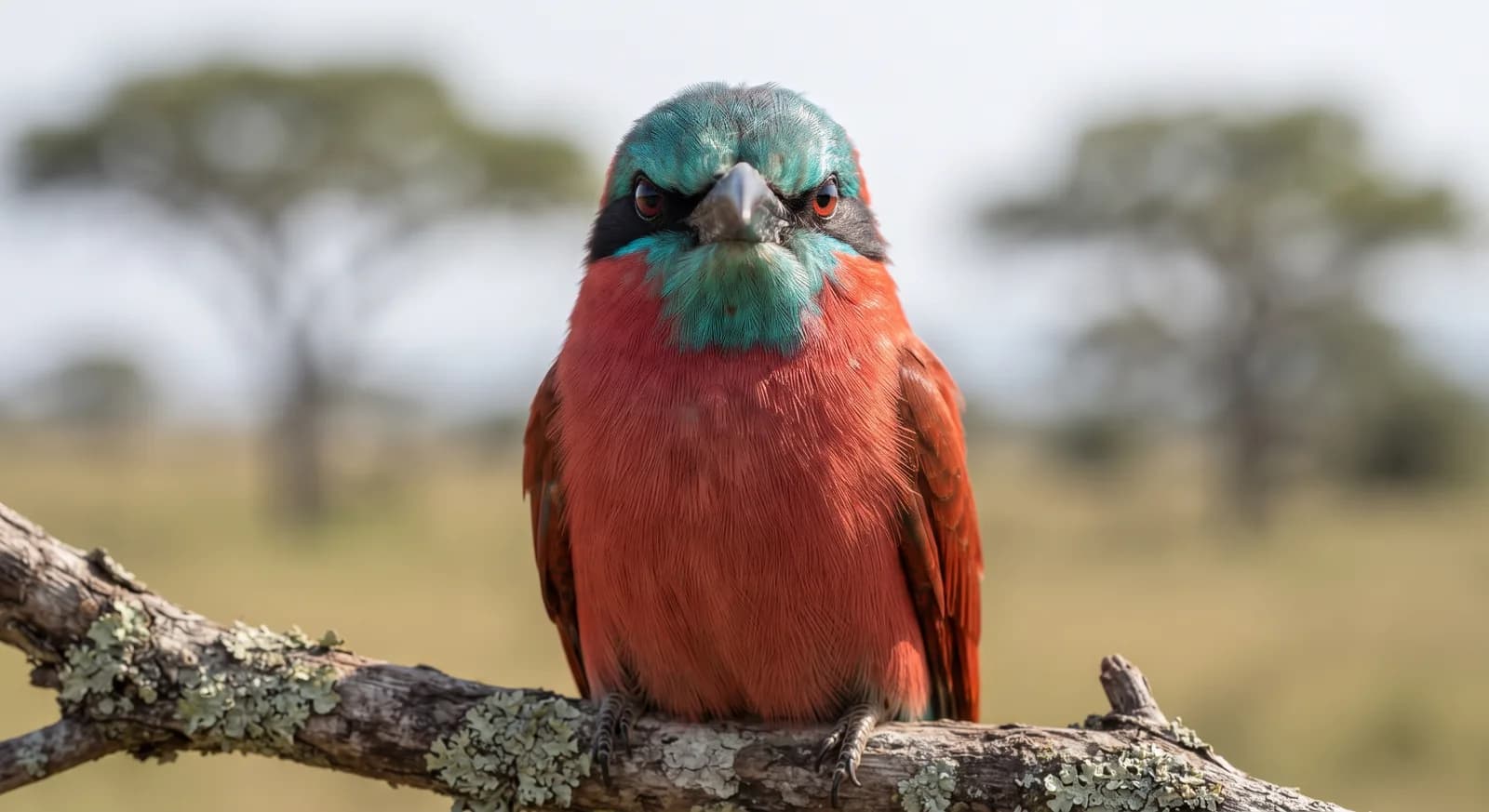
Northern Carmine Bee-eater
Merops nubicus
The species is abundant and widely distributed; it faces no significant short-term risk. See full glossary
The largest of the bee-eaters, an intense carmine pink rare among birds, with a blue-green crown and throat, black mask, red eyes and long central tail feathers that stream out in flight.
Weight
34 g – 60 g
Size
9.5 cm – 27 cm
Diet
Insectivore
Feeds mainly on insects and other invertebrates.
Activity
Diurnal
Active mainly during the day.
Social structure
Colony
Lives in large concentrations, often for breeding reasons.
Sighting difficulty
Easy
Estimated population
No up-to-date global estimate. A rough estimate from the 1980s put the two carmine bee-eater species combined at 5 million individuals
Fun facts
- GeneralIt nests in colonies of thousands of burrows and hunts insects from the backs of ostriches and antelopes.
- It comes to bush fires and hunts the fleeing insects alongside the flames; in the Manding languages it is called 'the cousin of fire'.
- It nests in extremely dense colonies of between 100 and 1,000 nests, and exceptionally up to 10,000, averaging some 60 holes per square metre.
- It perches on large mammals, ground birds and even moving vehicles to take advantage of the insects they flush.
Life cycle & biology
- Skeleton type
- Vertebrate - internal bony skeleton (bird)
- Habitat & environment
- Savannah, riverbanks and sandy bluffs
- Gestation / incubation
- About 3 weeks, shared by both parents. The chicks fledge 23 to 30 days after hatching
- Litter / clutch size
- 2-5 white eggs laid at intervals of about 48 hours
Sources consulted: Fry, Boesman y Kirwan 2020, Birds of the World (Cornell Lab); IUCN Red List (e.T22683768A92999759); Animal Diversity Web; San Diego Zoo Wildlife Alliance Library; del Hoyo et al. 2001, Handbook of the Birds of the World vol. 6
Where to find it
See its range on the interactive mapBest time: During the breeding season, between February and June in the north of its range and between September and October in the south
Where to watch it
Parks and dive sites where this species has been documented.
Related species
Other species in the catalogue with the most in common with Northern Carmine Bee-eater — same habitat, park, country, tags or family.
European Bee-eater
Merops apiaster
Fork-tailed Drongo
Dicrurus adsimilis
Banded Mongoose
Mungos mungo
Red-billed Oxpecker
Buphagus erythrorynchus
 Least Concern
Long-tailed Cormorant
Microcarbo africanus
Helmeted Guineafowl
Numida meleagris
Keep exploring
Based on what we already know about northern carmine bee-eater.
Comments
Share an experience, a fun fact or a tip for seeing the northern carmine bee-eater.
Be the first to comment.