One of the 2 kudus on WAnimals
Mammals · Artiodactyla · Bovidae
Lesser Kudu
Tragelaphus imberbis
It could become endangered in the near future if current threats go unchecked. See full glossary
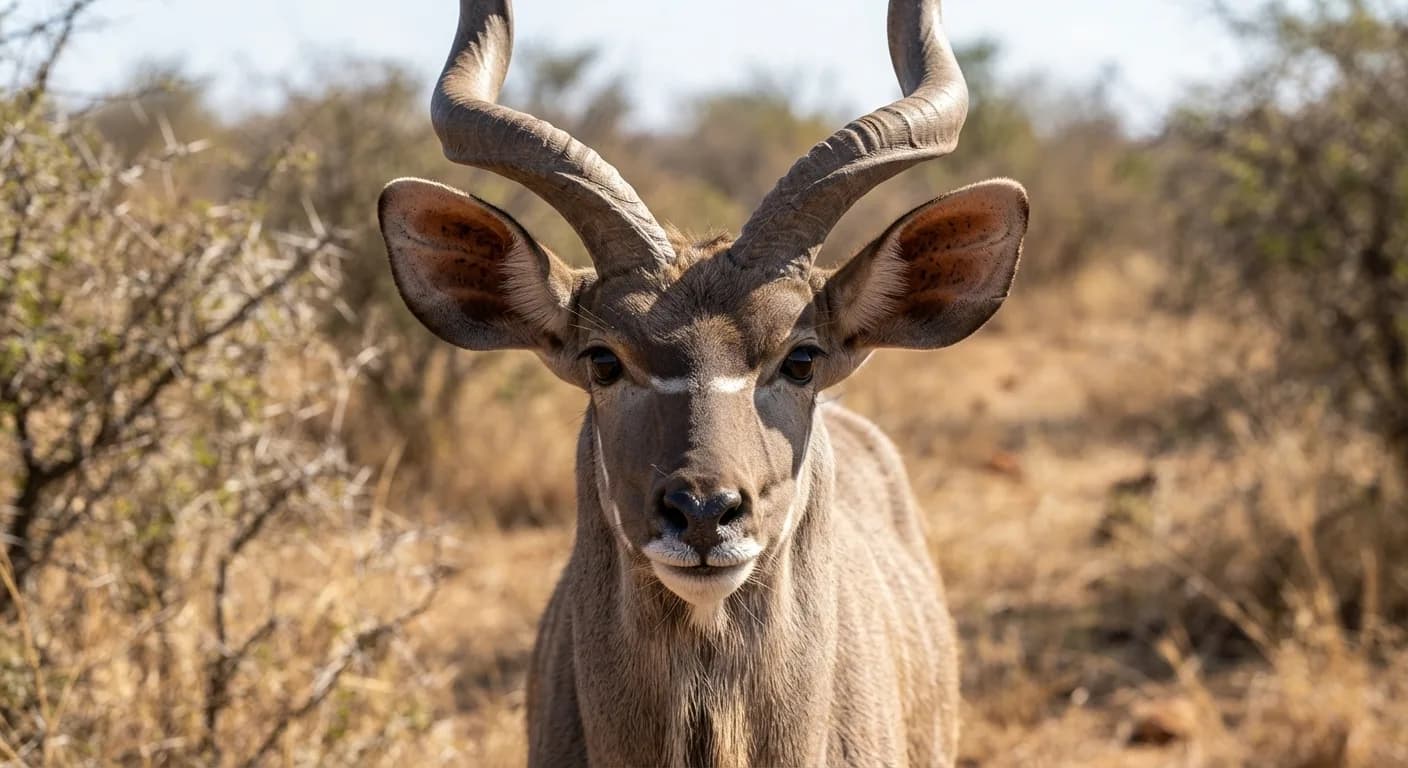
The lesser kudu is an elegant antelope of the arid scrub of East Africa, smaller and more slender than the greater kudu. It has a grey body with a dozen fine vertical white stripes, two white patches on the throat and tan-coloured legs. Only the males carry horns, in an open spiral. It is extremely unobtrusive: it stands motionless in the scrub and only bolts at the last moment, in leaps of more than two metres. It has virtually no need to drink.
Weight
56 kg – 108 kg
Size
1.1 m – 1.8 m
Lifespan
15 years
Diet
Herbivore
Feeds mainly on plants.
Activity
Crepuscular
Active above all at dawn and dusk.
Sighting difficulty
Moderate
Fun facts
- GeneralVery shy: it freezes in the scrub rather than running.
- It leaps more than two and a half metres vertically from a standing start, an ability it uses to cross thorn scrub instead of going round it.
- It does not drink: it meets its water needs from the leaves and fruit it browses, which lets it occupy parts of the Horn of Africa where there is no surface water for months on end.
Life cycle & biology
- Skeleton type
- Vertebrate - internal bony skeleton (mammal)
- Habitat & environment
- Dense thorn scrub and dry acacia woodland of the Horn of Africa and East Africa
- Sexual maturity
- 16.6 months
- Gestation / incubation
- 7.7 months
- Litter / clutch size
- 1
Sources consulted: https://es.wikipedia.org/wiki/Tragelaphus_imberbis
Where to find it
See its range on the interactive mapWhere to watch it
Parks and dive sites where this species has been documented.
Related species
Other species in the catalogue with the most in common with Lesser Kudu — same habitat, park, country, tags or family.
 Near Threatened
Gerenuk
Litocranius walleri
 Near Threatened
African Buffalo
Syncerus caffer
Klipspringer
Oreotragus oreotragus
Kirk's Dik-dik
Madoqua kirkii
Beisa Oryx
Oryx beisa
Steenbok
Raphicerus campestris
Keep exploring
Based on what we already know about lesser kudu.
Comments
Share an experience, a fun fact or a tip for seeing the lesser kudu.
Be the first to comment.