Bony fish · Scombriformes · Scombridae
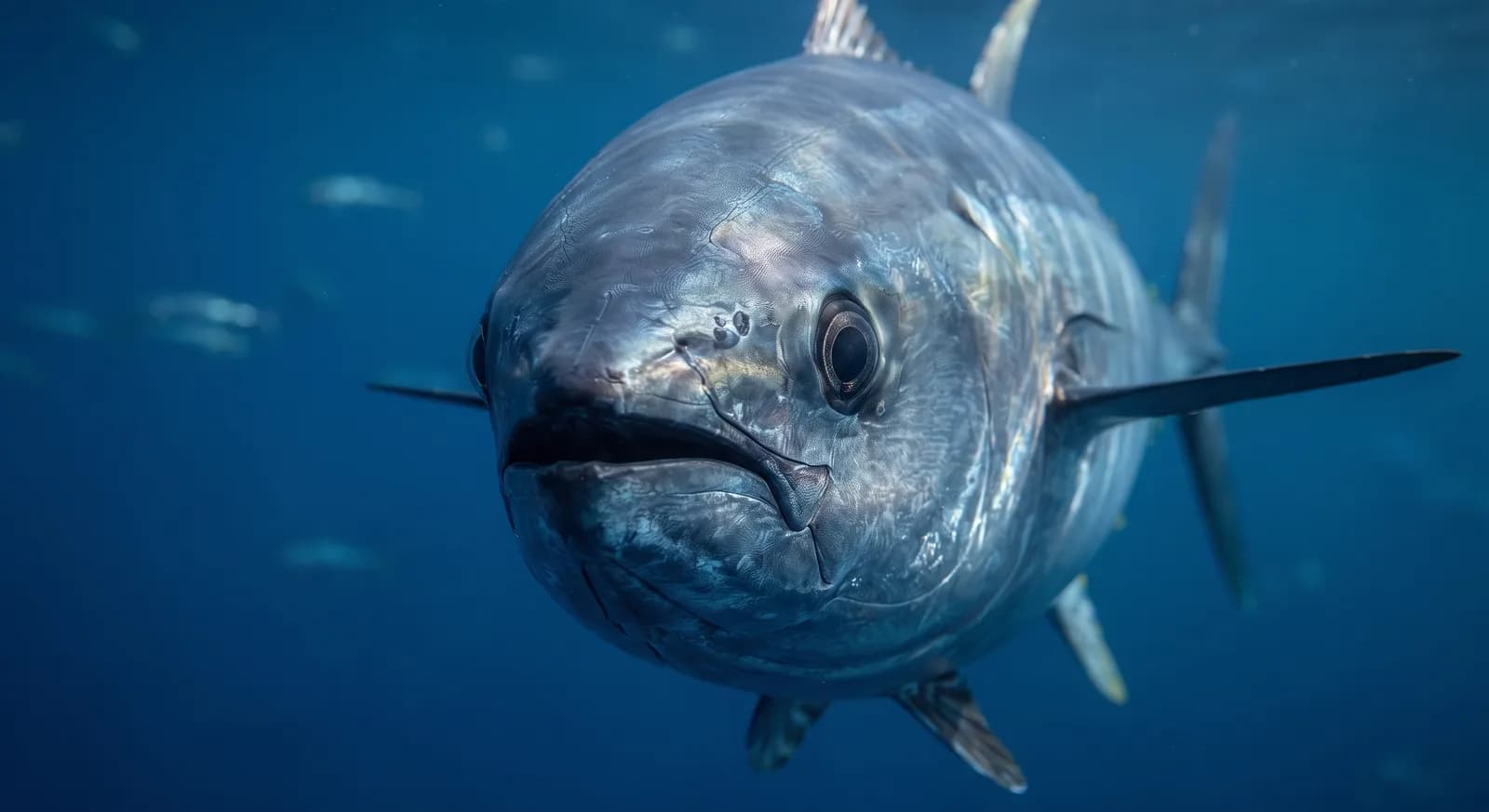
Mackerel
Scomber scombrus
The species is abundant and widely distributed; it faces no significant short-term risk. See full glossary
It has no swim bladder, so it has to keep swimming all its life.
Weight
up to 3.4 kg
Size
up to 60 cm
Lifespan
17 years
Diet
Carnivore
Feeds mainly on other animals.
Activity
Irregular activity
Active at irregular times, by day or night depending on circumstances.
Social structure
School
Gathers in coordinated schools, typical of fish.
Sighting difficulty
Easy
Fun facts
- It is a mainstay of the North Atlantic right whale's diet.
- It eats copepods and other zooplankton, supplemented with small fish, shrimp and squid.
- It has been protected in the European Union since 1996.
- It has no swim bladder, unlike the chub mackerel. That forces it to swim continuously so as not to sink, but lets it change depth very quickly without adjusting pressure.
- It also swims non-stop in order to breathe, because it ventilates its gills through its own forward motion.
- Its flesh is very oily and oxidises quickly after capture, which explains why it was traditionally salted or preserved in oil, and why it is among the fish with the most demanding cold chain.
- Its spawning grounds in the north-east Atlantic are shared among several national fleets, and disagreement over quotas has been a recurrent fishing dispute between the European Union, Norway, Iceland and the Faroe Islands.
Life cycle & biology
- Skeleton type
- Vertebrate - internal bony skeleton (fish)
- Habitat & environment
- Temperate pelagic waters of the North Atlantic, the Mediterranean included, from the surface down to 1,000 m
- Birth weight
- Pelagic larva after hatching from the egg
- Size at birth
- Pelagic larva at hatching
- Sexual maturity
- 1-3 years (usual reference 1-2 years)
- Litter / clutch size
- 40,000 to 190,000 eggs released in open water, with no parental care
Sources consulted: FishBase; PubMed; Fishipedia; Mass.gov Creature Feature; AnAge; U.S. Fish and Wildlife Service
Where to find it
See its range on the interactive mapWhere to watch it
Parques y spots de buceo donde se ha documentado esta especie — se muestran 20 de 131 documentados.
Related species
Other species in the catalogue with the most in common with Mackerel — same habitat, park, country, tags or family.
Atlantic Bonito
Sarda sarda
Bullet Tuna
Auxis rochei
Atlantic Chub Mackerel
Scomber colias
Little Tunny
Euthynnus alletteratus
 Endangered
Atlantic Bluefin Tuna
Thunnus thynnus
Atlantic Herring
Clupea harengus
Ecological relationships
How Mackerel relates to other species in the catalogue.
Atlantic Bonito
Sarda sarda
Keep exploring
Based on what we already know about mackerel.
Comments
Share an experience, a fun fact or a tip for seeing the mackerel.
Be the first to comment.