Bony fish · Scombriformes · Scombridae
Little Tunny
Euthynnus alletteratus
The species is abundant and widely distributed; it faces no significant short-term risk. See full glossary
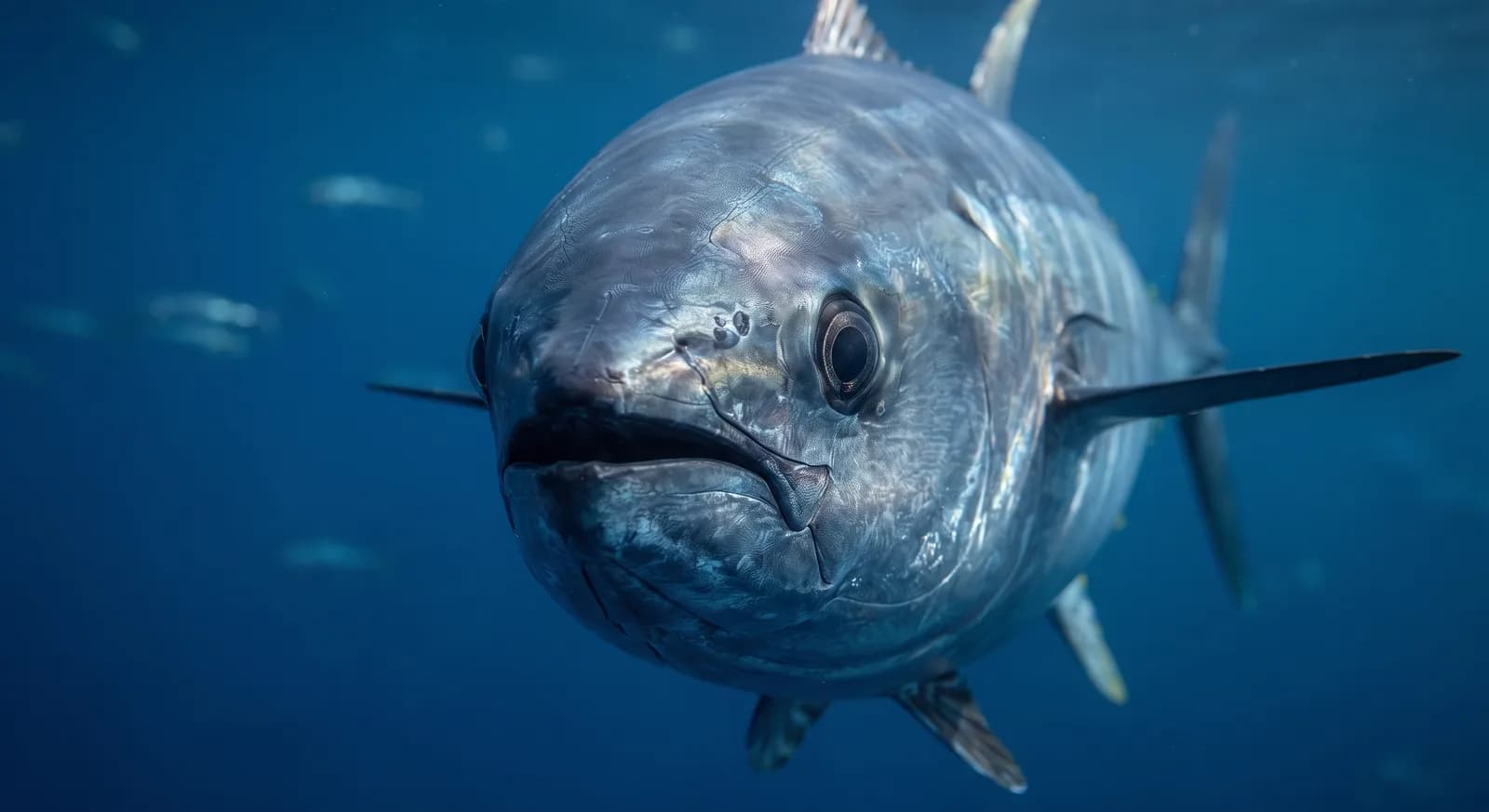
The little tunny is a small tuna with a blue back crossed by a pattern of broken dark lines and several black spots between the pectoral and pelvic fins. It swims in fast schools through the warm waters of the Atlantic and the Mediterranean, chasing small fish and squid.
Weight
up to 16.5 kg
Size
40 cm – 1.2 m
Lifespan
10 years
Diet
Carnivore
Feeds mainly on other animals.
Social structure
Colony
Lives in large concentrations, often for breeding reasons.
Sighting difficulty
Easy
Fun facts
- GeneralIt shoals in numbers that set the surface boiling as it hunts sardines.
- Like the other tunas, it keeps its muscles above the temperature of the water thanks to a network of blood vessels that recovers heat, which lets it swim faster and for longer.
- It cannot stop swimming: it has to keep water flowing over its gills in order to breathe.
- It forms large schools mixed with other scombrids of similar size, and groups itself by size.
- It is among the least commercially valued tunas because of its dark flesh, and a good share of its catch goes to cheap canning, to bait or to local consumption.
- Like the other tunas, it is a regional endotherm: it keeps parts of its body above water temperature thanks to a countercurrent heat-exchange system.
- It must swim continuously to breathe, because it ventilates its gills through its own forward motion.
Life cycle & biology
- Skeleton type
- Vertebrate - internal bony skeleton (fish)
- Habitat & environment
- Warm surface waters over the shelf
Sources consulted: FishBase (Froese & Pauly, eds.); Lista Roja de la UICN; Collette y Nauen, FAO Species Catalogue
Where to find it
See its range on the interactive mapWhere to watch it
Parques y spots de buceo donde se ha documentado esta especie — se muestran 20 de 116 documentados.
Related species
Other species in the catalogue with the most in common with Little Tunny — same habitat, park, country, tags or family.
Skipjack
Katsuwonus pelamis
Atlantic Chub Mackerel
Scomber colias
Atlantic Bonito
Sarda sarda
Bullet Tuna
Auxis rochei
Mackerel
Scomber scombrus
 Endangered
Atlantic Bluefin Tuna
Thunnus thynnus
Keep exploring
Based on what we already know about little tunny.
Comments
Share an experience, a fun fact or a tip for seeing the little tunny.
Be the first to comment.