One of the 24 beetles on WAnimals
Insects · Coleoptera · Scarabaeidae
Sacred Scarab
Scarabaeus sacer
It has not yet been assessed against the IUCN criteria. See full glossary
The sacred scarab is a beetle of the family Scarabaeidae that lives in the coastal dunes and marshes of the Mediterranean basin. The dung beetle gathers balls of dung and rolls them to an underground nest to feed its young. That behaviour led the ancient Egyptians to compare it with the god Khepri and to regard it as a sacred animal.
Size
2 cm – 3.2 cm
Diet
Omnivore
Combines animal and plant food depending on availability.
Activity
Diurnal
Active mainly during the day.
Social structure
Solitary
Lives and hunts alone, joining others only to breed.
Sighting difficulty
Unknown
Fun facts
- sentidosIt keeps a straight line while rolling its ball of dung by taking its bearings from the Milky Way at night, the only documented case of stellar navigation in an insect.
- The ancient Egyptians associated it with the god Khepri and the rising sun: they saw in the ball the beetle pushes across the sand an image of the solar disc crossing the sky.
- Dung beetles of the genus Scarabaeus steer while rolling their ball by the polarised light of the moon and, on moonless nights, by the glow of the Milky Way; navigation by the galaxy was demonstrated in the African species Scarabaeus satyrus.
- Before setting off it climbs onto the ball and turns on top of it in a dance that lets it take a bearing and hold a straight line.
- It is the sacred scarab of ancient Egypt. In the ball of dung it pushes the Egyptians saw the solar disc, and in the beetle the god Khepri, who rolled the sun across the sky each day; scarab amulets are among the most recognisable of Egyptian objects.
- It navigates by the Milky Way. An experiment in 2013 showed that it rolls its ball in a straight line guided by the luminous band of our galaxy, the first animal shown to use the Milky Way for orientation.
- It rolls in a straight line on purpose: it is not heading for a destination, it is trying to get away from the dung heap as fast as possible before another beetle steals its ball.
- Before setting off it climbs on top of the ball and performs an orientation dance, rotating on the spot to take its bearings from the sky.
- Its front legs are toothed like spades and lack tarsi, adapted for digging and for shaping the ball.
- The female buries a brood ball and lays a single egg inside; the larva develops by eating the dung from within.
Life cycle & biology
- Skeleton type
- Invertebrate - chitin exoskeleton (insect)
- Habitat & environment
- Mediterranean grassland, dehesa and sandy ground where livestock is present
Sources consulted: https://es.wikipedia.org/wiki/Scarabaeus_sacer
Where to find it
See its range on the interactive mapBest time: Spring and early summer, in grassland with livestock
Where to watch it
Parques y spots de buceo donde se ha documentado esta especie — se muestran 10 de 14 documentados.
Related species
Other species in the catalogue with the most in common with Sacred Scarab — same habitat, park, country, tags or family.
Dung Beetle
Onthophagus taurus
Rose Chafer
Cetonia aurata
Common Cockchafer
Melolontha melolontha
European Rhinoceros Beetle
Oryctes nasicornis
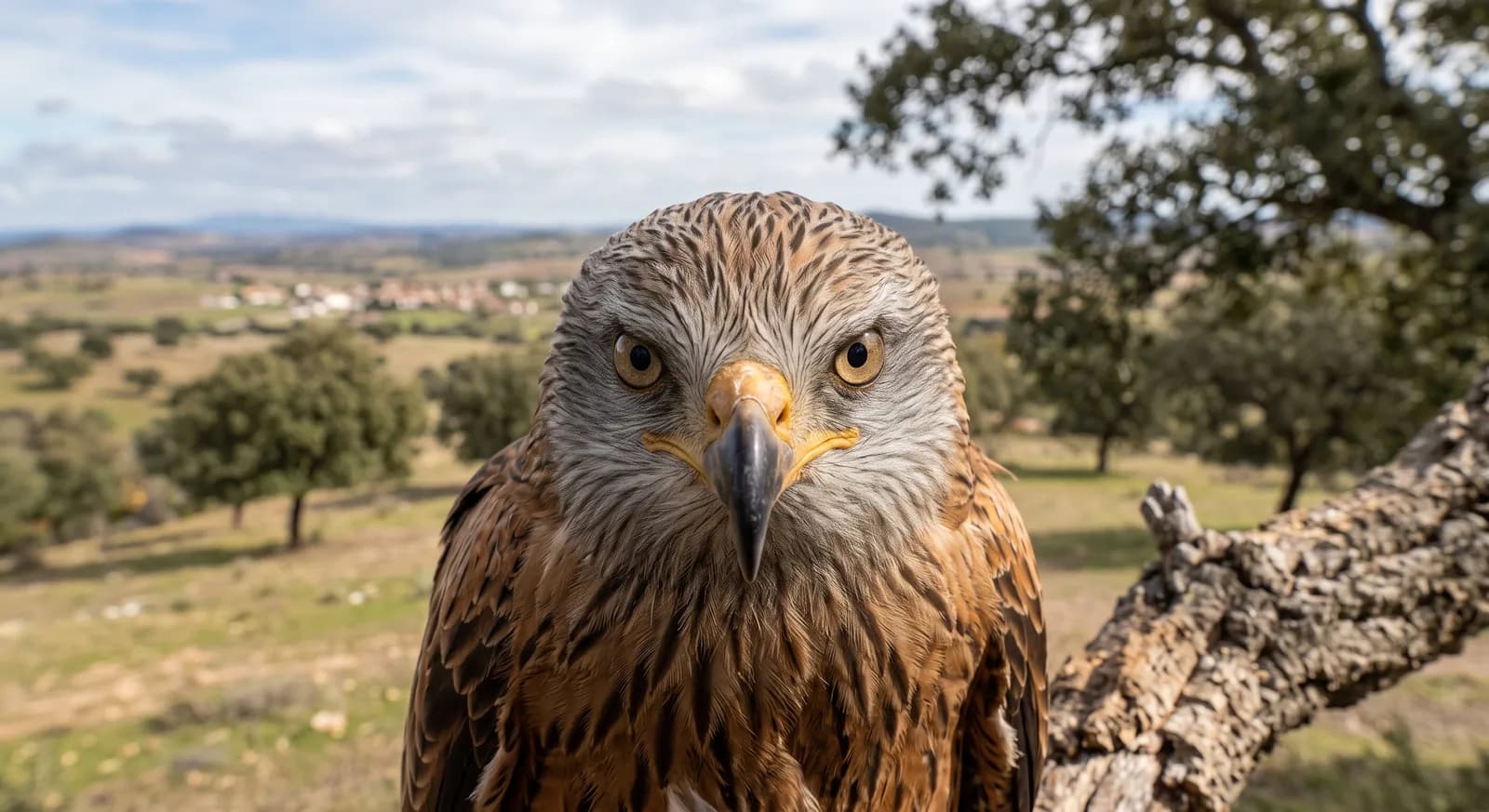 Least Concern
Red Kite
Milvus milvus
Common Chaffinch
Fringilla coelebs
Keep exploring
Based on what we already know about sacred scarab.
Comments
Share an experience, a fun fact or a tip for seeing the sacred scarab.
Be the first to comment.