One of the 24 beetles on WAnimals
Insects · Coleoptera · Scarabaeidae
European Rhinoceros Beetle
Oryctes nasicornis
It has not yet been assessed against the IUCN criteria. See full glossary
The European rhinoceros beetle is robust and a glossy reddish brown, and the male carries a horn curving back over its head. Its larvae, large and white, develop over several years in well-rotted wood, sawdust and compost.
Size
2 cm – 4 cm
Diet
Herbivore
Feeds mainly on plants.
Activity
Nocturnal
Active mainly at night.
Social structure
Solitary
Lives and hunts alone, joining others only to breed.
Sighting difficulty
Unknown
Fun facts
- The male's horn is not a weapon for killing: it is used as a lever to prise rivals out in fights over females.
- The adults barely feed and live only a few weeks: all the energy was stored by the larva during its three or four years underground.
- Compost heaps, sawmill sawdust and stacked bark have become an important substitute habitat for it, now that dead wood is scarce in managed forests.
- It is one of the largest beetles in Europe, and the male bears a curved horn on its head that it uses in fights with other males.
- The larva is enormous, up to 10 cm, and takes between three and five years to develop inside dead wood or compost.
- It has changed habitat: as dead wood is scarce in managed forests, today it lives mainly in piles of sawdust, wood shavings and compost of human origin, which have become its main refuge.
- It is completely harmless despite its looks: the adult barely eats, and the horn serves to attack no one but another male.
- It is the obligatory prey of the mammoth wasp, Megascolia maculata, which paralyses its larvae and lays an egg on each one.
Life cycle & biology
- Skeleton type
- Invertebrate - chitin exoskeleton (insect)
- Habitat & environment
- Woodland with dead wood, sawmills and compost heaps
Sources consulted: Buglife; Natural History Museum de Londres; proyecto LIFE4OakForests
Where to find it
See its range on the interactive mapBest time: From June to August, when the adults fly at dusk
Where to watch it
Parques y spots de buceo donde se ha documentado esta especie — se muestran 10 de 138 documentados.
Related species
Other species in the catalogue with the most in common with European Rhinoceros Beetle — same habitat, park, country, tags or family.
Rose Chafer
Cetonia aurata
Common Cockchafer
Melolontha melolontha
Dung Beetle
Onthophagus taurus
Sacred Scarab
Scarabaeus sacer
 Near Threatened
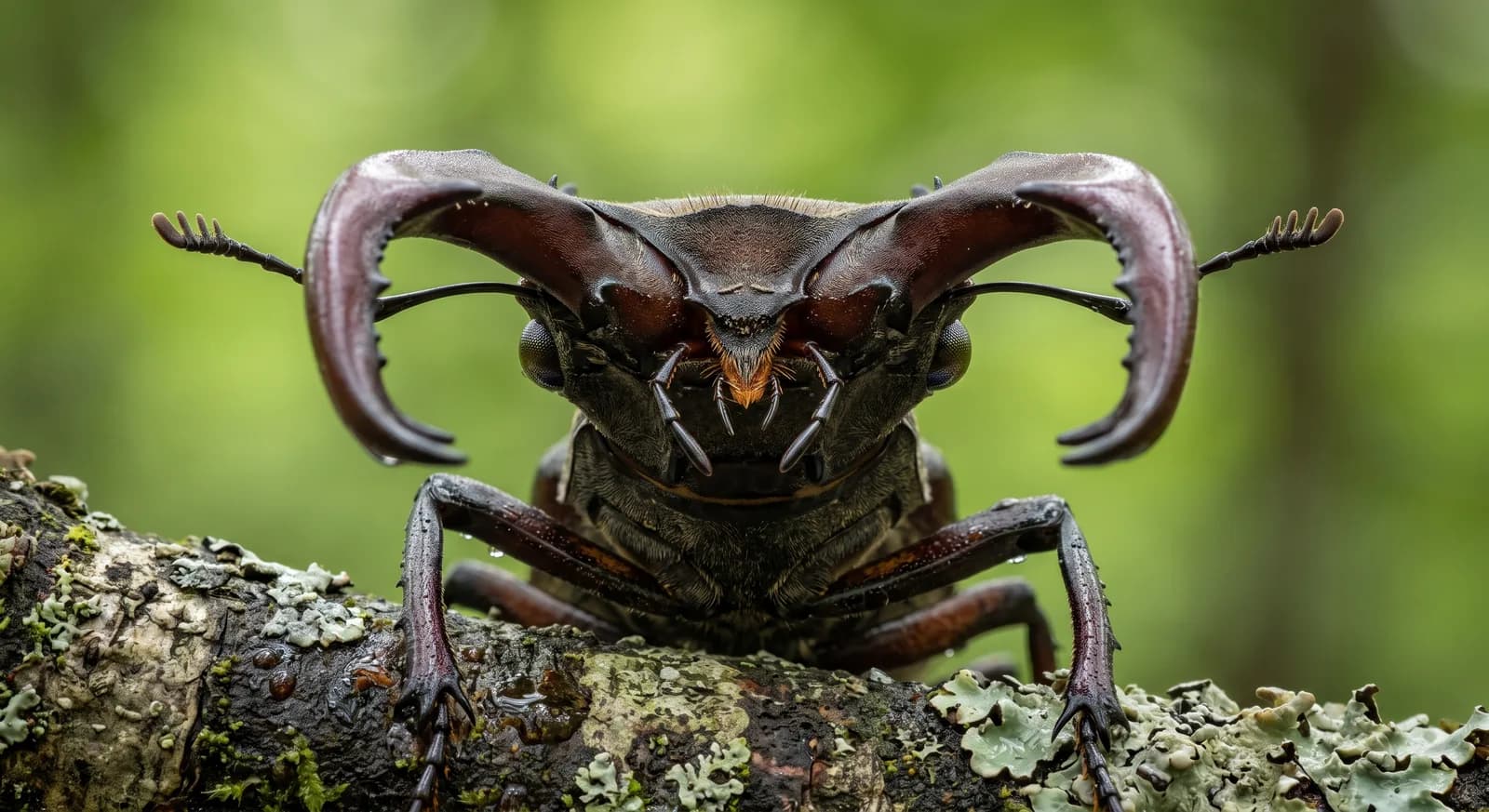
Stag Beetle
Lucanus cervus
Greater Capricorn Beetle
Cerambyx cerdo
Keep exploring
Based on what we already know about european rhinoceros beetle.
Comments
Share an experience, a fun fact or a tip for seeing the european rhinoceros beetle.
Be the first to comment.