Skip to content
WAnimals
  • Map
  • Species
  • Parks
  • Diving
Log inCreate account
WAnimals

The guide for travellers and animal lovers: discover, plan and share your wild adventures around the world.

Discover wildlife

  • Species
  • Ecosystems
  • Glossary
  • Tags

Explore places

  • Map
  • Countries
  • Parks
  • Diving

Plan experiences

  • Guides

Learn

  • Blog

Resources

  • Help centre
  • Contact
  • Install the app

Follow us

Account

  • Log in
  • Create account

© 2026 WAnimals. All rights reserved.

About usHow we build our profilesTerms of servicePrivacyLegal notice
MapSpeciesParksDiving
  1. Home
  2. Species
  3. Clown Anemonefish
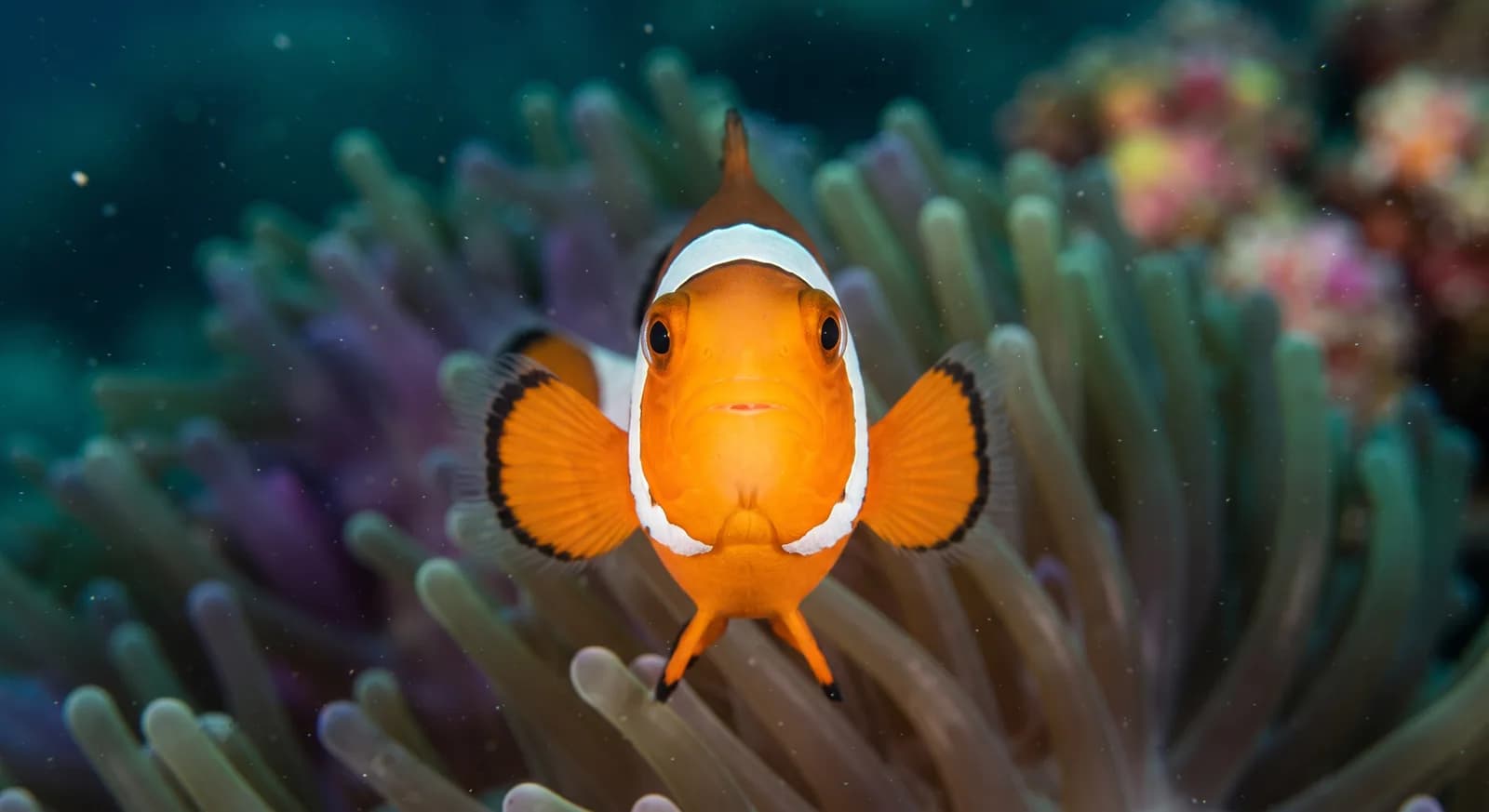
Clown Anemonefish (Amphiprion ocellaris)

Bony fish · Perciformes · Pomacentridae

Clown Anemonefish

Amphiprion ocellaris

Not Evaluated

It has not yet been assessed against the IUCN criteria.

Spotted something wrong?

It is a protandrous sequential hermaphrodite: all are born male, and the dominant individual in each group turns into the one breeding female; if she dies, her male partner becomes female.

Size

up to 11 cm

Life expectancy

6 years

Diet

Omnivore

Combines animal and plant food depending on availability.
Activity

Diurnal

Active mainly during the day.

Social structure

In pairs

Usually lives in pairs, sometimes for life.

Sighting difficulty

Unknown

Ocean
59countries30parks105dive sites1same family

AI-generated images: illustrations, not photographs.

Fun facts

  • It lives in symbiosis with sea anemones, which shelter it from predators because it is immune to their stinging tentacles.
  • It feeds on zooplankton, algae and scraps left by its host anemone.
  • It became famous worldwide as the star of the film "Finding Nemo".
  • comportamientoIt lives in a mutual partnership with stinging sea anemones, thanks to a special layer of mucus that protects it from their tentacles.
  • All are born male. It is a protandrous hermaphrodite: the group is headed by a large female, followed by the breeding male, and the rest are non-breeding juveniles ranked by size. If the female dies, the male changes sex and takes her place, and the largest of the juveniles becomes the breeding male.
  • The symbiosis with the anemone runs both ways: the anemone provides it with shelter and scraps of food, and the fish nourishes the anemone with its droppings and improves its oxygenation by stirring the water among the tentacles.
  • It can occupy up to four anemone species: Heteractis magnifica, H. crispa, Stichodactyla gigantea and S. mertensii.
  • The female lays her eggs on a surface next to the anemone, and the male guards them and fans them with his fins until they hatch.
  • It is told apart from the true clownfish, Amphiprion percula, by having eleven dorsal spines instead of ten and thinner black edges to its bands.
  • It is one of the few reef fishes bred successfully in captivity, which has greatly reduced collection pressure on wild populations.

Life cycle and biology

Skeleton type
Vertebrate - bony skeleton (fish)
Habitat and environment
Coral reefs and sheltered lagoons of the western Indo-Pacific, in symbiosis with sea anemones
Birth weight
An egg 3-4 mm long
Size at birth
A planktonic larva on hatching, which later drops down to settle in an anemone
Sexual maturity
Variable; it reaches maturity on becoming the dominant individual of its social group
Gestation / incubation
6-10 days of egg development
Litter / clutch size
100 to 1,518 eggs per spawning (~582 on average), repeated about every 2 weeks

Sources consulted: ScienceDirect (growth pattern study); Animal Diversity Web; A-Z Animals; Animalia.bio; Saltwater Aquarium Blog; Aquarium Source; PMC (egg clutch development study, lifespan evolution study)

Where to find it

Loading map…

Where to see it

Parks and dive sites where this species has been documented — showing 20 of 135.

Related species

Other species in the catalogue with the most in common with Clown Anemonefish — same habitat, park, country, tags or family.

Same taxonomic family
Shares a park
Shares a park
Shares a park
Shares a park
Shares a park

Keep exploring

Based on what we already know about clown anemonefish.

Comments

Share an experience, a fun fact or a tip for seeing the clown anemonefish.

Be the first to comment.

See full glossary
This page in other languages: Español · Deutsch · Français · Português · Italiano

The pins mark the parks and dive sites where its presence is documented.

See its range on the interactive map→
KomodoIndonesia
AldabraSeychelles
YakushimaJapan
Great Barrier ReefAustralia
NingalooAustralia
Rock Islands of PalauPalau
East RennellSolomon Islands
FakaravaFrench Polynesia
Mohéli Marine National ParkComoros
Bazaruto ArchipelagoMozambique
Raja AmpatIndonesia
Komodo National ParkIndonesia
Bunaken Marine ParkIndonesia
USAT Liberty (Tulamben)Indonesia
Amed and Jemeluk BayIndonesia
Menjangan Island (Bali Barat)Indonesia
Nusa Penida (Manta Point / Crystal Bay)Indonesia
Lembeh StraitIndonesia
Wakatobi National ParkIndonesia
Banda IslandsIndonesia
See all 30 parks
See all 105 dive sites
Banded HumbugLeast Concern

Banded Humbug

Dascyllus aruanus

Vulnerable

Spotted Seahorse

Hippocampus kuda

Emperor AngelfishLeast Concern

Emperor Angelfish

Pomacanthus imperator

Yellow BoxfishLeast Concern

Yellow Boxfish

Ostracion cubicus

Moorish IdolLeast Concern

Moorish Idol

Zanclus cornutus

Whale SharkEndangered

Whale Shark

Rhincodon typus

CountriesIndonesia
ParksKomodoIndonesia
TagsOmnivore
Omnivore
Diurnal
In pairs
Fish
Ocean

Asia24

Oceania20

Africa15

Indonesia
Philippines
Thailand
Australia
Malaysia
Japan
Bangladesh
Brunei
Cambodia
China
India
Indonesia
Israel
Japan
Jordan
Malaysia
Maldives
Myanmar
Oman
Pakistan
Philippines
Saudi Arabia
Singapore
Sri Lanka
Taiwan
Thailand
Timor-Leste
United Arab Emirates
Vietnam
Yemen
American Samoa
Australia
Cook Islands
Fiji
French Polynesia
Guam
Kiribati
Marshall Islands
Micronesia
Nauru
New Caledonia
Niue
Northern Mariana Islands
Palau
Papua New Guinea
Samoa
Solomon Islands
Tonga
Tuvalu
Vanuatu
Comoros
Djibouti
Egypt
Eritrea
Kenya
Madagascar
Mauritius
Mayotte
Mozambique
Réunion
Seychelles
Somalia
South Africa
Sudan
Tanzania