One of the 4 storks on WAnimals
Birds · Ciconiiformes · Ciconiidae
Black Stork
Ciconia nigra
The species is abundant and widely distributed; it faces no significant short-term risk. See full glossary
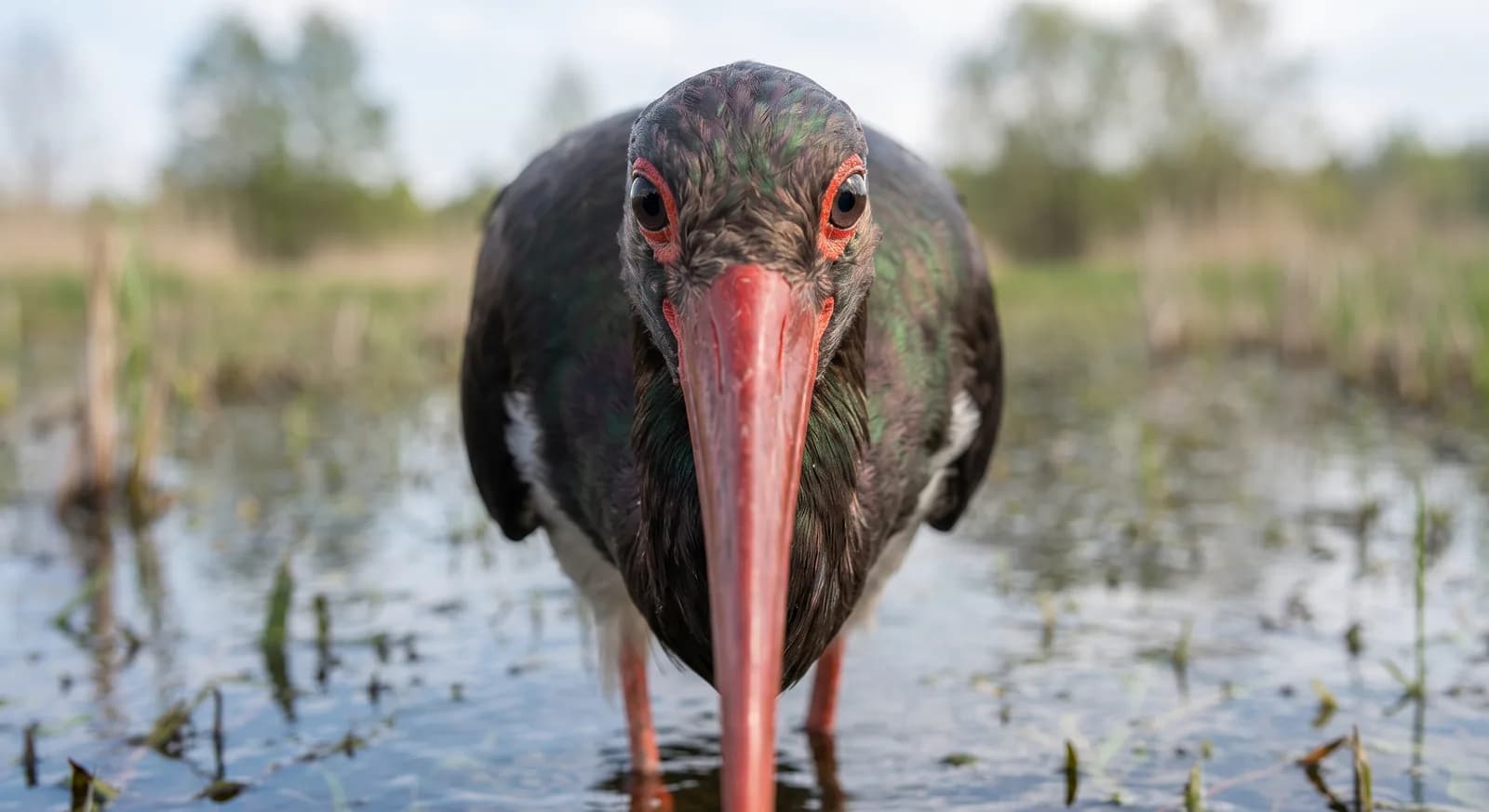
A slender, dark-toned wader, somewhat smaller than the white stork. Head, neck, breast, back, wings and tail are black with intense green and purple iridescence, and the underparts white. Bill, legs and eye-ring are red. The breast feathers form a hanging ruff that it fans out in courtship.
Weight
3 kg on average
Size
95 cm – 1.1 m
Diet
Carnivore
Feeds mainly on other animals.
Activity
Diurnal
Active mainly during the day.
Social structure
In pairs
Usually lives in pairs, sometimes for life.
Sighting difficulty
Easy
Estimated population
386 pairs on the Iberian Peninsula according to the 2017 SEO/BirdLife survey (346 confirmed and 40 probable). Some 50 pairs remain in Germany and the eastern European population is around 500
Fun facts
- comportamientoUnlike the white stork it avoids towns, preferring quiet woodland beside rivers, and is far shyer and harder to see.
- Unlike the white stork, it avoids people altogether and seeks out the most isolated corners in which to breed.
- On migration between Europe and Africa it avoids long sea crossings and skirts the Mediterranean by way of Gibraltar, Sicily or the Levant.
- There is a southern African population that does not migrate at all.
Life cycle & biology
- Skeleton type
- Vertebrate - internal bony skeleton (bird)
- Habitat & environment
- Remote spots in sierras and woodland, far from any human presence, where it nests on rock or in large trees. It winters in the Guadalquivir marshes and on some Extremaduran reservoirs
- Sexual maturity
- 3 years
- Gestation / incubation
- 38-42 days, with both parents incubating
- Litter / clutch size
- 3-5 white eggs, from April to June. One of the parents always stays with the chicks for the first 10-15 days, and they fledge at 63-71 days
Sources consulted: SEO/BirdLife (ficha y censo nacional 2017); IUCN Red List; Kahl 1987, Colonial Waterbirds 10(2); Wood 1984, Journal of Ornithology 125
Where to find it
See its range on the interactive mapBest time: From spring to summer in the sierras of the south-western quarter; on migration it crosses the Strait of Gibraltar
Where to watch it
Parques y spots de buceo donde se ha documentado esta especie — se muestran 10 de 15 documentados.
Related species
Other species in the catalogue with the most in common with Black Stork — same habitat, park, country, tags or family.
 Least Concern
White Stork
Ciconia ciconia
Great Crested Grebe
Podiceps cristatus
 Least Concern
Golden Eagle
Aquila chrysaetos
 Least Concern
Peregrine Falcon
Falco peregrinus
Goosander
Mergus merganser
Red-throated Loon
Gavia stellata
Keep exploring
Based on what we already know about black stork.
Comments
Share an experience, a fun fact or a tip for seeing the black stork.
Be the first to comment.