Bony fish · Cypriniformes · Cyprinidae
Goldfish
Carassius auratus
The species is abundant and widely distributed; it faces no significant short-term risk. See full glossary
It was one of the first fish domesticated and selectively bred by people, a process that goes back more than 1,000 years to a Chinese dynasty.
Weight
100 g – 3 kg
Size
up to 59 cm
Lifespan
6 years
Diet
Omnivore
Combines animal and plant food depending on availability.
Activity
Irregular activity
Active at irregular times, by day or night depending on circumstances.
Social structure
School
Gathers in coordinated schools, typical of fish.
Sighting difficulty
Easy
Fun facts
- It has given rise to dozens of ornamental varieties of extremely varied shape and colour.
- It eats zooplankton, insect larvae and plant matter.
- It is considered invasive in many regions where it has been introduced.
- It was the first fish domesticated as a companion animal: the selective breeding of colour varieties began in China during the Song dynasty, more than a thousand years ago.
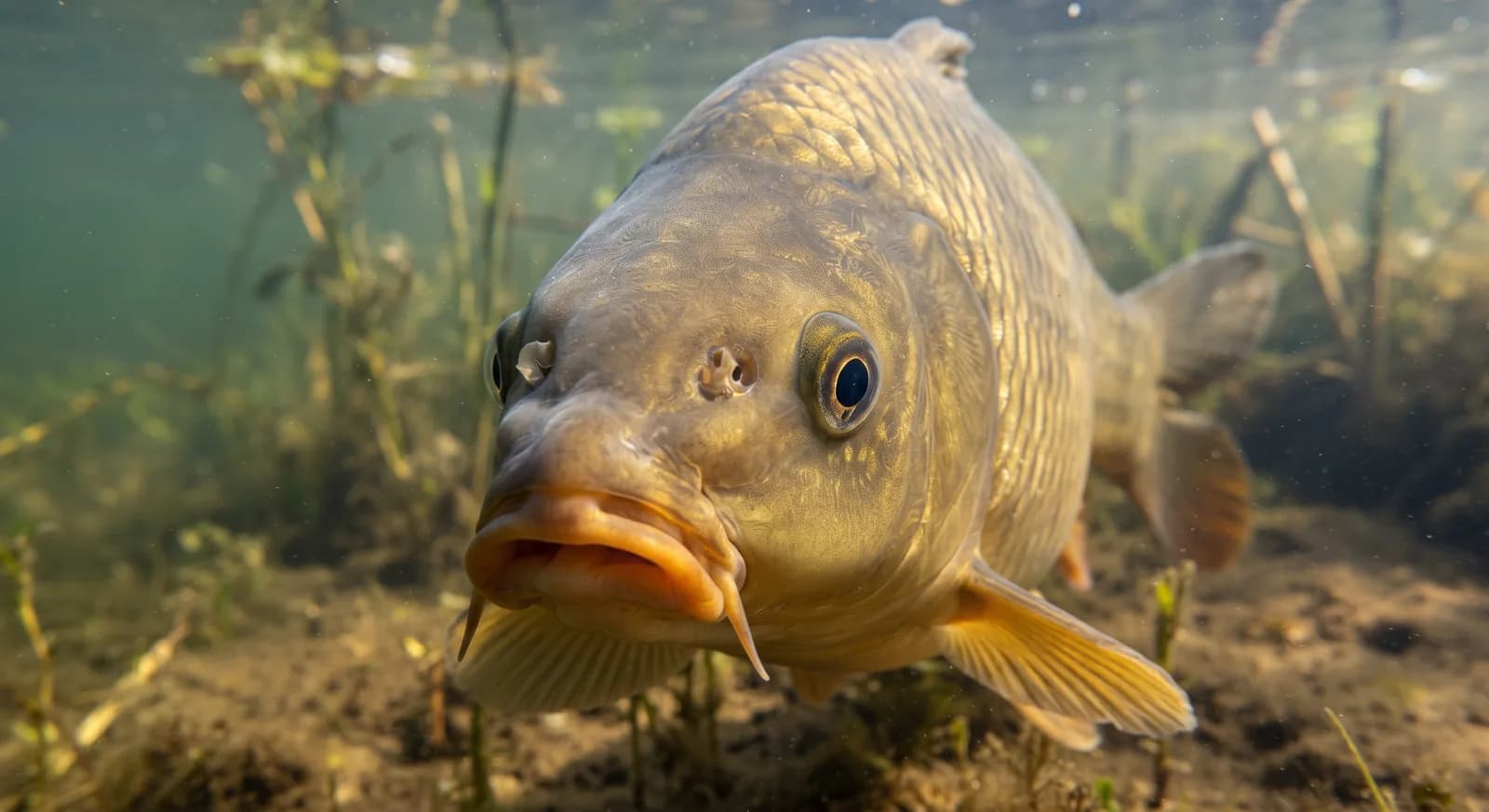
- Released into the wild it does not stay small or orange. It reverts to the wild brown colour and can exceed 40 cm and several kilos, and it is listed as invasive in numerous countries.
- It survives for weeks without oxygen by converting lactic acid into ethanol and expelling it through its gills, a metabolic pathway exceptional among vertebrates that allows it to overwinter beneath the ice in enclosed ponds.
- Its reputation for a three-second memory is false: conditioning experiments show that it retains what it learns for months.
- By stirring up the bottom to feed it clouds the water and uproots submerged vegetation, degrading the ecosystems into which it is introduced.
Life cycle & biology
- Skeleton type
- Vertebrate - bony skeleton (fish)
- Habitat & environment
- Slow-flowing vegetated fresh water of China and East Asia; widely introduced worldwide
- Birth weight
- Egg 1.2-1.5 mm long; 4.5 mm long on hatching
- Size at birth
- 4.5 mm long at hatching
- Sexual maturity
- 1-2 years
- Gestation / incubation
- 48-72 hours of egg development at 20-23°C
- Litter / clutch size
- Thousands of eggs per clutch, repeated several times through the breeding season
Sources consulted: USGS NAS Species Profile; Animal Diversity Web; A-Z Animals; FishBase; Shrimp and Snail Breeder; De Peces (guía); Academia.edu (reproductive periodicity study)
Where to find it
See its range on the interactive mapRelated species
Other species in the catalogue with the most in common with Goldfish — same habitat, park, country, tags or family.
Roach
Rutilus rutilus
Zebra Danio
Danio rerio
Sumatra Barb
Puntigrus tetrazona
Harlequin Rasbora
Trigonostigma heteromorpha
Dace
Leuciscus leuciscus
 Least Concern
Common Carp
Cyprinus carpio
Keep exploring
Based on what we already know about goldfish.
Comments
Share an experience, a fun fact or a tip for seeing the goldfish.
Be the first to comment.