Skip to content
WAnimals
  • Map
  • Species
  • Parks
  • Diving
Log inCreate account
WAnimals

The guide for travellers and animal lovers: discover, plan and share your wild adventures around the world.

Discover wildlife

  • Species
  • Ecosystems
  • Glossary
  • Tags

Explore places

  • Map
  • Countries
  • Parks
  • Diving

Plan experiences

  • Guides

Learn

  • Blog

Resources

  • About us
  • How we build our profiles
  • Help centre
  • Contact
  • Install the app

Follow us

Account

  • Log in
  • Create account

© 2026 WAnimals. All rights reserved.

Terms of servicePrivacyCookiesLegal notice
MapSpeciesParksDiving
  1. Home
  2. Species
  3. Common Emperor Scorpion

One of the 7 scorpions on WAnimals
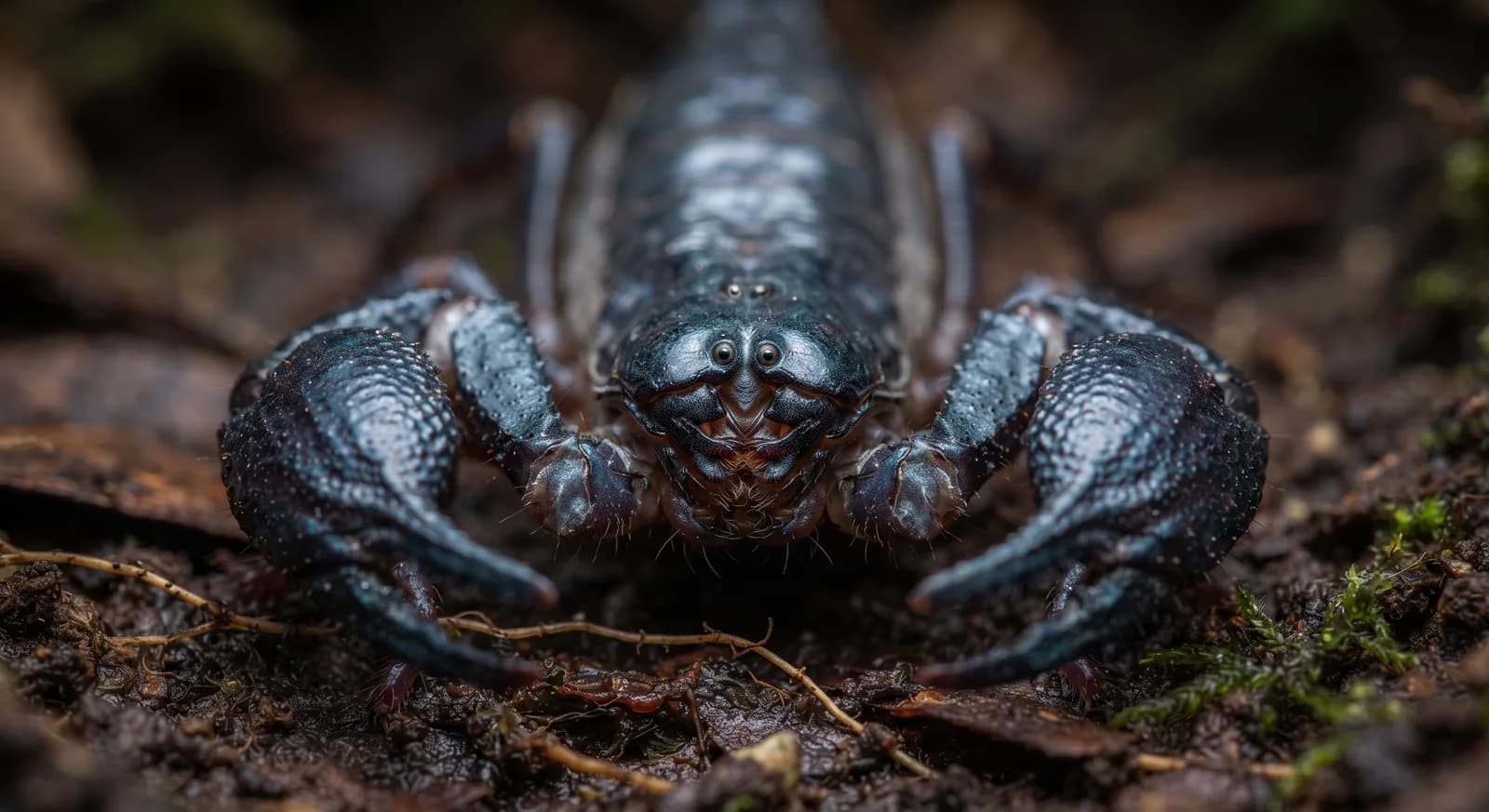
Common Emperor Scorpion (Pandinus imperator)

Arachnids · Scorpiones · Scorpionidae

Common Emperor Scorpion

Pandinus imperator

Not Evaluated

It has not yet been assessed against the IUCN criteria.

Spotted something wrong?

The emperor scorpion is a species of the order Scorpiones belonging to the family Scorpionidae.

Size

15 cm – 20 cm

Life expectancy

8 years

Diet

Carnivore

Feeds mainly on other animals.
Activity

Nocturnal

Active mainly at night.

Social structure

Solitary

Lives and hunts alone, joining others only to breed.

Rainforest
43countries14parks

AI-generated images: illustrations, not photographs.

Fun facts

  • It has been listed in CITES Appendix II since 1995, because demand from the pet trade once meant hundreds of thousands of animals were exported a year.
  • It is one of the few scorpions with any social life: mothers and young may share a burrow, and family groups have been seen hunting together.
  • The females give birth to live white young that climb onto their back, where they stay until the first moult.
  • It is one of the largest scorpions in the world, at up to 20 cm and more than 30 grams, and at the same time one of the least dangerous: its venom is weak and it prefers to crush prey with its enormous pincers rather than use its sting.
  • That contrast illustrates the general rule of scorpions: large pincers and a thin tail indicate little venom, and small pincers with a thick tail indicate the opposite.
  • It is social, which is exceptional: it lives in family groups in which the mother and her young cohabit long after birth and sometimes hunt cooperatively.
  • Its docility and its size have made it the most popular scorpion in the pet trade, and that demand took it onto Appendix II of CITES in 1995.
  • It lives up to eight years, a long time for a terrestrial invertebrate.
  • It detects its prey with the pectines, comb-shaped sensory organs on the underside of the abdomen, which it drags along the ground picking up chemicals and textures.

Life cycle and biology

Skeleton type
Invertebrate - chitin exoskeleton (arachnid)
Habitat and environment
Rainforest and savannah of West Africa; burrows and leaf litter

Sources consulted: Wikipedia (es): Pandinus imperator

Where to find it

Loading map…

Where to see it

Parks and dive sites where this species has been documented — showing 10 of 14.

Related species

Other species in the catalogue with the most in common with Common Emperor Scorpion — same habitat, park, country, tags or family.

Shares a park
Shares a park
Shares a park
Shares a park
Shares a park
Shares a park

Keep exploring

Based on what we already know about common emperor scorpion.

Share an experience, a fun fact or a tip for seeing the common emperor scorpion.
See full glossary
This page in other languages: Español · Deutsch · Français · Português · Italiano

The pins mark the parks where its presence is documented.

See its range on the interactive map→
ComoéCôte d’Ivoire
MoleGhana
KakumGhana
TaïCôte d’Ivoire
Niokolo-KobaSenegal
Sapo National ParkLiberia
Yankari National ParkNigeria
Outamba-Kilimi National ParkSierra Leone
KorupCameroon
Gola RainforestSierra Leone
See all 14 parks
LeopardVulnerable

Leopard

Panthera pardus

Vulnerable

African Dwarf Crocodile

Osteolaemus tetraspis

Critically Endangered

Slender-snouted Crocodile

Mecistops cataphractus

Gaboon ViperNot Evaluated

Gaboon Viper

Bitis gabonica

Giant Slippery FrogEndangered

Giant Slippery Frog

Conraua goliath

Vulnerable

African Golden Cat

Caracal aurata

CountriesNigeria
ParksComoéCôte d’Ivoire
TagsCarnivore
Carnivore
Nocturnal
Solitary
Rainforest
Arachnid
Nigeria
Cameroon
Côte d’Ivoire
Ghana
Sierra Leone
Guinea
Angola
Benin
Botswana
Burkina Faso
Burundi
Cameroon
Central African Republic
Chad
Côte d’Ivoire
Democratic Republic of the Congo
Djibouti
Equatorial Guinea
Eritrea
Eswatini
Ethiopia
Gabon
Gambia
Ghana
Guinea
Guinea-Bissau
Kenya
Lesotho
Liberia
Malawi
Mali
Mauritania
Mozambique
Namibia
Niger
Nigeria
Republic of the Congo
Rwanda
Senegal
Sierra Leone
Somalia
South Africa
South Sudan
Sudan
Tanzania
Togo
Uganda
Zambia
Zimbabwe