One of the 6 terns on WAnimals
Birds · Charadriiformes · Laridae
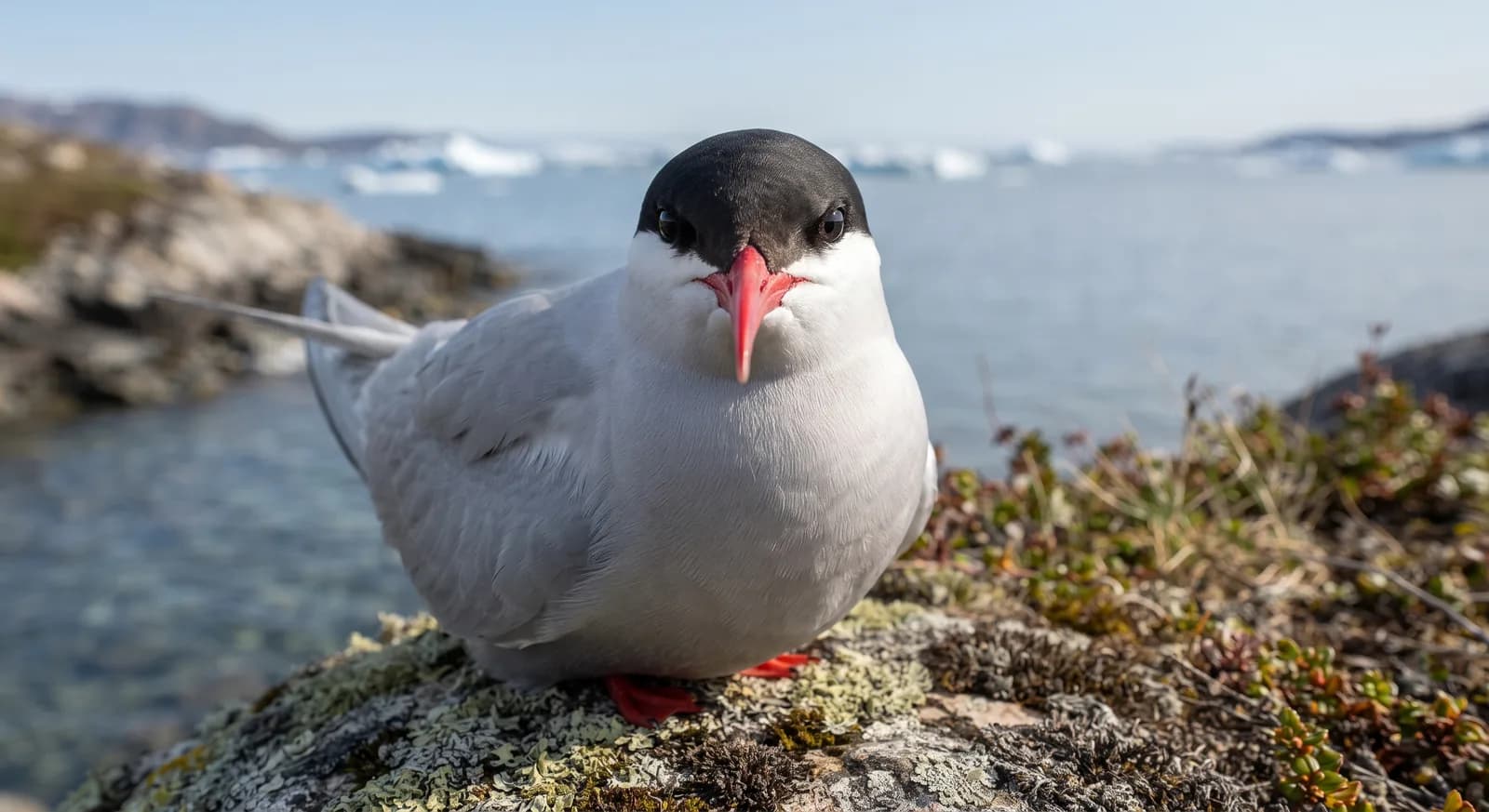
Arctic Tern
Sterna paradisaea
The species is abundant and widely distributed; it faces no significant short-term risk. See full glossary
It makes the longest annual migration known in any animal, travelling pole to pole and so living through two summers a year.
Weight
95 g – 120 g
Size
33 cm – 43 cm
Lifespan
15 years
Diet
Piscivore
Feeds mainly on fish.
Activity
Diurnal
Active mainly during the day.
Social structure
Colony
Lives in large concentrations, often for breeding reasons.
Sighting difficulty
Easy
Fun facts
- GPS tracking studies have shown it can cover up to 90,000 km a year by following favourable wind patterns.
- It eats small fish such as herring and capelin, and crustaceans such as krill.
- It lives on open tundra, boreal forest and rocky coasts of the circumpolar Arctic.
- récordIt makes the longest known migration of any animal: some 90,000 km a year between the Arctic and Antarctica and back.
Life cycle & biology
- Skeleton type
- Vertebrate - pneumatised bony skeleton (bird)
- Habitat & environment
- Open tundra, boreal forest and rocky coasts of the circumpolar Arctic; makes the longest known migration, between the Arctic and Antarctica
- Birth weight
- ~13.1 grams at hatching
- Size at birth
- Covered in down at hatching
- Sexual maturity
- 3-4 years
- Gestation / incubation
- 21-24 days
- Litter / clutch size
- 1 to 3 eggs per clutch (most commonly 2)
Sources consulted: American Oceans; AnAge (genomics.senescence.info); Arctic Portal; Cool Antarctica; NHPBS NatureWorks; Animalia.bio; Animal Diversity Web; Mass.gov; bioRxiv (natal philopatry study)
Where to find it
See its range on the interactive mapWhere to watch it
Parks and dive sites where this species has been documented.
Related species
Other species in the catalogue with the most in common with Arctic Tern — same habitat, park, country, tags or family.
Lesser Black-backed Gull
Larus fuscus
Great Black-backed Gull
Larus marinus
Black-headed Gull
Chroicocephalus ridibundus
Herring Gull
Larus argentatus
Sandwich Tern
Thalasseus sandvicensis
Little Tern
Sternula albifrons
Keep exploring
Based on what we already know about arctic tern.
Comments
Share an experience, a fun fact or a tip for seeing the arctic tern.
Be the first to comment.