One of the 14 salamanders on WAnimals
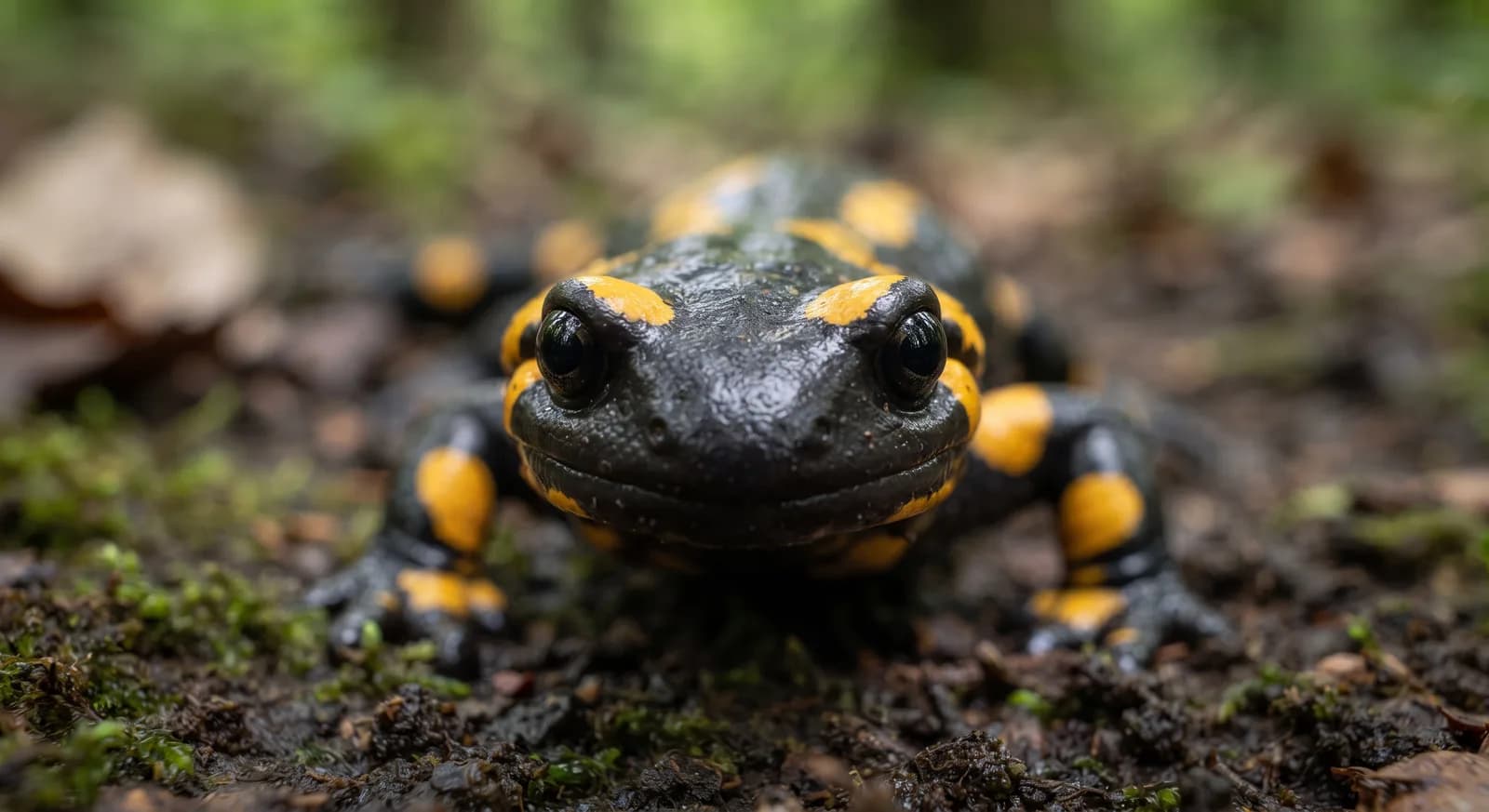
Amphibians · Caudata · Salamandridae
Fire Salamander
Salamandra salamandra
The species is abundant and widely distributed; it faces no significant short-term risk. See full glossary
Unlike most amphibians it is ovoviviparous or viviparous depending on the subspecies: it holds the eggs internally and gives birth to fully formed larvae.
Weight
16 g – 56 g
Size
14 cm – 30 cm
Lifespan
22 years
Diet
Carnivore
Feeds mainly on other animals.
Activity
Nocturnal
Active mainly at night.
Social structure
Solitary
Lives and hunts alone, joining others only to breed.
Sighting difficulty
Easy
Fun facts
- Unlike most amphibians, it holds its eggs internally and gives birth to fully formed larvae.
- Its black and yellow pattern is a warning about the toxins it secretes through its skin.
- It can live for over 50 years in captivity, an exceptional record for an amphibian.
- defensaIt secretes skin toxins that deter most predators; in antiquity it was wrongly believed to survive fire.
- reproducciónIn some Iberian populations the females are viviparous, giving birth to fully formed young rather than laying eggs.
Life cycle & biology
- Skeleton type
- Vertebrate - internal bony skeleton (amphibian)
- Habitat & environment
- Damp shaded woodland close to streams or ponds across central and southern Europe, extending into North Africa and the Near East
- Birth weight
- Born as an aquatic larva after a live birth (the female retains the eggs internally)
- Size at birth
- Born as an aquatic larva
- Sexual maturity
- 2-4 years
- Litter / clutch size
- 10 to 30 live larvae per birth
- Lifespan in captivity
- Documented record of over 50 years in a specimen at the Koenig Museum in Germany
Sources consulted: Amphibienschutz; Animal Diversity Web; Inside Ecology; Animalia.bio; AnAge (genomics.senescence.info); PMC (environmental drivers demography study); Britannica
Where to find it
See its range on the interactive mapWhere to watch it
Parques y spots de buceo donde se ha documentado esta especie — se muestran 10 de 18 documentados.
Related species
Other species in the catalogue with the most in common with Fire Salamander — same habitat, park, country, tags or family.
Great Crested Newt
Triturus cristatus
Palmate Newt
Lissotriton helveticus
Smooth Newt
Lissotriton vulgaris
Bosca's Newt
Lissotriton boscai
Golden-striped Salamander
Chioglossa lusitanica
Marbled Newt
Triturus marmoratus
Keep exploring
Based on what we already know about fire salamander.
Comments
Share an experience, a fun fact or a tip for seeing the fire salamander.
Be the first to comment.