Skip to content
WAnimals
  • Map
  • Species
  • Parks
  • Diving
Log inCreate account
WAnimals

The guide for travellers and animal lovers: discover, plan and share your wild adventures around the world.

Discover wildlife

  • Species
  • Ecosystems
  • Glossary
  • Tags

Explore places

  • Map
  • Countries
  • Parks
  • Diving

Plan experiences

  • Guides

Learn

  • Blog

Resources

  • Help centre
  • Contact
  • Install the app

Follow us

Account

  • Log in
  • Create account

© 2026 WAnimals. All rights reserved.

About usHow we build our profilesTerms of servicePrivacyLegal notice
MapSpeciesParksDiving
  1. Home
  2. Species
  3. Brittlestar

One of the 2 brittlestars on WAnimals

Brittle stars · Amphilepidida · Amphiuridae

Brittlestar

Amphiura filiformis

Not Evaluated

It has not yet been assessed against the IUCN criteria.

Spotted something wrong?

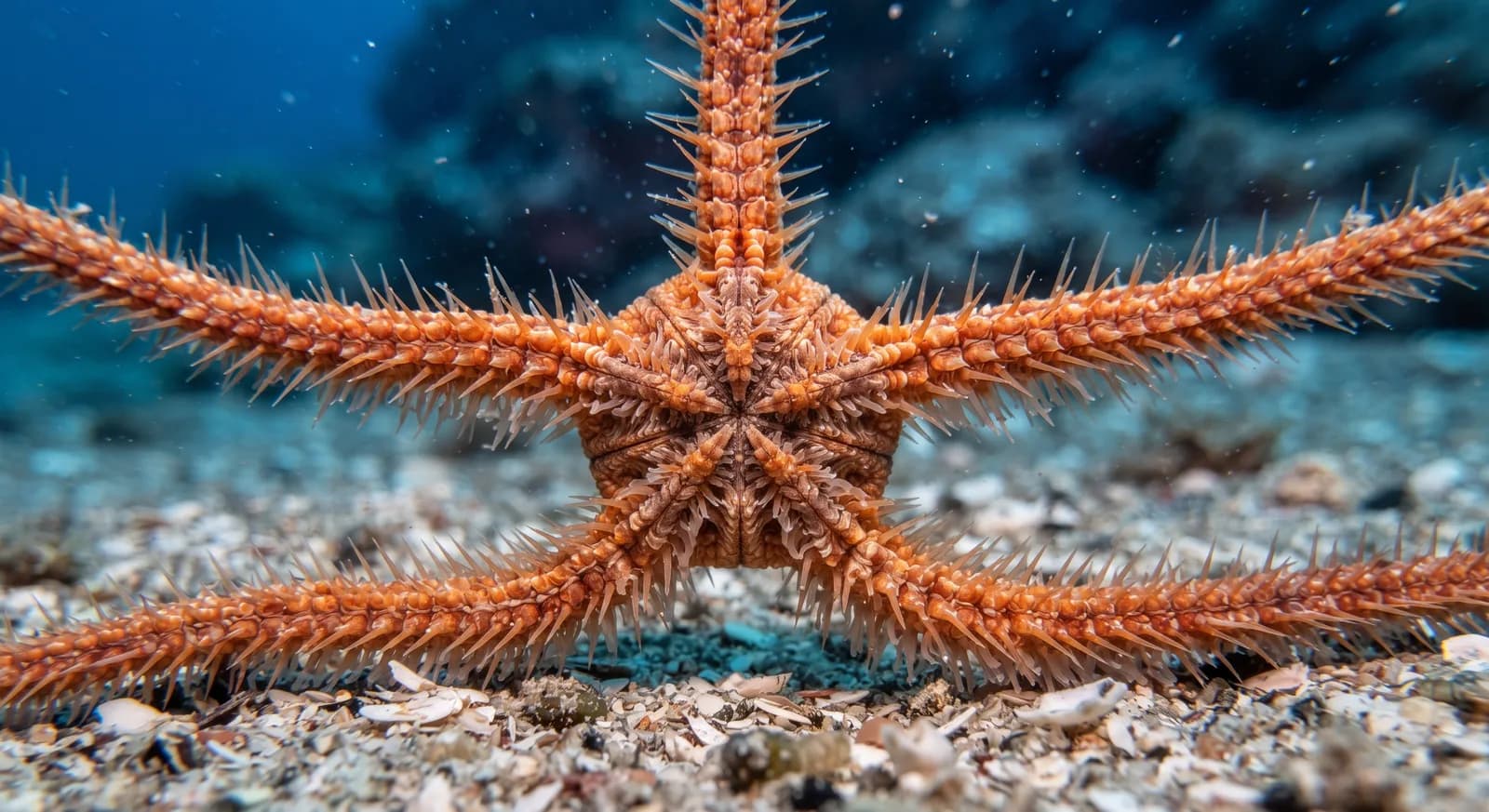
A thread-armed brittle star with a minute disc and extremely fine arms, which lives buried in the mud with its body several centimetres down and only two or three arms protruding and waving in the water to capture particles.

Size

5 cm – 15 cm

Diet

Omnivore

Combines animal and plant food depending on availability.

Social structure

Solitary

Lives and hunts alone, joining others only to breed.

Sighting difficulty

Unknown

Ocean
31countries45parks80dive sites

Fun facts

  • It is one of the animals that contribute most to turning over and oxygenating the muddy bottoms of the north-eastern Atlantic, and its densities can exceed a thousand individuals per square metre.
  • It is bioluminescent: the arms emit blue flashes when something touches them, probably to give the predator away to a larger one.
  • Fish and crustaceans constantly nip off the tips of the arms that protrude, and the brittle star regrows them endlessly; that cycle of loss and regeneration is in itself a pathway of energy transfer to the rest of the community.
  • It lives buried with its disc several centimetres down and extends its arms into the water to capture particles, a way of life straddling the sediment and the water column.
  • It is bioluminescent: the arms flash blue when something touches them, probably to startle a predator or to signal that the arm is expendable.
  • Flatfish eat the arms that protrude, and it regenerates them continuously. That constant production of new tissue makes it one of the most important species in carbon recycling on muddy bottoms.
  • Its burrows bioturbate the sediment and oxygenate deeper layers, which alters the chemistry of the seabed.
  • It is used as a model for studying the effects of ocean acidification on regeneration and calcification.

Life cycle and biology

Skeleton type
Invertebrate - endoskeleton of calcareous plates (echinoderm)
Habitat and environment
Muddy bottoms of the continental shelf, from 5 to 200 m

Sources consulted: O.F. Müller (1776); Wood et al. (2008), Proceedings of the Royal Society B; Marine Life Information Network; ScienceDirect (Hughes 1989); Science Advances, How colonial animals evolve; Wikipedia, Zooid

Where to find it

Loading map…

Where to see it

Parks and dive sites where this species has been documented — showing 20 of 125.

Related species

Other species in the catalogue with the most in common with Brittlestar — same habitat, park, country, tags or family.

Shares a park
Shares a park
Shares a park
Shares a park
Shares a park
Shares a park

Keep exploring

Based on what we already know about brittlestar.

Comments

Share an experience, a fun fact or a tip for seeing the brittlestar.

Be the first to comment.

See full glossary
This page in other languages: Español · Deutsch · Français · Português · Italiano

The pins mark the parks and dive sites where its presence is documented.
See its range on the interactive map→
CalanquesFrance
Cinque TerreItaly
Alonissos and the Northern SporadesGreece
Wadden Sea National ParkDenmark
Majjistral ParkMalta
Wadden SeaGermany
Port-CrosFrance
Pembrokeshire CoastUnited Kingdom
NorthumberlandUnited Kingdom
Cabrera ArchipelagoSpain
Scapa FlowUnited Kingdom
Zenobia WreckCyprus
Medes IslandsSpain
Cap de CreusSpain
Zakynthos (loggerhead turtle)Greece
Kastellorizo (Blue Cave)Greece
Malta (Blue Hole Gozo / Um El Faroud)Malta
Tavolara (Sardinia)Italy
Plemmirio Marine Reserve (Sicily)Italy
Vis Island (wrecks)Croatia
See all 45 parks
See all 80 dive sites
Not Evaluated

Rosy Feather-star

Antedon bifida

Not Evaluated

Orange-footed Sea Cucumber

Cucumaria frondosa

Mediterranean MusselNot Evaluated

Mediterranean Mussel

Mytilus galloprovincialis

Not Evaluated

Chequered Carpet Shell

Ruditapes decussatus

Common BrittlestarNot Evaluated

Common Brittlestar

Ophiothrix fragilis

Not Evaluated

Peacock Worm

Sabella pavonina

CountriesItaly
ParksCalanquesFrance
TagsOmnivore
Omnivore
Colonial
Ocean
Echinoderm

Europe22

Africa5

Asia4

Italy
Spain
Greece
United Kingdom
Croatia
France
Albania
Belgium
Bosnia and Herzegovina
Croatia
Cyprus
Denmark
France
Germany
Greece
Iceland
Ireland
Italy
Malta
Monaco
Montenegro
Netherlands
Norway
Portugal
Slovenia
Spain
Sweden
United Kingdom
Algeria
Egypt
Libya
Morocco
Tunisia
Israel
Lebanon
Syria
Türkiye