Skip to content
WAnimals
  • Map
  • Species
  • Parks
  • Diving
Log inCreate account
WAnimals

The guide for travellers and animal lovers: discover, plan and share your wild adventures around the world.

Discover wildlife

  • Species
  • Ecosystems
  • Glossary
  • Tags

Explore places

  • Map
  • Countries
  • Parks
  • Diving

Plan experiences

  • Guides

Learn

  • Blog

Resources

  • About us
  • How we build our profiles
  • Help centre
  • Contact
  • Install the app

Follow us

Account

  • Log in
  • Create account

© 2026 WAnimals. All rights reserved.

Terms of servicePrivacyCookiesLegal notice
MapSpeciesParksDiving
  1. Home
  2. Species
  3. Brown Centipede

One of the 3 centipedes on WAnimals
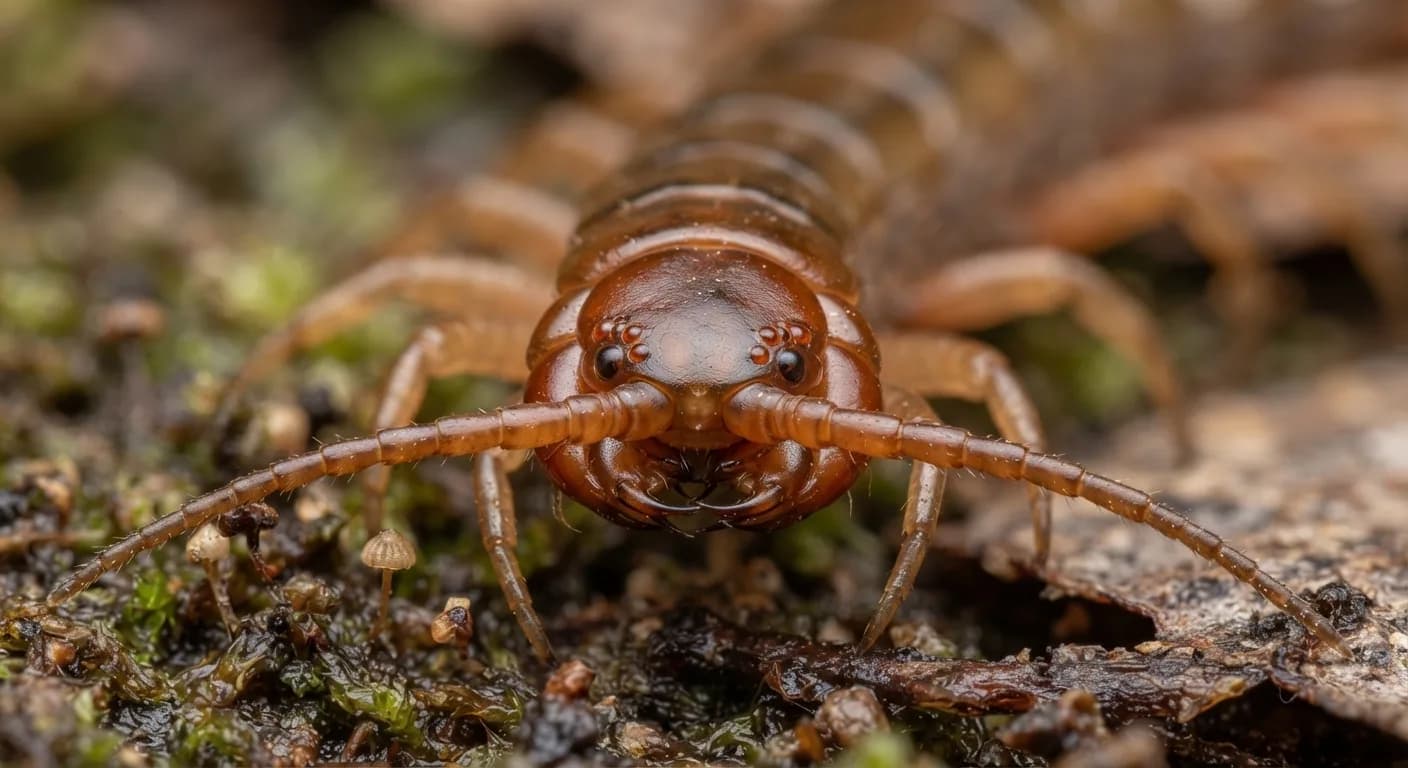
Brown Centipede (Lithobius forficatus)

Centipedes · Lithobiomorpha · Lithobiidae

Brown Centipede

Lithobius forficatus

Not Evaluated

It has not yet been assessed against the IUCN criteria.

Spotted something wrong?

A centipede with an elongated, flattened chestnut-brown body, fifteen pairs of legs and short antennae of 30 to 55 segments. Its hind legs are elongated and project beyond the body like a second pair of antennae, hence the epithet forficatus, "scissor-shaped". The first pair of legs is modified into venomous forcipules.

Size

0.4 cm – 3.2 cm

Life expectancy

6 years

Diet

Carnivore

Feeds mainly on other animals.

Activity

Nocturnal

Active mainly at night.

Social structure

Solitary

Lives and hunts alone, joining others only to breed.

Temperate forest
45countries

AI-generated images: illustrations, not photographs.

Fun facts

  • Its name means literally "life among the stones", from the Greek lithos, stone, and bios, life.
  • It is identified by its reaction on being uncovered: it dashes for cover at full speed, far faster than other large Lithobius.
  • Its bite can barely pierce human skin, but its venomous forcipules are highly effective against spiders, slugs, worms and flies.
  • It is the centipede that turns up under any stone or flowerpot in Europe: reddish brown, fast, and with fifteen pairs of legs.
  • It has neither a thousand legs nor a hundred: lithobiomorph centipedes always have exactly fifteen pairs as adults, and they add them progressively through the juvenile moults.
  • It is a voracious predator of the soil: it eats insects, spiders, earthworms and slugs, and in a vegetable garden it is clearly beneficial.
  • It self-amputates legs to escape and regenerates them over the following moults.
  • Its cuticle has no waxy waterproof layer, so it loses water very quickly and depends on damp refuges; that explains why it is always seen under things and never in full sun.
  • Its bite is harmless to people: its forcipules barely pierce the skin.

Life cycle and biology

Skeleton type
Invertebrate - chitin exoskeleton (myriapod)
Habitat and environment
Upper layers of the soil, especially under stones and rotting logs. It is eurytopic: from damp temperate woodland to urban gardens
Size at birth
It hatches with only seven pairs of legs and adds new segments and pairs at each moult, up to a maximum of fifteen

Sources consulted: Wikipedia (Lithobius forficatus) · Lewis 2006, The Biology of Centipedes · Revista IDE@-SEA nº 32 (Orden Lithobiomorpha) · Woodland Trust · Smithsonian, Animal: The Definitive Visual Guide

Where to find it

Best time: All year round, under stones, rotting logs and leaf litter

Loading map…

Related species

Other species in the catalogue with the most in common with Brown Centipede — same habitat, park, country, tags or family.

Related to
Related to
Related to
Related to
Related to
Related to

Keep exploring

Based on what we already know about brown centipede.

Share an experience, a fun fact or a tip for seeing the brown centipede.
See full glossary
This page in other languages: Español · Deutsch · Français · Português · Italiano
See its range on the interactive map→
Eurasian LynxLeast Concern

Eurasian Lynx

Lynx lynx

WolverineLeast Concern

Wolverine

Gulo gulo

Tawny OwlLeast Concern

Tawny Owl

Strix aluco

Least Concern

Long-eared Owl

Asio otus

Common ToadLeast Concern

Common Toad

Bufo bufo

Least Concern

Common Tree Frog

Hyla arborea

CountriesAlbania
TagsCarnivore
Carnivore
Nocturnal
Solitary
Temperate forest
Myriapod

Europe40

Asia5

Albania
Andorra
Armenia
Austria
Azerbaijan
Belarus
Albania
Andorra
Austria
Belarus
Belgium
Bosnia and Herzegovina
Bulgaria
Croatia
Czechia
Denmark
Estonia
Finland
France
Germany
Greece
Hungary
Ireland
Italy
Kosovo
Latvia
Liechtenstein
Lithuania
Luxembourg
Moldova
Montenegro
Netherlands
North Macedonia
Norway
Poland
Portugal
Romania
San Marino
Serbia
Slovakia
Slovenia
Spain
Sweden
Switzerland
Ukraine
United Kingdom
Armenia
Azerbaijan
Georgia
Russia
Türkiye