Skip to content
WAnimals
  • Map
  • Species
  • Parks
  • Diving
Log inCreate account
WAnimals

The guide for travellers and animal lovers: discover, plan and share your wild adventures around the world.

Discover wildlife

  • Species
  • Ecosystems
  • Glossary
  • Tags

Explore places

  • Map
  • Countries
  • Parks
  • Diving

Plan experiences

  • Guides

Learn

  • Blog

Resources

  • About us
  • How we build our profiles
  • Help centre
  • Contact
  • Install the app

Follow us

Account

  • Log in
  • Create account

© 2026 WAnimals. All rights reserved.

Terms of servicePrivacyCookiesLegal notice
MapSpeciesParksDiving
  1. Home
  2. Species
  3. Cinnamon Sedge

One of the 2 sedges on WAnimals

Insects · Trichoptera · Limnephilidae

Cinnamon Sedge

Limnephilus lunatus

Not Evaluated

It has not yet been assessed against the IUCN criteria.

Spotted something wrong?

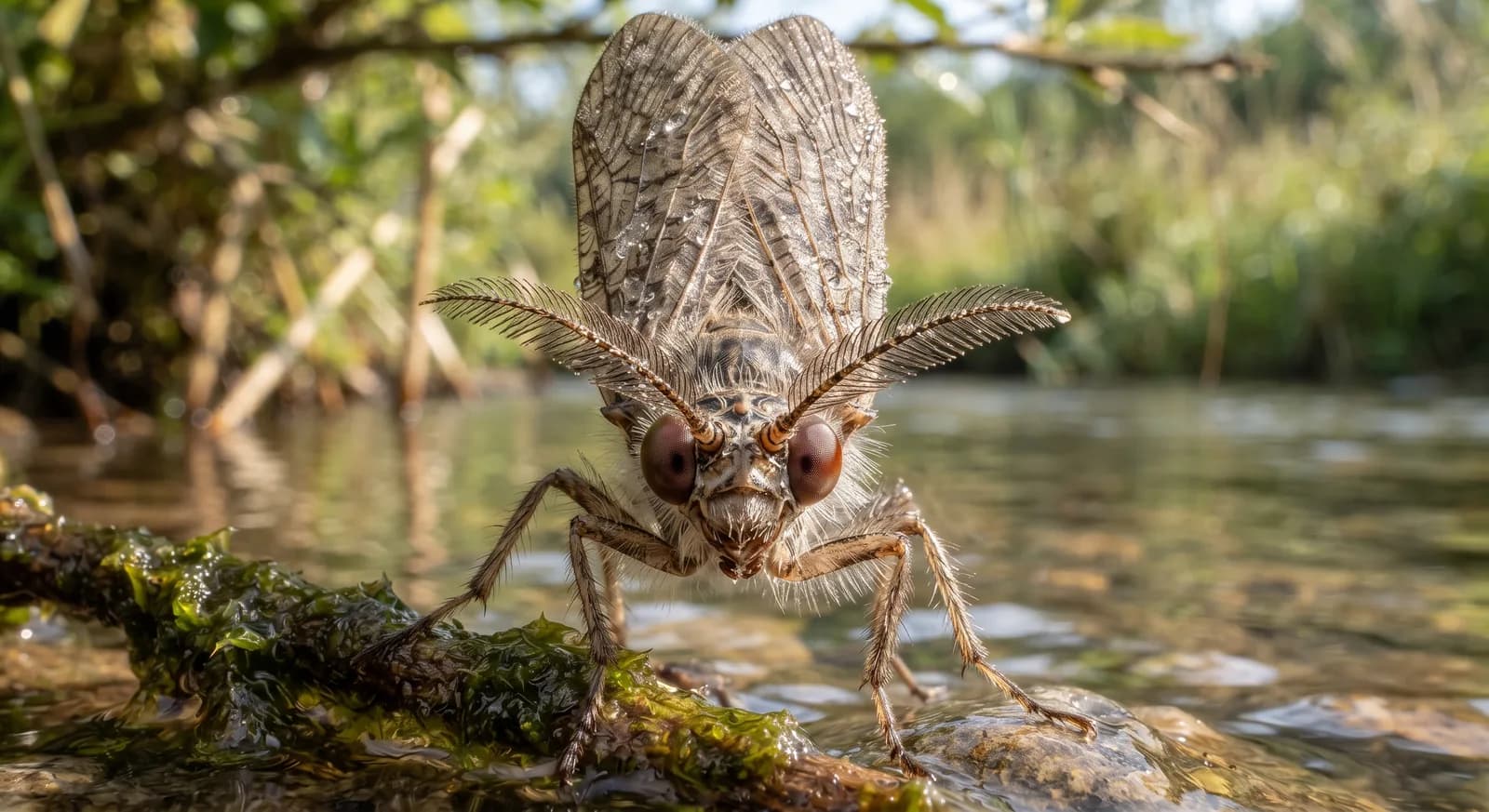
A caddisfly with brown wings bearing a pale crescent-shaped mark on the edge, which at rest it folds tent-like over the body, giving it the look of a small moth. Its larva lives in the water inside a portable case that it builds itself.

Size

1 cm – 1.8 cm

Life expectancy

1 year

Diet

Omnivore

Combines animal and plant food depending on availability.

Activity

Nocturnal

Active mainly at night.

Social structure

Solitary

Lives and hunts alone, joining others only to breed.

Freshwater
40countries

Fun facts

  • The larva weaves a silk tube and coats it with fragments of leaves, stems and grains of sand gathered from the bottom, forming a portable house that it drags along and withdraws into when threatened.
  • A French artist gave caddisfly larvae gold, pearls and precious stones instead of sand, and the larvae built cases from them that are exhibited as works of art.
  • It is an essential decomposer of the leaf litter that falls into rivers and ponds, and a key prey for fish and amphibians.
  • Its larva builds a portable house: a silk tube to which it glues sand grains, shell fragments and little pieces of leaf or stem, and which it drags along with it, with only its head and legs poking out.
  • The silk it produces is silky and adhesive under water, and that underwater glue is being investigated in biomedicine as a model for surgical adhesives that work on moist tissues.
  • The French artist Hubert Duprat exploited this behaviour: he gave the larvae gold and precious stones instead of sand, and they built their cases from those materials. The resulting works are exhibited in museums.
  • The composition of the case depends on what is available, and its shape and weight are tuned to the local current.
  • Caddisflies are the sister group of the moths and butterflies, and share with them the ability to produce silk.
  • It is a staple in the diet of trout, and many artificial fishing flies imitate its larvae and adults.

Life cycle and biology

Skeleton type
Invertebrate - chitin exoskeleton (insect)
Habitat and environment
Ponds, ditches, canals and backwaters with vegetation and submerged leaf litter
Sexual maturity
The adults from permanent waters emerge at different times and enter ovarian diapause before breeding; those from temporary waters have to emerge early, before their habitat dries out
Gestation / incubation
Laying takes place in late summer in a gelatinous mass near the waterline; the larvae hatch when the mass is wetted or as the jelly liquefies, and the pupa lasts two to three weeks
Litter / clutch size
Gelatinous egg masses laid on vegetation overhanging the water; rain triggers hatching and washes the larvae into the water

Sources consulted: Wiggins, Larvae of the North American Caddisfly Genera · Stewart y Wang (2010), Biomacromolecules · Duprat, obra artística documentada · Wildlife Gardening Forum, ficha Caddisflies · NCBI PMC10318372 · NCBI PMC10318372, genoma de Limnephilus lunatus · guias de biologia de tricopteros · ficha de la familia Limnephilidae · Nature Journeys, ficha Crescent Cinnamon Sedge

Where to find it

Best time: Adults on the wing from May to November, mainly at dusk and at night; they come to light traps

Loading map…

Related species

Other species in the catalogue with the most in common with Cinnamon Sedge — same habitat, park, country, tags or family.

Related to
Related to
Related to
Related to
Related to
Related to

Keep exploring

Based on what we already know about cinnamon sedge.
Share an experience, a fun fact or a tip for seeing the cinnamon sedge.
See full glossary
This page in other languages: Español · Deutsch · Français · Português · Italiano
See its range on the interactive map→
TenchLeast Concern

Tench

Tinca tinca

Least Concern

African Catfish

Clarias gariepinus

Vulnerable

Noble Crayfish

Astacus astacus

Great Diving BeetleNot Evaluated

Great Diving Beetle

Dytiscus marginalis

Least Concern

Ruddy Duck

Oxyura jamaicensis

Great Red SedgeNot Evaluated

Great Red Sedge

Phryganea grandis

CountriesAlbania
TagsOmnivore
Omnivore
Nocturnal
Solitary
Insect
Freshwater

Europe39

Asia1

Albania
Andorra
Austria
Belarus
Belgium
Bosnia and Herzegovina
Albania
Andorra
Austria
Belarus
Belgium
Bosnia and Herzegovina
Bulgaria
Croatia
Czechia
Denmark
Estonia
Finland
France
Germany
Greece
Hungary
Ireland
Italy
Latvia
Liechtenstein
Lithuania
Luxembourg
Moldova
Monaco
Montenegro
Netherlands
North Macedonia
Norway
Poland
Portugal
Romania
Serbia
Slovakia
Slovenia
Spain
Sweden
Switzerland
Ukraine
United Kingdom
Russia