Skip to content
WAnimals
  • Map
  • Species
  • Parks
  • Diving
Log inCreate account
WAnimals

The guide for travellers and animal lovers: discover, plan and share your wild adventures around the world.

Discover wildlife

  • Species
  • Ecosystems
  • Glossary
  • Tags

Explore places

  • Map
  • Countries
  • Parks
  • Diving

Plan experiences

  • Guides

Learn

  • Blog

Resources

  • Help centre
  • Contact
  • Install the app

Follow us

Account

  • Log in
  • Create account

© 2026 WAnimals. All rights reserved.

About usHow we build our profilesTerms of servicePrivacyLegal notice
MapSpeciesParksDiving
  1. Home
  2. Species
  3. Great Diving Beetle

One of the 24 beetles on WAnimals
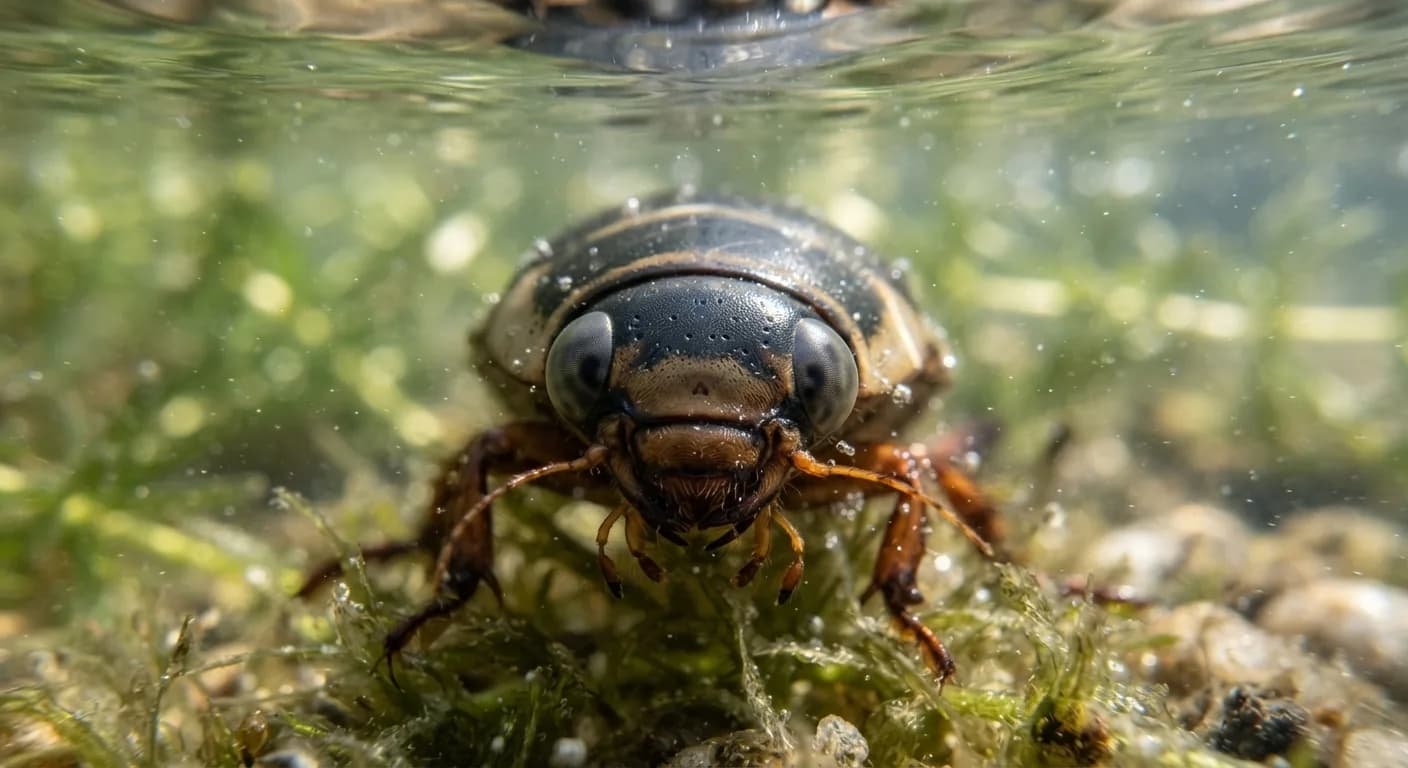
Great Diving Beetle (Dytiscus marginalis)

Insects · Coleoptera · Dytiscidae

Great Diving Beetle

Dytiscus marginalis

Not Evaluated

It has not yet been assessed against the IUCN criteria.

Spotted something wrong?

A large diving beetle of still European waters, with an oval, greenish-black body edged in yellow. It swims by driving itself along with flattened hind legs fringed with hairs, which it moves together like oars. Both the adult and the larva are voracious predators of tadpoles, insects and fish fry.

Size

2.7 cm – 3.5 cm

Life expectancy

2 years

Diet

Carnivore

Feeds mainly on other animals.
Activity

Nocturnal

Active mainly at night.

Social structure

Solitary

Lives and hunts alone, joining others only to breed.

Sighting difficulty

Unknown

Freshwater
45countries140parks

AI-generated images: illustrations, not photographs.

Fun facts

  • fisiologíaIt stores a bubble of air under its wing cases, which lets it breathe underwater for long spells while it hunts small invertebrates.
  • Its larva, known as the water tiger, has hollow jaws with which it injects digestive enzymes into its prey and then sucks out the liquefied tissue.
  • It flies between ponds at night, and sometimes mistakes the gleam of a wet roof or a dark car for the surface of the water.
  • It breathes from a tank. It rises to the surface back first, pokes the tip of its abdomen out and stores a bubble of air beneath its elytra, which serves it both as a reserve and as a physical gill: oxygen from the water diffuses into the bubble while it dives.
  • It is a fearsome predator for its size: it attacks tadpoles, insect larvae and small fish, and can kill prey larger than itself.
  • The larva is even more voracious and is known as the water tiger. It has hollow mandibles through which it injects digestive enzymes and then sucks up the liquefied prey.
  • The male's front legs are fitted with suckers with which it grips the female's back during mating; she usually has grooved elytra, and it has been proposed that those grooves are a counter-adaptation to make this harder.
  • It flies well, mostly at night, and colonises new ponds. It sometimes mistakes shiny surfaces such as car roofs or greenhouses for water and lands on them.

Life cycle and biology

Skeleton type
Invertebrate - chitin exoskeleton (insect)
Habitat and environment
Ponds, pools and still, vegetated backwaters
Size at birth
The larva reaches up to 60 mm, nearly twice the length of the adult
Gestation / incubation
The eggs, inserted one by one into the stems of submerged plants, take 17 to 19 days to hatch; the larva goes through three instars and pupates in damp soil at the water's edge
Litter / clutch size
The eggs are laid one by one into incisions made with the ovipositor in the stems of aquatic plants; in the family Dytiscidae up to 1,000 eggs per female are reported

Sources consulted: Natural History Museum de Londres; Buglife; Bergsten y Miller (2007), PLOS ONE; First Nature; datos de la familia Dytiscidae; First Nature, ficha Dytiscus marginalis; guias de identificacion; EBSCO Research Starters, ficha Great diving beetle; Ficha de especie de Dytiscus marginalis

Where to find it

Best time: The young adults emerge from the pupa in mid-autumn but stay buried until spring; they fly at night and navigate by the moon's reflection on the water

Loading map…

Where to see it

Parks and dive sites where this species has been documented — showing 10 of 140.

Related species

Other species in the catalogue with the most in common with Great Diving Beetle — same habitat, park, country, tags or family.

Shares a park
Shares a park
Shares a park
Shares a park
Shares a park
Shares a park

Keep exploring

Based on what we already know about great diving beetle.

Comments

Share an experience, a fun fact or a tip for seeing the great diving beetle.

Be the first to comment.

See full glossary
This page in other languages: Español · Deutsch · Français · Português · Italiano

The pins mark the parks where its presence is documented.

See its range on the interactive map→
SarekSweden
PadjelantaSweden
HardangerviddaNorway
Lake DistrictUnited Kingdom
CairngormsUnited Kingdom
Snowdonia (Eryri)United Kingdom
KillarneyIreland
Picos de EuropaSpain
Ordesa y Monte PerdidoSpain
Aiguestortes i Estany de Sant MauriciSpain
See all 140 parks
European OtterNear Threatened

European Otter

Lutra lutra

Least Concern

American Bullfrog

Lithobates catesbeianus

Least Concern

Common Tree Frog

Hyla arborea

Great Crested NewtLeast Concern

Great Crested Newt

Triturus cristatus

Least Concern

Smooth Newt

Lissotriton vulgaris

Least Concern

Sharp-ribbed Salamander

Pleurodeles waltl

CountriesSpain
ParksSarekSweden
TagsCarnivore
Carnivore
Nocturnal
Solitary
Insect
Freshwater

Europe40

Asia5

Spain
Sweden
United Kingdom
Finland
Poland
Germany
Albania
Andorra
Austria
Belarus
Belgium
Bosnia and Herzegovina
Bulgaria
Croatia
Czechia
Denmark
Estonia
Finland
France
Germany
Greece
Hungary
Ireland
Italy
Kosovo
Latvia
Liechtenstein
Lithuania
Luxembourg
Moldova
Montenegro
Netherlands
North Macedonia
Norway
Poland
Portugal
Romania
San Marino
Serbia
Slovakia
Slovenia
Spain
Sweden
Switzerland
Ukraine
United Kingdom
Armenia
Azerbaijan
Georgia
Russia
Türkiye