Skip to content
WAnimals
  • Map
  • Species
  • Parks
  • Diving
Log inCreate account
WAnimals

The guide for travellers and animal lovers: discover, plan and share your wild adventures around the world.

Discover wildlife

  • Species
  • Ecosystems
  • Glossary
  • Tags

Explore places

  • Map
  • Countries
  • Parks
  • Diving

Plan experiences

  • Guides

Learn

  • Blog

Resources

  • Help centre
  • Contact
  • Install the app

Follow us

Account

  • Log in
  • Create account

© 2026 WAnimals. All rights reserved.

About usHow we build our profilesTerms of servicePrivacyLegal notice
MapSpeciesParksDiving
  1. Home
  2. Species
  3. Great Crested Newt

One of the 10 newts on WAnimals
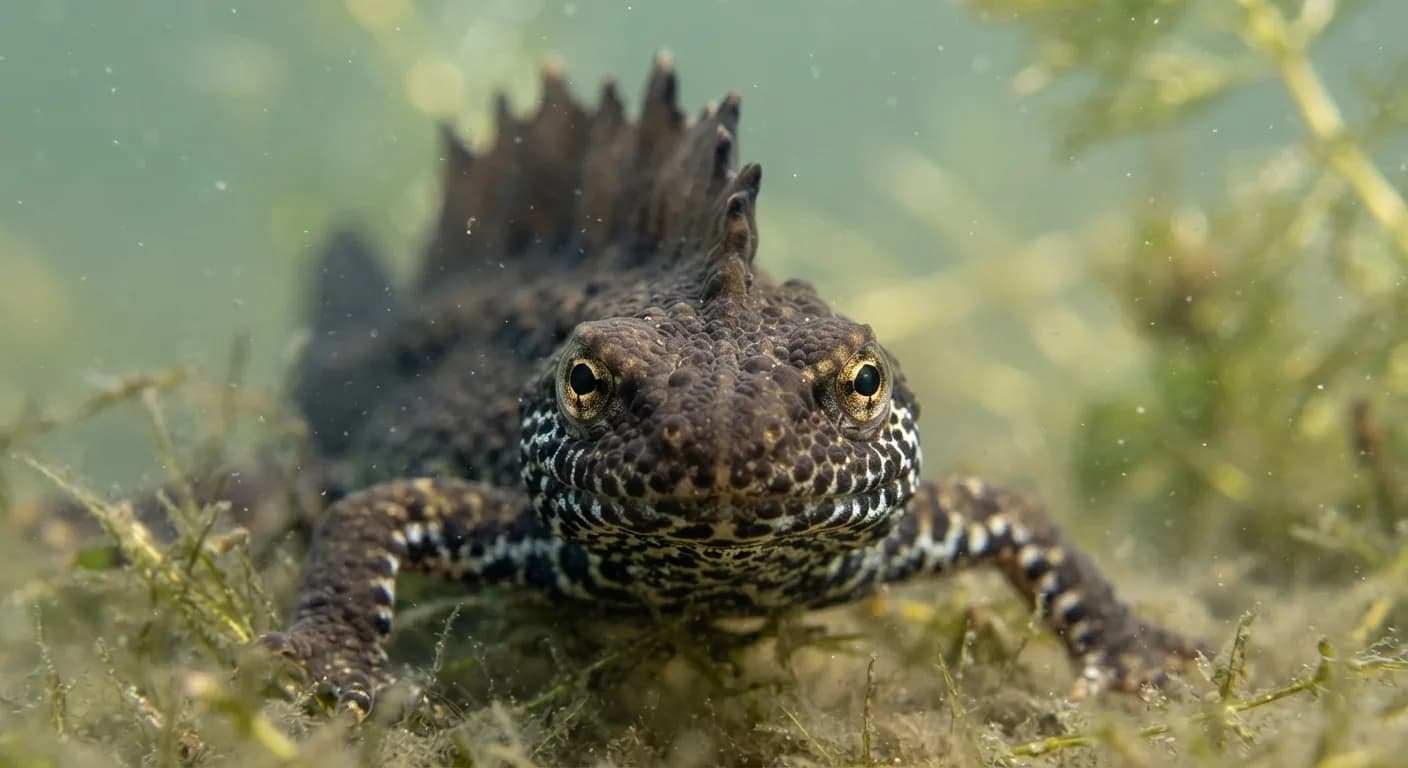
Great Crested Newt (Triturus cristatus)

Amphibians · Caudata · Salamandridae

Great Crested Newt

Triturus cristatus

Least Concern

The species is abundant and widely distributed; it faces no significant short-term risk.

Spotted something wrong?

Males grow a striking jagged crest along the back and tail in the breeding season, used in elaborate courtship displays.

Size

up to 20 cm

Life expectancy

8 years

Diet

Carnivore

Feeds mainly on other animals.
Activity

Nocturnal

Active mainly at night.

Social structure

Solitary

Lives and hunts alone, joining others only to breed.

Sighting difficulty

Easy

Temperate forestFreshwater
45countries50parks13same family

AI-generated images: illustrations, not photographs.

Fun facts

  • Its skin produces a milky, acrid secretion that works as a chemical defence against predators.
  • It eats aquatic invertebrates, tadpoles and even small newts.
  • It is the largest newt in Great Britain, living in large fish-free ponds.
  • In spring the male grows a tall, jagged dorsal crest that gives him the look of a dragon, and with it he performs an elaborate courtship dance in front of the female, fanning pheromones towards her with his tail.
  • There is no contact: the male deposits a spermatophore on the bottom and guides the female to it.
  • The female wraps each egg, one by one, in an aquatic leaf she folds with her hind legs. She can spend weeks doing it.
  • Half of its eggs always die from an inherited chromosomal abnormality that cannot be eliminated: a genetic burden fixed in the species.
  • It is strictly protected throughout the European Union under the Habitats Directive, and in the United Kingdom its presence shapes public works projects.
  • It needs fish-free ponds, because fish prey on its larvae, and that requirement explains much of its decline.

Life cycle and biology

Skeleton type
Vertebrate - internal bony skeleton (amphibian)
Habitat and environment
Large fish-free ponds and the woodland around them in Great Britain, northern and central continental Europe and western Siberia
Birth weight
A tiny larva on hatching, each wrapped in the leaf of a water plant
Size at birth
Tiny at hatching
Sexual maturity
2-4 years (after 1-2 years as a larva)
Gestation / incubation
14-35 days of egg development
Litter / clutch size
~200-225 eggs per female, each wrapped in the leaf of a water plant
Life expectancy in captivity
Documented record of up to 28 years in captivity

Sources consulted: AnAge (genomics.senescence.info); National Geographic; DU Waterscapes; Animalia.bio; EBSCO Research Starters; Kintbury Eco Centre; Wikipedia (Northern crested newt); The Animal Facts; JNCC

Where to find it

Loading map…

Where to see it

Parks and dive sites where this species has been documented — showing 10 of 50.

Related species

Other species in the catalogue with the most in common with Great Crested Newt — same habitat, park, country, tags or family.

Same taxonomic family

Keep exploring

Based on what we already know about great crested newt.

Comments

Share an experience, a fun fact or a tip for seeing the great crested newt.

Be the first to comment.

See full glossary
This page in other languages: Español · Deutsch · Français · Português · Italiano

The pins mark the parks where its presence is documented.

See its range on the interactive map→
BiałowieżaPoland
LahemaaEstonia
Aukštaitija National ParkLithuania
Peak DistrictUnited Kingdom
Šumava (Bohemian Forest)Czechia
Yorkshire DalesUnited Kingdom
NorthumberlandUnited Kingdom
High Veluwe (Hoge Veluwe)Netherlands
Donau-AuenAustria
EifelGermany
See all 50 parks
Least Concern

Palmate Newt

Lissotriton helveticus

Least Concern

Smooth Newt

Lissotriton vulgaris

Fire SalamanderLeast Concern

Fire Salamander

Salamandra salamandra

Least Concern

Marbled Newt

Triturus marmoratus

Least Concern

Sharp-ribbed Salamander

Pleurodeles waltl

Bosca's NewtLeast Concern

Bosca's Newt

Lissotriton boscai

CountriesPoland
ParksBiałowieżaPoland
TagsCarnivore
Carnivore
Nocturnal
Solitary
Amphibian
Temperate forest
Freshwater

Europe40

Asia5

Poland
Germany
Netherlands
United Kingdom
Estonia
Hungary
Albania
Andorra
Austria
Belarus
Belgium
Bosnia and Herzegovina
Bulgaria
Croatia
Czechia
Denmark
Estonia
Finland
France
Germany
Greece
Hungary
Ireland
Italy
Kosovo
Latvia
Liechtenstein
Lithuania
Luxembourg
Moldova
Montenegro
Netherlands
North Macedonia
Norway
Poland
Portugal
Romania
San Marino
Serbia
Slovakia
Slovenia
Spain
Sweden
Switzerland
Ukraine
United Kingdom
Armenia
Azerbaijan
Georgia
Russia
Türkiye