Skip to content
WAnimals
  • Map
  • Species
  • Parks
  • Diving
Log inCreate account
WAnimals

The guide for travellers and animal lovers: discover, plan and share your wild adventures around the world.

Discover wildlife

  • Species
  • Ecosystems
  • Glossary
  • Tags

Explore places

  • Map
  • Countries
  • Parks
  • Diving

Plan experiences

  • Guides

Learn

  • Blog

Resources

  • Help centre
  • Contact
  • Install the app

Follow us

Account

  • Log in
  • Create account

© 2026 WAnimals. All rights reserved.

About usHow we build our profilesTerms of servicePrivacyLegal notice
MapSpeciesParksDiving
  1. Home
  2. Species
  3. Whip-spider
Whip-spider (Damon variegatus)

Arachnids · Amblypygi · Phrynidae

Whip-spider

Damon variegatus

Not Evaluated

It has not yet been assessed against the IUCN criteria.

Spotted something wrong?

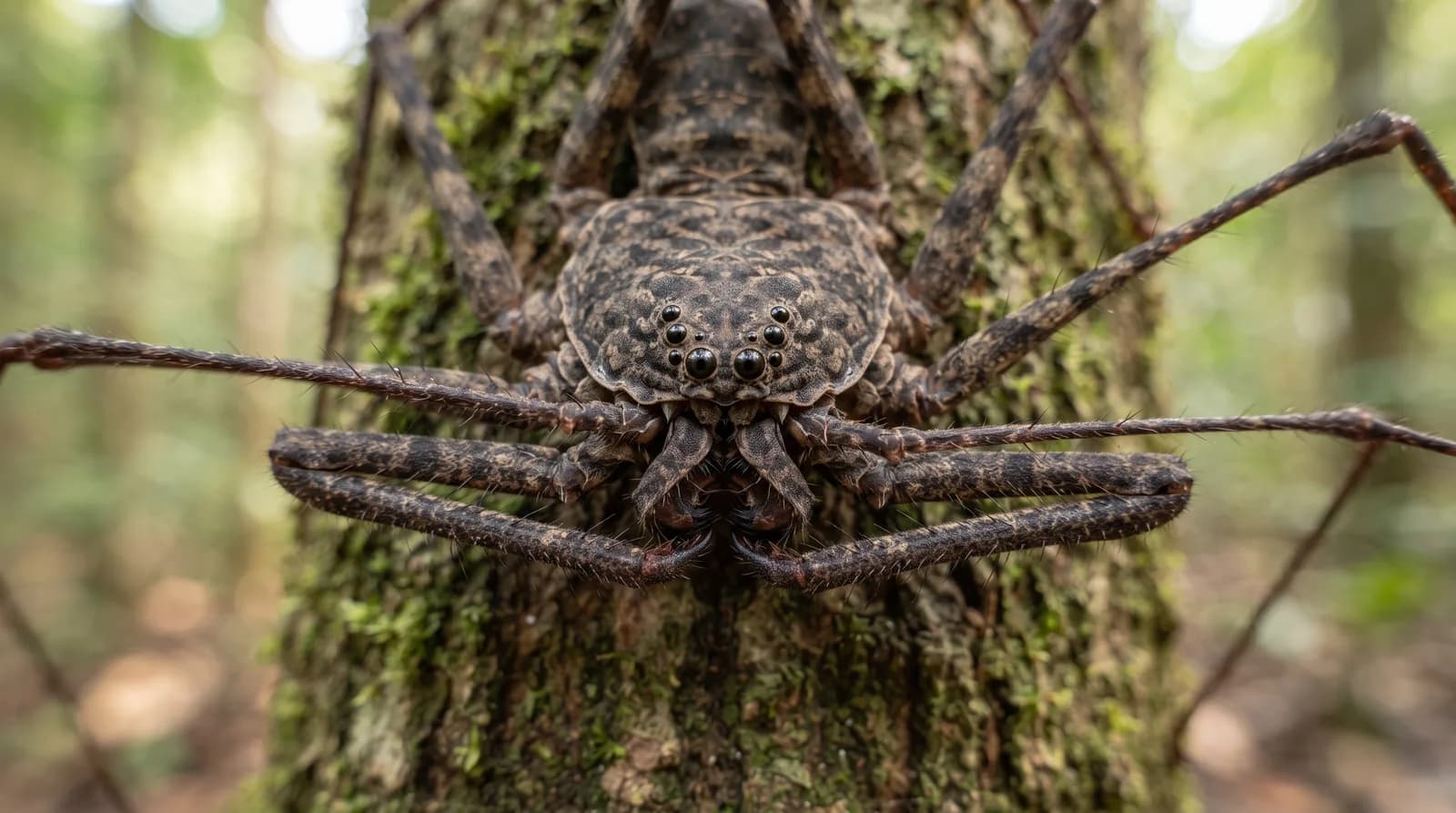
An African whip spider with a flattened body, extremely long legs and two spiny pedipalps with which it seizes its prey. It is neither a spider nor a scorpion: it belongs to an order of its own, with no venom and no silk glands. By day it hides pressed flat into crevices and under bark, and at night it hunts insects.

Size

up to 4.5 cm

Diet

Carnivore

Feeds mainly on other animals.

Activity

Nocturnal
Active mainly at night.

Social structure

Solitary

Lives and hunts alone, joining others only to breed.

Sighting difficulty

Unknown

Savanna
43countries55parks

AI-generated images: illustrations, not photographs.

Fun facts

  • Its first pair of legs is not used for walking: it has become two extremely fine, extremely long feelers with which it probes the ground and locates prey in total darkness.
  • It has no venom and produces no silk, and it is completely harmless to people despite its intimidating appearance.
  • Some species in the group have been shown to recognise their own kind, and the mothers care for the young for weeks.
  • It is neither a spider nor a scorpion: the amblypygids are an order of their own, with no venom, no silk and no tail. They are completely harmless.
  • It walks on six legs. The first pair has been transformed into extremely long, fine feelers, which can span several times the width of the body and which it uses to explore the ground by touch in the dark.
  • Its pedipalps are spiny and raptorial: it thrusts them forward to impale prey and hold it fast.
  • It navigates with those feelers in a surprising way: experiments have shown it can return to its refuge from several metres away in total darkness, guided by chemical and tactile cues, a remarkable navigational ability in an arachnid.
  • It is gregarious and tolerant: several individuals may share the same crevice, and mothers care for their young, which ride on their backs.
  • Its looks have made it famous: it is the species that appears in a Harry Potter film, which sent its presence in the terrarium trade soaring.

Life cycle and biology

Skeleton type
Invertebrate - chitin exoskeleton (arachnid)
Habitat and environment
Rock crevices, bark and caves in savannah and scrub of southern and eastern Africa

Sources consulted: Weygoldt, Whip Spiders: Their Biology, Morphology and Systematics; Hebets et al., trabajos sobre navegación en amblipigios; Universidad de Cornell

Where to find it

Loading map…

Where to see it

Parks and dive sites where this species has been documented — showing 10 of 55.

Related species

Other species in the catalogue with the most in common with Whip-spider — same habitat, park, country, tags or family.

Shares a park
Shares a park
Shares a park
Shares a park
Shares a park
Shares a park

Keep exploring

Based on what we already know about whip-spider.

Comments

Share an experience, a fun fact or a tip for seeing the whip-spider.

Be the first to comment.

See full glossary
This page in other languages: Español · Deutsch · Français · Português · Italiano

The pins mark the parks where its presence is documented.

See its range on the interactive map→
Serengeti National ParkTanzania
Maasai Mara National ReserveKenya
Kruger National ParkSouth Africa
NgorongoroTanzania
AmboseliKenya
TsavoKenya
Lake NakuruKenya
BwindiUganda
VirungaDemocratic Republic of the Congo
GorongosaMozambique
See all 55 parks
African LeopardVulnerable

African Leopard

Panthera pardus pardus

LeopardVulnerable

Leopard

Panthera pardus

Least Concern

Ball Python

Python regius

Puff AdderLeast Concern

Puff Adder

Bitis arietans

Least Concern

Black-necked Spitting Cobra

Naja nigricollis

CaracalLeast Concern

Caracal

Caracal caracal

CountriesTanzania
ParksSerengeti National ParkTanzania
TagsCarnivore
Carnivore
Nocturnal
Solitary
Savanna
Arachnid
Tanzania
Uganda
Kenya
Cameroon
Democratic Republic of the Congo
Gabon
Angola
Benin
Botswana
Burkina Faso
Burundi
Cameroon
Central African Republic
Chad
Côte d’Ivoire
Democratic Republic of the Congo
Djibouti
Equatorial Guinea
Eritrea
Eswatini
Ethiopia
Gabon
Gambia
Ghana
Guinea
Guinea-Bissau
Kenya
Lesotho
Liberia
Malawi
Mali
Mauritania
Mozambique
Namibia
Niger
Nigeria
Republic of the Congo
Rwanda
Senegal
Sierra Leone
Somalia
South Africa
South Sudan
Sudan
Tanzania
Togo
Uganda
Zambia
Zimbabwe