Skip to content
WAnimals
  • Map
  • Species
  • Parks
  • Diving
Log inCreate account
WAnimals

The guide for travellers and animal lovers: discover, plan and share your wild adventures around the world.

Discover wildlife

  • Species
  • Ecosystems
  • Glossary
  • Tags

Explore places

  • Map
  • Countries
  • Parks
  • Diving

Plan experiences

  • Guides

Learn

  • Blog

Resources

  • Help centre
  • Contact
  • Install the app

Follow us

Account

  • Log in
  • Create account

© 2026 WAnimals. All rights reserved.

About usHow we build our profilesTerms of servicePrivacyLegal notice
MapSpeciesParksDiving
  1. Home
  2. Species
  3. Wonder-worm
Wonder-worm (Eunice aphroditois)

Polychaetes · Eunicida · Eunicidae

Wonder-worm

Eunice aphroditois

Not Evaluated

It has not yet been assessed against the IUCN criteria.

Spotted something wrong?

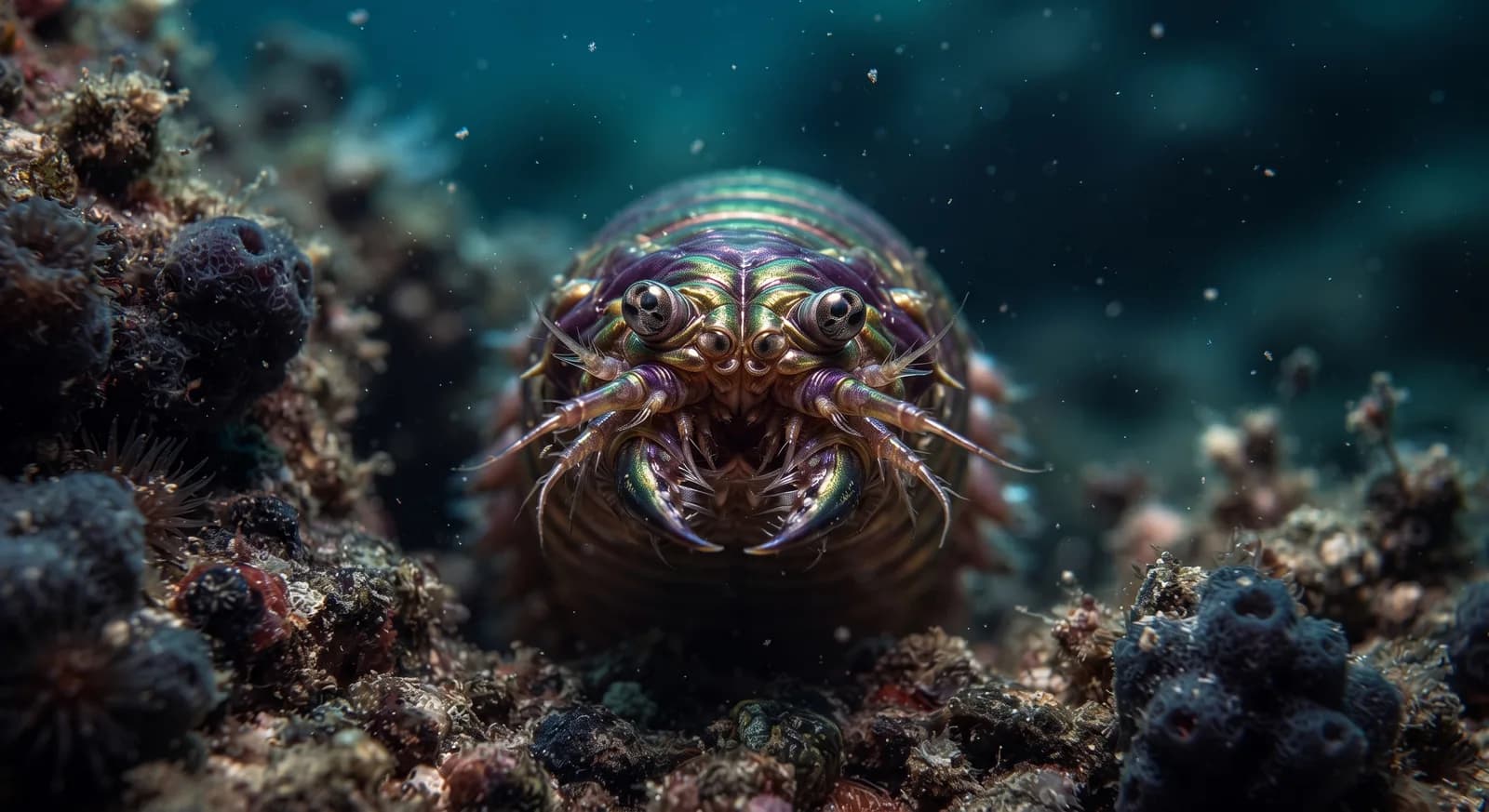
The Bobbit worm, also spelt Bobbitt, or giant reef worm, is a polychaete annelid of the family Eunicidae. It lives on the floor of the Atlantic and the Indo-Pacific, where it buries its body in a bed of sand, gravel, mud or coral, waits patiently for a stimulus on one of its five antennae and strikes when it detects prey. Ranging in size from less than 10 centimetres to some 3 metres long, it is armed with sharp teeth and can strike at such speed that it cuts its prey in two. Although the worm hunts, it is omnivorous.

Size

1 m – 3 m

Diet

Carnivore

Feeds mainly on other animals.
Activity

Nocturnal

Active mainly at night.

Social structure

Solitary

Lives and hunts alone, joining others only to breed.

Sighting difficulty

Unknown

Ocean
61countries35parks161dive sites

AI-generated images: illustrations, not photographs.

Fun facts

  • Its strike is so fast and so powerful that it can cut a prey animal in two, and its common name comes from that reputation rather than from any biological trait.
  • Fossil burrows attributed to similar ambush worms have been found in Miocene rocks in Taiwan, with the same funnel structure that living ones leave behind.
  • In marine aquariums it sometimes turns up with no one knowing how, arriving as a stowaway in live rock, and is discovered when fish start disappearing at night.
  • It is a polychaete worm that can exceed three metres in length, and it lives buried in a burrow from which only its head protrudes.
  • It hunts from ambush with five sensory antennae spread over the sand. When something brushes them, it strikes with extraordinary speed and chitinous jaws capable of cutting a fish in two.
  • It became famous through a real-life case: in 2009, staff at the Newquay aquarium in Cornwall had long been baffled because fish kept disappearing and corals were turning up mutilated. When they dismantled the tank they found a specimen over a metre long that had arrived years earlier hidden in a piece of live rock.
  • Its chaetae, the lateral bristles, have an iridescent sheen that makes it unmistakable.
  • Its reproductive biology and longevity are poorly known, because it is almost impossible to observe in its natural environment.
  • The group's taxonomy is under revision: what is called Eunice aphroditois may correspond to several distinct species.

Life cycle and biology

Skeleton type
Invertebrate - no rigid skeleton (annelid)
Habitat and environment
Sandy, muddy and gravelly bottoms of warm waters, from 10 to 40 m

Sources consulted: https://es.wikipedia.org/wiki/Eunice_aphroditois

Where to find it

Loading map…

Where to see it

Parks and dive sites where this species has been documented — showing 20 of 196.

Related species

Other species in the catalogue with the most in common with Wonder-worm — same habitat, park, country, tags or family.

Shares a park
Shares a park
Shares a park
Shares a park
Shares a park
Shares a park

Keep exploring

Based on what we already know about wonder-worm.

Comments

Share an experience, a fun fact or a tip for seeing the wonder-worm.

Be the first to comment.

See full glossary
This page in other languages: Español · Deutsch · Français · Português · Italiano

The pins mark the parks and dive sites where its presence is documented.

See its range on the interactive map→
KomodoIndonesia
AldabraSeychelles
YakushimaJapan
Ras MohammedEgypt
Great Barrier ReefAustralia
NingalooAustralia
Rock Islands of PalauPalau
East RennellSolomon Islands
FakaravaFrench Polynesia
Mohéli Marine National ParkComoros
Musandam PeninsulaOman
Daymaniyat IslandsOman
Raja AmpatIndonesia
Komodo National ParkIndonesia
Bunaken Marine ParkIndonesia
USAT Liberty (Tulamben)Indonesia
Amed and Jemeluk BayIndonesia
Menjangan Island (Bali Barat)Indonesia
Nusa Penida (Manta Point / Crystal Bay)Indonesia
Lembeh StraitIndonesia
See all 35 parks
See all 161 dive sites
Data Deficient

Flatback

Natator depressus

Saltwater CrocodileLeast Concern

Saltwater Crocodile

Crocodylus porosus

Least Concern

Yellow-bellied Sea Snake

Hydrophis platurus

Red LionfishLeast Concern

Red Lionfish

Pterois volitans

Spot-fin PorcupinefishLeast Concern

Spot-fin Porcupinefish

Diodon hystrix

CoelacanthCritically Endangered

Coelacanth

Latimeria chalumnae

CountriesIndonesia
ParksKomodoIndonesia
TagsCarnivore
Carnivore
Nocturnal
Solitary
Ocean
Worm

Asia26

Oceania20

Africa15

Indonesia
Philippines
Australia
Thailand
Japan
Malaysia
Bahrain
Bangladesh
Brunei
Cambodia
China
India
Indonesia
Iran
Japan
Kuwait
Malaysia
Maldives
Myanmar
Oman
Pakistan
Philippines
Qatar
Saudi Arabia
Singapore
Sri Lanka
Taiwan
Thailand
Timor-Leste
United Arab Emirates
Vietnam
Yemen
American Samoa
Australia
Cook Islands
Fiji
French Polynesia
Guam
Kiribati
Marshall Islands
Micronesia
Nauru
New Caledonia
Niue
Northern Mariana Islands
Palau
Papua New Guinea
Samoa
Solomon Islands
Tonga
Tuvalu
Vanuatu
Comoros
Djibouti
Egypt
Eritrea
Kenya
Madagascar
Mauritius
Mayotte
Mozambique
Réunion
Seychelles
Somalia
South Africa
Sudan
Tanzania