One of the 15 butterflies on WAnimals
Insects · Lepidoptera · Geometridae
Peppered Moth
Biston betularia
It has not yet been assessed against the IUCN criteria. See full glossary
A broad-winged moth with salt-and-pepper mottling over a whitish ground, crossed by fine dark lines, which camouflages it perfectly against lichen-covered bark. There is also an almost entirely black form, the variety carbonaria. The caterpillar, elongated like a twig, mimics the bark of a tree.
Size
6 cm on average
Lifespan
1 years
Diet
Herbivore
Feeds mainly on plants.
Activity
Nocturnal
Active mainly at night.
Social structure
Solitary
Lives and hunts alone, joining others only to breed.
Sighting difficulty
Unknown
Fun facts
- It is the most celebrated example of natural selection observed within a human lifetime: industrial melanism ran its course in about 50 generations. The first dark specimen was caught near Manchester in 1848, and by 1898 dark moths already made up 95% of the local population.
- In 2016 the mutation responsible was identified: a transposable element inserted into a gene, published in Nature.
- The dark form is in retreat today because cleaner air has brought the lichens back to the tree trunks: natural selection working in reverse.
- It is the most-cited example of natural selection in all the textbooks. During the Industrial Revolution, soot darkened the tree trunks of English woodlands and the black form, called carbonaria, went from exceedingly rare to dominant in polluted areas, because birds spotted it less often.
- With the clean air laws of the 20th century the process reversed: the lichens returned, the trunks lightened and the pale form regained ground. It is evolution observed in real time, over a century and a half.
- The genetic cause was identified in 2016: a transposable element, a jumping fragment of DNA, inserted into the first intron of the cortex gene. Statistical analysis places that mutation around 1819, with the Industrial Revolution already under way.
- The caterpillar mimics a twig, and not only in shape: it adopts the posture of a dry branch and can change colour to match the tone of the one it is sitting on.
- There is a third form, insularia, with intermediate patterns, genetically distinct from the other two.
Life cycle & biology
- Skeleton type
- Invertebrate - chitin exoskeleton (insect)
- Habitat & environment
- Floodplains, wetlands and mixed deciduous woodland and their fringes. It also occurs on cultivated or abandoned farmland and even in densely built-up residential areas
- Litter / clutch size
- A single, very drawn-out generation a year. The females lay eggs in great numbers and the newly hatched caterpillars disperse by spinning silk threads on which they let the wind carry them
Sources consulted: Kettlewell 1955, Heredity 9(3); Kettlewell 1973, The Evolution of Melanism; Majerus 2008, Evolution: Education and Outreach 2(1); Van't Hof et al. 2016, Nature 534; Walton et al. 2018, Communications Biology 1; Cook 2003
Where to find it
See its range on the interactive mapBest time: From early May to August
Where to watch it
Parques y spots de buceo donde se ha documentado esta especie — se muestran 10 de 139 documentados.
Related species
Other species in the catalogue with the most in common with Peppered Moth — same habitat, park, country, tags or family.
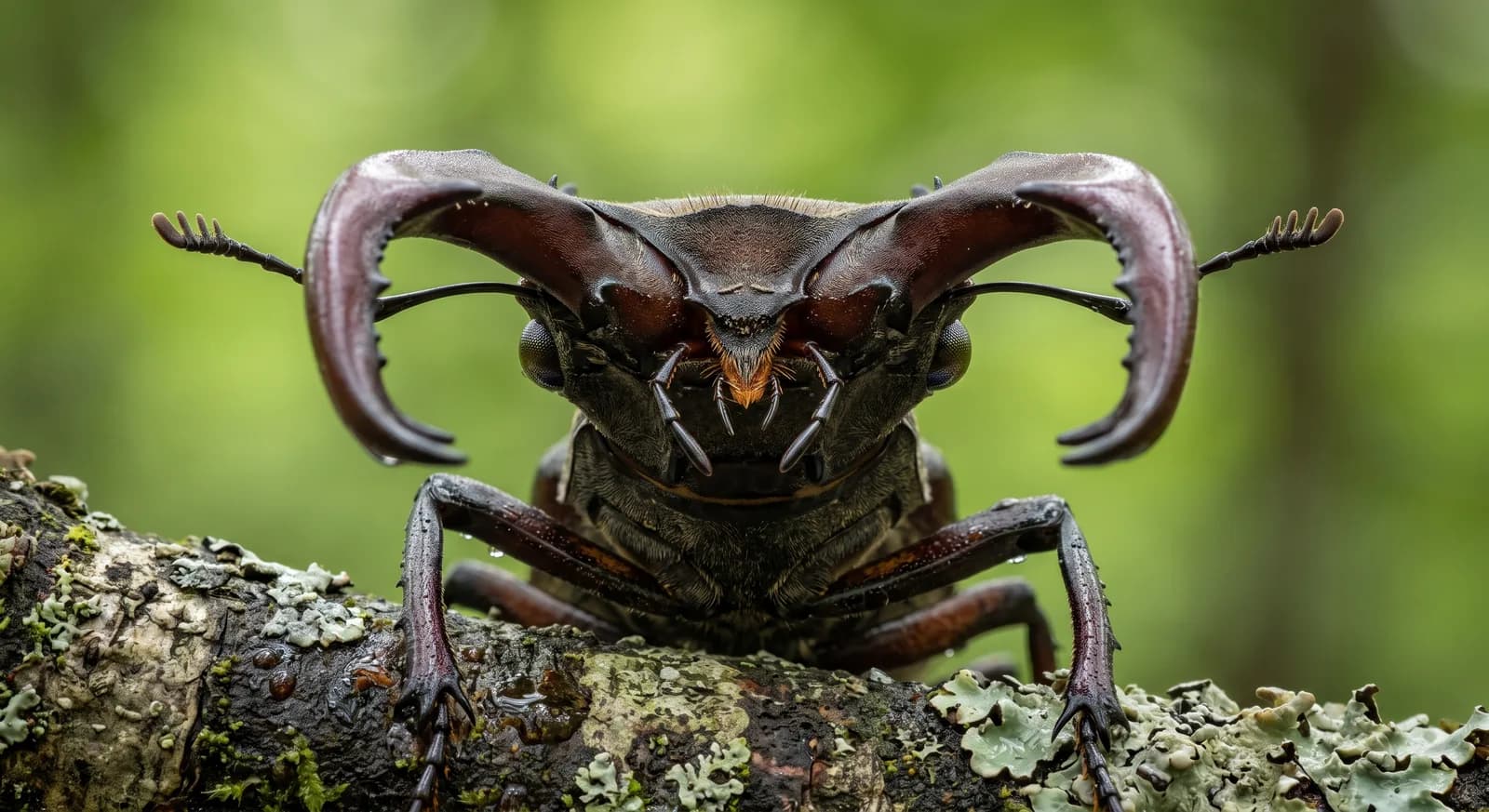 Near Threatened
Stag Beetle
Lucanus cervus
Greater Capricorn Beetle
Cerambyx cerdo
Ant-lion
Myrmeleon formicarius
European Rhinoceros Beetle
Oryctes nasicornis
Pill Millipede
Glomeris marginata
Keep exploring
Based on what we already know about peppered moth.
Comments
Share an experience, a fun fact or a tip for seeing the peppered moth.
Be the first to comment.