Skip to content
WAnimals
  • Map
  • Species
  • Parks
  • Diving
Log inCreate account
WAnimals

The guide for travellers and animal lovers: discover, plan and share your wild adventures around the world.

Discover wildlife

  • Species
  • Ecosystems
  • Glossary
  • Tags

Explore places

  • Map
  • Countries
  • Parks
  • Diving

Plan experiences

  • Guides

Learn

  • Blog

Resources

  • Help centre
  • Contact
  • Install the app

Follow us

Account

  • Log in
  • Create account

© 2026 WAnimals. All rights reserved.

About usHow we build our profilesTerms of servicePrivacyLegal notice
MapSpeciesParksDiving
  1. Home
  2. Species
  3. Common Chiffchaff

One of the 4 chiffchaffs on WAnimals

Birds · Passeriformes · Phylloscopidae

Common Chiffchaff

Phylloscopus collybita

Least Concern

The species is abundant and widely distributed; it faces no significant short-term risk.

Spotted something wrong?

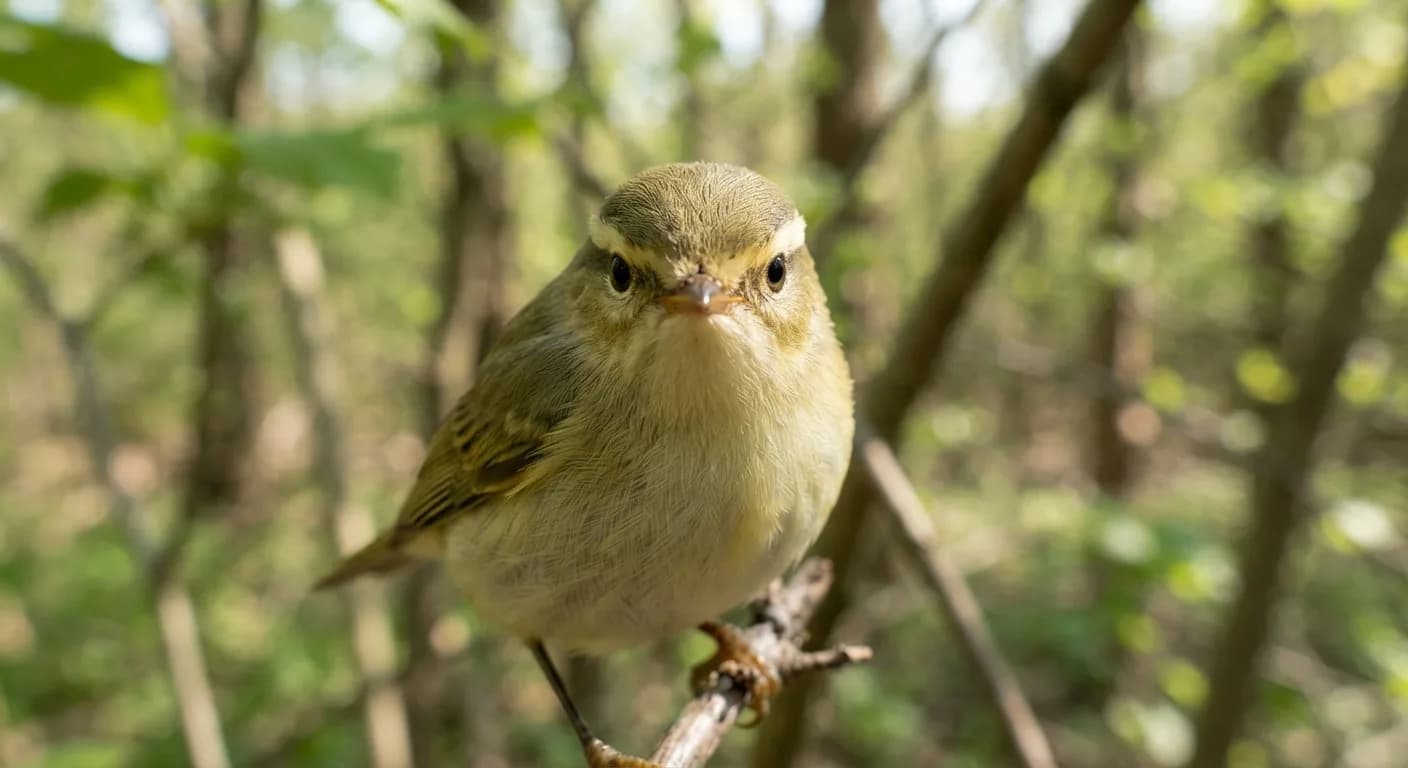
A tiny, very active passerine, olive green on the back and whitish or yellowish below, with a faint pale eyebrow, dark legs and a fine black bill. It is almost identical to the willow warbler and can only be separated with certainty by voice.

Weight

6 g – 9 g

Size

10 cm – 12 cm

Life expectancy

5 years

Diet

Insectivore

Feeds mainly on insects and other invertebrates.

Activity

Diurnal

Active mainly during the day.

Social structure

Solitary

Lives and hunts alone, joining others only to breed.

Sighting difficulty

Easy

Estimated population

The European population is estimated at 30-60 million pairs, one of the commonest species on the continent

45countries261parks3same family

Fun facts

  • Its English name, chiffchaff, reproduces its song literally: a repeated, irregular "chiff-chaff" that is the surest way to identify it.
  • It takes in up to a third of its own weight in insects every day.
  • Ringing has revealed that males and females choose different habitats in winter.

Life cycle and biology

Skeleton type
Vertebrate - internal bony skeleton (bird)
Habitat and environment
Open woodland and wooded and scrubby habitats, often near water. As a breeder it is limited to the Pyrenees, Catalonia, the riverside groves of the northern meseta, the Sistema Central and the Valencian Community; as a winter visitor it occupies the whole peninsula and the Balearics
Size at birth
The chicks hatch altricial and completely helpless
Gestation / incubation
13-15 days, by the female alone. The chicks fledge at 14-16 days
Litter / clutch size
3-9 white eggs, plain or speckled, in a domed nest with a side entrance placed very close to the ground. Two clutches a season between March and July

Sources consulted: SEO/BirdLife (ficha y III Atlas de las aves en época de reproducción en España); IUCN Red List; Asturnatura; III Atlas (ficha mosquitero común); Balmori, Cuesta y Caballero 2002, Ardeola 49(1); Cantos 1992; Clement 2015, Handbook of the Birds of the World Alive; Iberfauna (MNCN-CSIC)

Where to find it

Best time: October to March is when it is most abundant, with the mass arrival of wintering birds from central Europe

Loading map…

Where to see it

Parks and dive sites where this species has been documented — showing 10 of 261.

Related species

Other species in the catalogue with the most in common with Common Chiffchaff — same habitat, park, country, tags or family.

Same taxonomic family
Shares a park
Shares a park
Shares a park
Shares a park

Keep exploring

Based on what we already know about common chiffchaff.

Comments

Share an experience, a fun fact or a tip for seeing the common chiffchaff.

Be the first to comment.

See full glossary
This page in other languages: Español · Deutsch · Français · Português · Italiano

The pins mark the parks where its presence is documented.
See its range on the interactive map→
Doñana National ParkSpain
SarekSweden
PadjelantaSweden
JotunheimenNorway
HardangerviddaNorway
Pallas-YllastunturiFinland
Urho KekkonenFinland
Lake DistrictUnited Kingdom
CairngormsUnited Kingdom
Snowdonia (Eryri)United Kingdom
See all 261 parks
Least Concern

Iberian Chiffchaff

Phylloscopus ibericus

Willow WarblerLeast Concern

Willow Warbler

Phylloscopus trochilus

Least Concern

Common Cuckoo

Cuculus canorus

Least Concern

Sanderling

Calidris alba

Least Concern

European Green Woodpecker

Picus viridis

Eurasian WrenLeast Concern

Eurasian Wren

Troglodytes troglodytes

CountriesSpain
ParksDoñana National ParkSpain
TagsInsectivore
Insectivore
Diurnal
Solitary
Bird

Europe40

Asia5

Spain
Poland
Finland
Italy
Sweden
United Kingdom
Albania
Andorra
Austria
Belarus
Belgium
Bosnia and Herzegovina
Bulgaria
Croatia
Czechia
Denmark
Estonia
Finland
France
Germany
Greece
Hungary
Ireland
Italy
Kosovo
Latvia
Liechtenstein
Lithuania
Luxembourg
Moldova
Montenegro
Netherlands
North Macedonia
Norway
Poland
Portugal
Romania
San Marino
Serbia
Slovakia
Slovenia
Spain
Sweden
Switzerland
Ukraine
United Kingdom
Armenia
Azerbaijan
Georgia
Russia
Türkiye