Skip to content
WAnimals
  • Map
  • Species
  • Parks
  • Diving
Log inCreate account
WAnimals

The guide for travellers and animal lovers: discover, plan and share your wild adventures around the world.

Discover wildlife

  • Species
  • Ecosystems
  • Glossary
  • Tags

Explore places

  • Map
  • Countries
  • Parks
  • Diving

Plan experiences

  • Guides

Learn

  • Blog

Resources

  • About us
  • How we build our profiles
  • Help centre
  • Contact
  • Install the app

Follow us

Account

  • Log in
  • Create account

© 2026 WAnimals. All rights reserved.

Terms of servicePrivacyCookiesLegal notice
MapSpeciesParksDiving
  1. Home
  2. Species
  3. Great Green Bush Cricket

One of the 2 grasshoppers on WAnimals
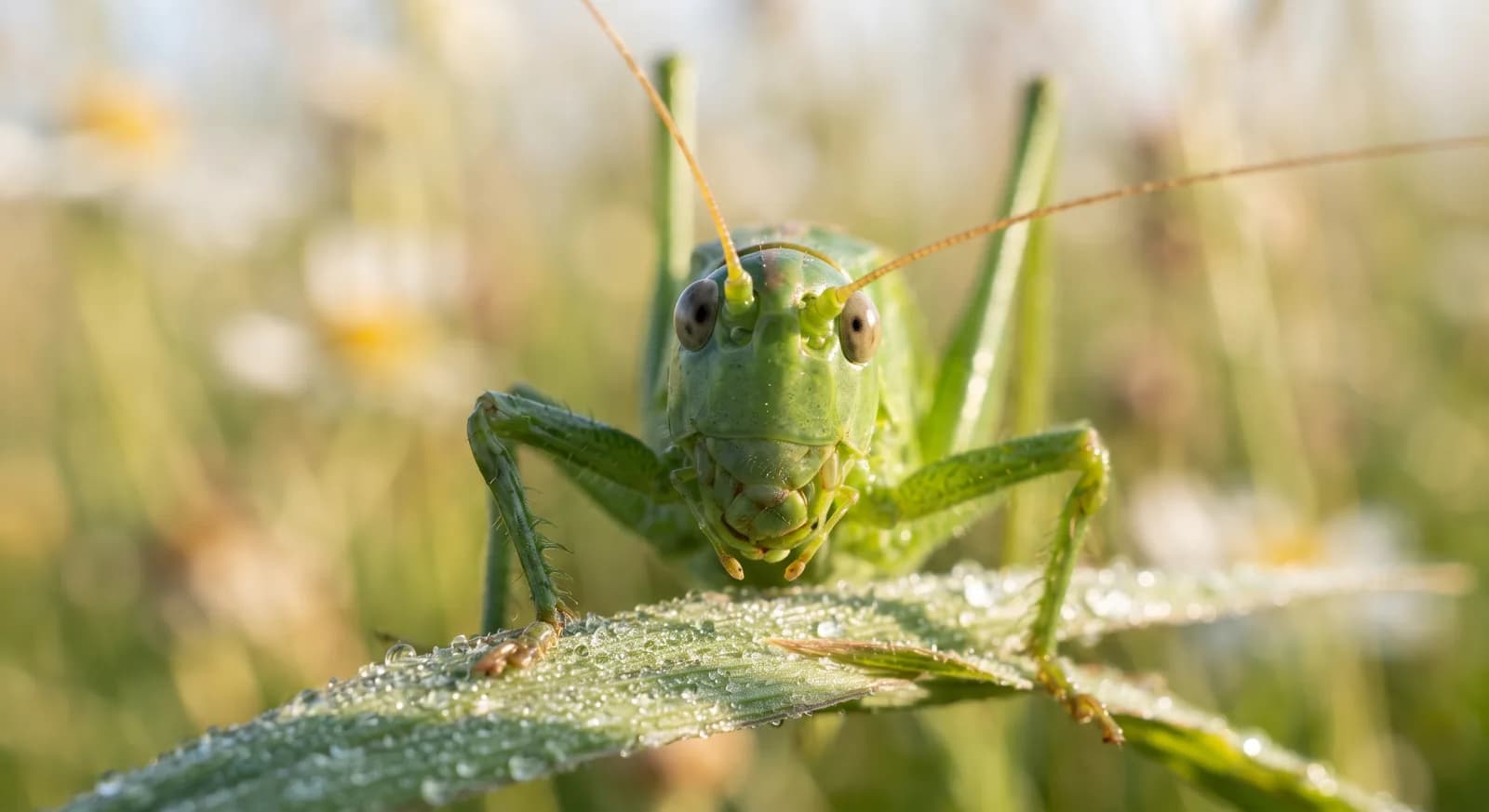
Great Green Bush Cricket (Tettigonia viridissima)

Insects · Orthoptera · Tettigoniidae

Great Green Bush Cricket

Tettigonia viridissima

Not Evaluated

It has not yet been assessed against the IUCN criteria.

Spotted something wrong?

A large green bush-cricket with extremely long antennae, longer than its own body, which identify it as a tettigoniid rather than a true grasshopper. It lives in bramble thickets and tall hedges, is an active predator of other insects, and its song — a continuous, strident churring — carries on for hours at dusk.

Size

2.8 cm – 4.2 cm

Life expectancy

2 years

Diet

Omnivore

Combines animal and plant food depending on availability.
Activity

Nocturnal

Active mainly at night.

Social structure

Solitary

Lives and hunts alone, joining others only to breed.

Grassland
45countries136parks

AI-generated images: illustrations, not photographs.

Fun facts

  • Its ears are on the tibiae of the front legs, in the form of two slits leading to tympanic membranes.
  • Despite looking like a peaceable herbivore, it hunts caterpillars, flies and other insects, and can bite hard if held.
  • The female carries a long, sabre-shaped ovipositor with which she inserts the eggs into the soil, and which is often mistaken for a sting.
  • It is not a grasshopper but a long-horned relative, a tettigoniid, and those extremely fine antennae longer than the body are the trait that separates it from the true grasshoppers.
  • It hears through its legs: its tympanal organs are on the front tibiae, not on the abdomen as in grasshoppers.
  • The male sings by rubbing his forewings together, with a file and a scraper, and his stridulation is a continuous, penetrating buzz that can be heard more than a hundred metres away on summer nights.
  • It is omnivorous and above all predatory: it hunts caterpillars, flies and other insects, and bites hard if handled.
  • The female has a long, curved, sabre-shaped ovipositor with which she inserts her eggs into the soil; it is not a sting and she does not sting.
  • Its eggs can spend more than one winter in diapause before hatching.

Life cycle and biology

Skeleton type
Invertebrate - chitin exoskeleton (insect)
Habitat and environment
Bramble thickets, hedges, tall grassland and field margins
Size at birth
The nymph resembles the adult but without developed wings; after each moult it eats its own cast skin
Gestation / incubation
The female lays in the soil in autumn and the eggs enter diapause; they usually hatch in April after one winter, but the diapause can go on for another one or two years. The nymphs go through 5-7 instars in one or two months
Litter / clutch size
Up to 600 eggs per female, laid one by one by driving a sabre-shaped ovipositor of 23 to 32 mm into the soil

Sources consulted: Ragge y Reynolds, The Songs of the Grasshoppers and Crickets of Western Europe · Buglife · Fauna Ibérica · EBSCO Research Starters, ficha Great green bush cricket · recopilacion de biologia · Recopilacion de biologia de Tettigonia viridissima · Insect Week · Ficha de especie de Tettigonia viridissima · Animalia · Orthoptera & Allied Insects

Where to find it

Best time: Nymphs from April, adults from late June until October; it sings from late afternoon and through the night, with a piercing sound that carries a long way

Loading map…

Where to see it

Parks and dive sites where this species has been documented — showing 10 of 136.

Related species

Other species in the catalogue with the most in common with Great Green Bush Cricket — same habitat, park, country, tags or family.

Shares a park
Shares a park
Shares a park
Shares a park
Shares a park
Shares a park

Keep exploring

Based on what we already know about great green bush cricket.

Share an experience, a fun fact or a tip for seeing the great green bush cricket.
See full glossary
This page in other languages: Español · Deutsch · Français · Português · Italiano

The pins mark the parks where its presence is documented.

See its range on the interactive map→
Lake DistrictUnited Kingdom
CairngormsUnited Kingdom
Snowdonia (Eryri)United Kingdom
KillarneyIreland
Picos de EuropaSpain
Ordesa y Monte PerdidoSpain
Aigüestortes i Estany de Sant MauriciSpain
Peneda-GerêsPortugal
Abruzzo, Lazio and MoliseItaly
Alta MurgiaItaly
See all 136 parks
Critically Endangered

Common Hamster

Cricetus cricetus

Red FoxLeast Concern

Red Fox

Vulpes vulpes

Sacred ScarabNot Evaluated

Sacred Scarab

Scarabaeus sacer

Death's-head Hawk-mothNot Evaluated

Death's-head Hawk-moth

Acherontia atropos

Not Evaluated

Bull-headed Dung Beetle

Onthophagus taurus

Pale Giant HorseflyNot Evaluated

Pale Giant Horsefly

Tabanus bovinus

CountriesSpain
ParksLake DistrictUnited Kingdom
TagsOmnivore
Omnivore
Nocturnal
Solitary
Insect
Grassland

Europe40

Asia5

Spain
Italy
United Kingdom
Poland
Germany
Greece
Albania
Andorra
Austria
Belarus
Belgium
Bosnia and Herzegovina
Bulgaria
Croatia
Czechia
Denmark
Estonia
Finland
France
Germany
Greece
Hungary
Ireland
Italy
Kosovo
Latvia
Liechtenstein
Lithuania
Luxembourg
Moldova
Montenegro
Netherlands
North Macedonia
Norway
Poland
Portugal
Romania
San Marino
Serbia
Slovakia
Slovenia
Spain
Sweden
Switzerland
Ukraine
United Kingdom
Armenia
Azerbaijan
Georgia
Russia
Türkiye