Skip to content
WAnimals
  • Map
  • Species
  • Parks
  • Diving
Log inCreate account
WAnimals

The guide for travellers and animal lovers: discover, plan and share your wild adventures around the world.

Discover wildlife

  • Species
  • Ecosystems
  • Glossary
  • Tags

Explore places

  • Map
  • Countries
  • Parks
  • Diving

Plan experiences

  • Guides

Learn

  • Blog

Resources

  • About us
  • How we build our profiles
  • Help centre
  • Contact
  • Install the app

Follow us

Account

  • Log in
  • Create account

© 2026 WAnimals. All rights reserved.

Terms of servicePrivacyCookiesLegal notice
MapSpeciesParksDiving
  1. Home
  2. Species
  3. Bombardier Beetle

One of the 24 beetles on WAnimals

Insects · Coleoptera · Carabidae

Bombardier Beetle

Brachinus crepitans

Not Evaluated

It has not yet been assessed against the IUCN criteria.

Spotted something wrong?

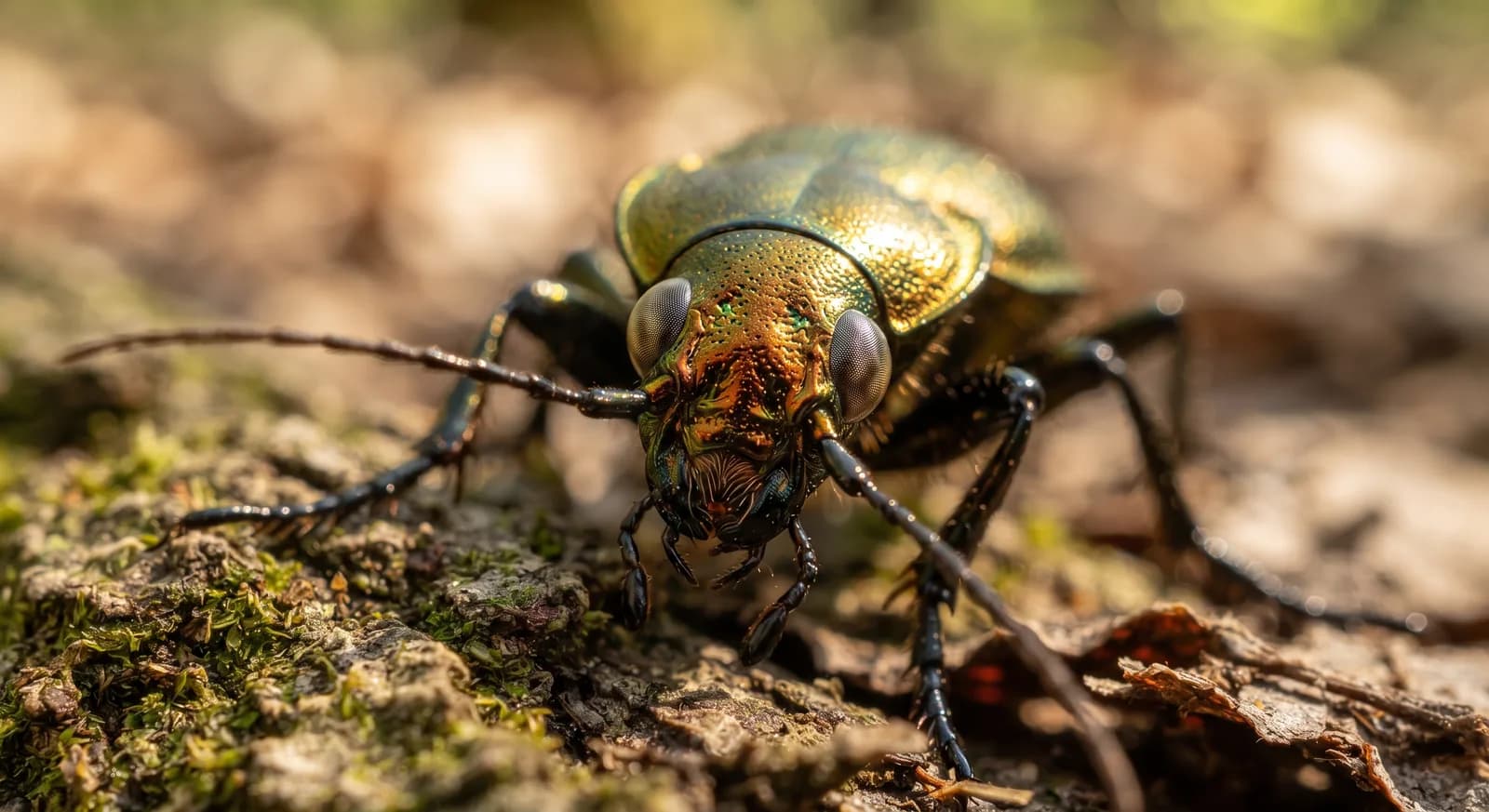
A bombardier beetle with an orange head and legs and bluish elytra, a nocturnal hunter under stones and in cultivated ground. Its defence is one of the most extraordinary in the animal kingdom: it ejects a boiling chemical jet from its abdomen, accompanied by an audible detonation.

Size

0.6 cm – 1 cm

Diet

Carnivore

Feeds mainly on other animals.

Activity

Nocturnal

Active mainly at night.

Social structure

Solitary

Lives and hunts alone, joining others only to breed.

Grassland
40countries1parks1same family

Fun facts

  • GeneralIt fires a chemical jet at 100°C from its abdomen with an audible crack.
  • In an armoured chamber it mixes hydroquinones and hydrogen peroxide with enzymes that set off an explosive reaction, in pulses of hundreds per second.
  • It can swivel the tip of its abdomen and aim the discharge in almost any direction, even forwards by bouncing it off its elytra.
  • Toads have been filmed swallowing a bombardier beetle and vomiting it up alive minutes later: the beetle was still detonating inside the stomach.
  • It is the only animal known to be able to sustain an explosion of hot substances inside its own body.
  • It stores 25% hydrogen peroxide and 10% hydroquinones separately; when they are mixed in a rigid-walled chamber with catalases and peroxidases, the reaction shoots out a jet of benzoquinones at 100 °C.
  • It does not fire a continuous jet but a very rapid series of pulses, and aims the nozzle precisely at the exact point where it is being attacked.
  • Two of the key ingredients, the benzoquinones and the peroxide, are potent cytotoxins: part of the mystery is how it stores them without harming itself.
  • A 2025 study finally identified the enzymes involved and found that glucose is the stable precursor of both the peroxide and the hydroquinone.

Life cycle and biology

Skeleton type
Invertebrate - chitin exoskeleton (insect)
Habitat and environment
Farmland, grassland and under stones on damp soil
Sexual maturity
The larva is an obligate ectoparasitoid of the pupae of other ground beetles, mainly of the genus Amara; the size of the adult depends on the size of the pupa it has consumed
Gestation / incubation
Full post-embryonic development takes about 24 days at 24.7 °C; the third-instar larva attaches to the host pupa and consumes it entirely in about two days
Litter / clutch size
The females lay the eggs in the soil or inside protective mud cells; the first-instar larva actively searches for a host pupa

Sources consulted: Vogel et al. (2025), Royal Society Open Science · Aneshansley y Eisner (1969), Science · Saska & Honek 2004, Journal of Zoology · ficha de especie · Saska & Honek 2004, Journal of Zoology, desarrollo de Brachinus explodens y B. crepitans · Worcestershire Biological Records Centre · ficha de especie de Brachinus crepitans · Saska & Honek, sincronizacion con Amara

Where to find it

Best time: Adults active in spring and summer, under stones and leaf rosettes in dry grassland on limestone; breeding is synchronised with the host's pupation, between June and early July

Loading map…

Where to see it

Parks and dive sites where this species has been documented.

Related species

Other species in the catalogue with the most in common with Bombardier Beetle — same habitat, park, country, tags or family.

Same taxonomic family
Shares a park
Shares a park
Shares a park
Shares a park
Shares a park

Keep exploring

Based on what we already know about bombardier beetle.

Share an experience, a fun fact or a tip for seeing the bombardier beetle.
See full glossary
This page in other languages: Español · Deutsch · Français · Português · Italiano

The pins mark the parks where its presence is documented.
See its range on the interactive map→
Amazonien de GuyaneFrance
Golden Ground BeetleLeast Concern

Golden Ground Beetle

Carabus auratus

Garden TigerNot Evaluated

Garden Tiger

Arctia caja

Not Evaluated

Spanish Festoon

Zerynthia rumina

Not Evaluated

Daddy Long-legs Spider

Pholcus phalangioides

Least Concern

Pale-throated Three-toed Sloth

Bradypus tridactylus

Least Concern

Crimson Topaz

Topaza pella

CountriesFrance
ParksAmazonien de GuyaneFrance
TagsCarnivore
Carnivore
Nocturnal
Solitary
Insect
Grassland

Europe38

Asia2

France
Albania
Austria
Belarus
Belgium
Bosnia and Herzegovina
Albania
Austria
Belarus
Belgium
Bosnia and Herzegovina
Bulgaria
Croatia
Cyprus
Czechia
Denmark
Estonia
Finland
France
Germany
Greece
Hungary
Ireland
Italy
Latvia
Lithuania
Luxembourg
Malta
Moldova
Montenegro
Netherlands
North Macedonia
Norway
Poland
Portugal
Romania
Serbia
Slovakia
Slovenia
Spain
Sweden
Switzerland
Ukraine
United Kingdom
Russia
Türkiye