Skip to content
WAnimals
  • Map
  • Species
  • Parks
  • Diving
Log inCreate account
WAnimals

The guide for travellers and animal lovers: discover, plan and share your wild adventures around the world.

Discover wildlife

  • Species
  • Ecosystems
  • Glossary
  • Tags

Explore places

  • Map
  • Countries
  • Parks
  • Diving

Plan experiences

  • Guides

Learn

  • Blog

Resources

  • Help centre
  • Contact
  • Install the app

Follow us

Account

  • Log in
  • Create account

© 2026 WAnimals. All rights reserved.

About usHow we build our profilesTerms of servicePrivacyLegal notice
MapSpeciesParksDiving
  1. Home
  2. Species
  3. Golden Ground Beetle

One of the 24 beetles on WAnimals
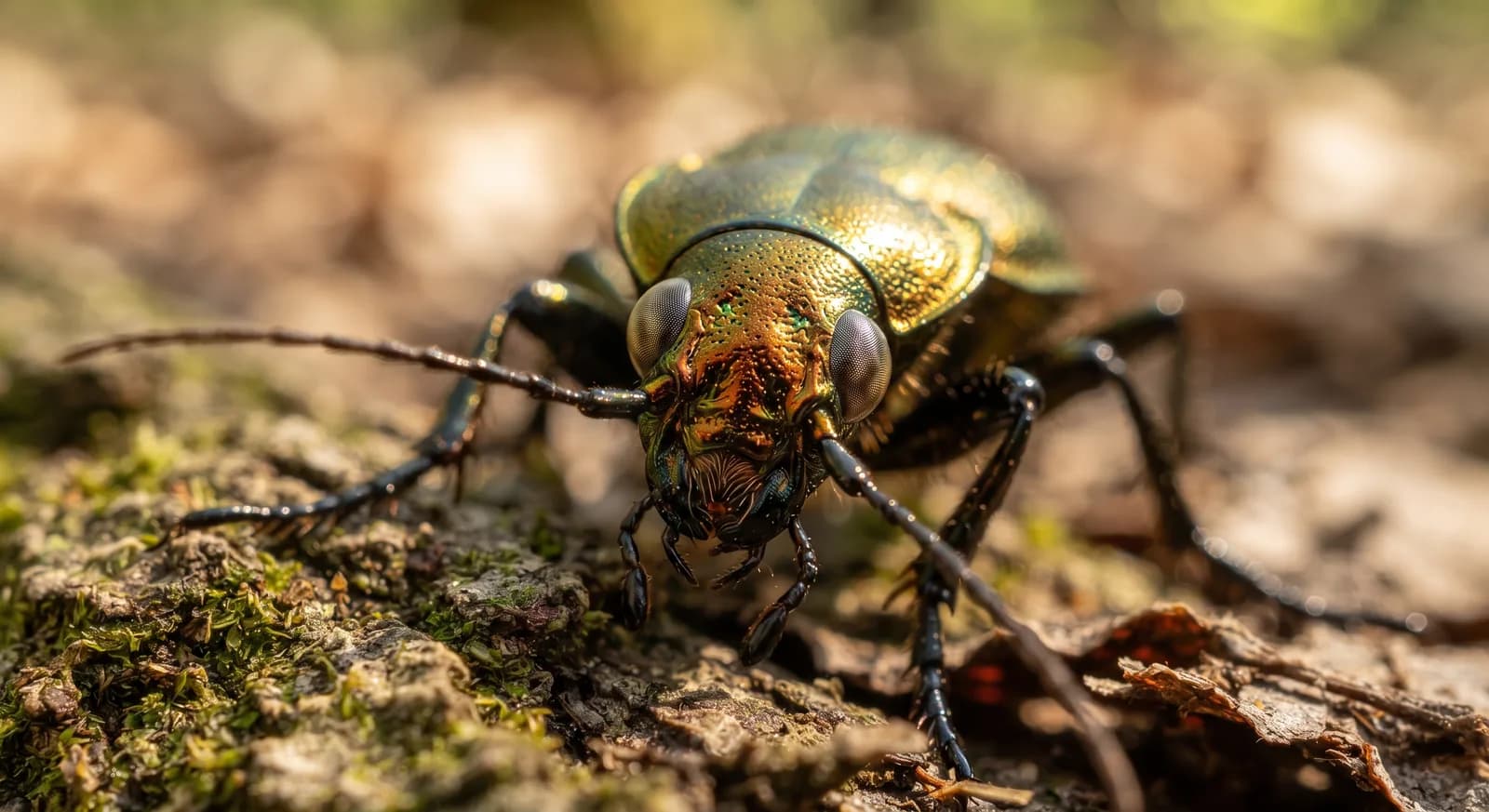
Golden Ground Beetle (Carabus auratus)

Insects · Coleoptera · Carabidae

Golden Ground Beetle

Carabus auratus

Least Concern

The species is abundant and widely distributed; it faces no significant short-term risk.

Spotted something wrong?

It cannot fly — its hind wings are vestigial — so it travels on foot within a radius of up to 70 metres. It can eat its own body weight in slugs and snails in just 24 hours.

Size

1.7 cm – 2 cm

Life expectancy

2 years

Diet

Carnivore

Feeds mainly on other animals.
Activity

Crepuscular

Active mainly at dawn and dusk.

Social structure

Solitary

Lives and hunts alone, joining others only to breed.

Sighting difficulty

Easy

Grassland
46countries164parks1same family

AI-generated images: illustrations, not photographs.

Fun facts

  • It cannot fly: its hind wings are vestigial.
  • It can eat its own weight in slugs and snails in just 24 hours.
  • French farmers historically moved it from field to field for biological pest control.
  • It is one of the few ground beetles with daytime habits: most of its relatives hunt by night.
  • It is a voracious predator of slugs, snails, worms and insect larvae, and in agriculture it is regarded as a valuable ally; its abundance is used as an indicator of soil health in crops.
  • It digests outside its body: it vomits enzymes onto its prey, liquefies it and sucks up the result.
  • It does not fly: like many Carabus, it has fused elytra and atrophied wings, which makes it highly sensitive to landscape fragmentation, because it cannot cross barriers.
  • Its metallic gold is also structural colour.
  • It is sensitive to insecticides and to intensive tillage, and its populations have fallen in areas of industrial agriculture.

Life cycle and biology

Skeleton type
Invertebrate - chitin exoskeleton (insect)
Habitat and environment
Open fields, hedgerows and gardens on clay or loam soils of central and western Europe, introduced to North America
Birth weight
Eggs laid singly or in small groups on damp ground
Size at birth
A black, long, slender larva, active mainly at dawn and dusk
Sexual maturity
Reached once metamorphosis is complete (no fixed age applies; the adults breed in their first spring after hibernating)
Gestation / incubation
A larval stage through spring and summer, with 3 instars before pupating in late summer
Litter / clutch size
Up to 50 eggs per female

Sources consulted: Entomologist.net; Animalia.bio; Biocommunication Group; SummitPost; Encyclopedia of Life; iNaturalist; Plantiary; Wikipedia (Carabus auratus, español)

Where to find it

Loading map…

Where to see it

Parks and dive sites where this species has been documented — showing 10 of 164.

Related species

Other species in the catalogue with the most in common with Golden Ground Beetle — same habitat, park, country, tags or family.

Shares a park
Shares a park
Shares a park
Shares a park
Shares a park
Same taxonomic family

Keep exploring

Based on what we already know about golden ground beetle.

Comments

Share an experience, a fun fact or a tip for seeing the golden ground beetle.

Be the first to comment.

See full glossary
This page in other languages: Español · Deutsch · Français · Português · Italiano

The pins mark the parks where its presence is documented.

See its range on the interactive map→
Lake DistrictUnited Kingdom
CairngormsUnited Kingdom
Snowdonia (Eryri)United Kingdom
KillarneyIreland
Swiss National ParkSwitzerland
Gran ParadisoItaly
VanoiseFrance
Hohe TauernAustria
BerchtesgadenGermany
Stelvio (Stilfserjoch)Italy
See all 164 parks
Least Concern

Little Owl

Athene noctua

Praying MantisLeast Concern

Praying Mantis

Mantis religiosa

Least Concern

Conehead Mantis

Empusa pennata

Least Concern

Nose-horned Viper

Vipera ammodytes

Green Tiger BeetleLeast Concern

Green Tiger Beetle

Cicindela campestris

Not Evaluated

Bombadier Beetle

Brachinus crepitans

CountriesSpain
ParksLake DistrictUnited Kingdom
TagsCarnivore
Carnivore
Crepuscular
Solitary
Insect
Grassland

Europe40

Asia5

North America1

Spain
Italy
Poland
United Kingdom
Germany
Greece
Albania
Andorra
Austria
Belarus
Belgium
Bosnia and Herzegovina
Bulgaria
Croatia
Czechia
Denmark
Estonia
Finland
France
Germany
Greece
Hungary
Ireland
Italy
Kosovo
Latvia
Liechtenstein
Lithuania
Luxembourg
Moldova
Montenegro
Netherlands
North Macedonia
Norway
Poland
Portugal
Romania
San Marino
Serbia
Slovakia
Slovenia
Spain
Sweden
Switzerland
Ukraine
United Kingdom
Armenia
Azerbaijan
Georgia
Russia
Türkiye
Canada