Skip to content
WAnimals
  • Map
  • Species
  • Parks
  • Diving
Log inCreate account
WAnimals

The guide for travellers and animal lovers: discover, plan and share your wild adventures around the world.

Discover wildlife

  • Species
  • Ecosystems
  • Glossary
  • Tags

Explore places

  • Map
  • Countries
  • Parks
  • Diving

Plan experiences

  • Guides

Learn

  • Blog

Resources

  • Help centre
  • Contact
  • Install the app

Follow us

Account

  • Log in
  • Create account

© 2026 WAnimals. All rights reserved.

About usHow we build our profilesTerms of servicePrivacyLegal notice
MapSpeciesParksDiving
  1. Home
  2. Species
  3. Garden Tiger

One of the 15 butterflies on WAnimals
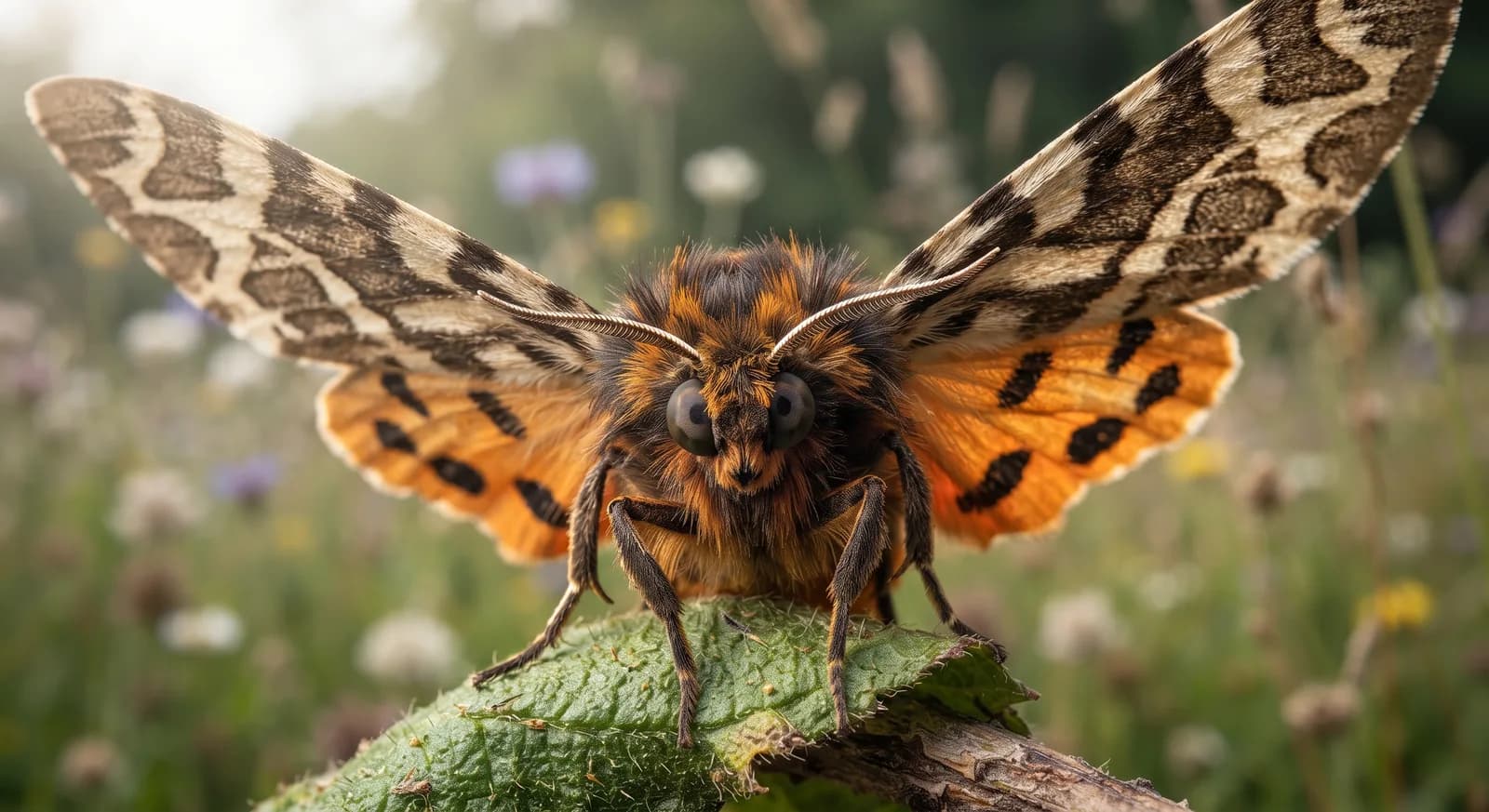
Garden Tiger (Arctia caja)

Insects · Lepidoptera · Erebidae

Garden Tiger

Arctia caja

Not Evaluated

It has not yet been assessed against the IUCN criteria.

Spotted something wrong?

The garden tiger is a brightly coloured ditrysian lepidopteran of the family Erebidae, found throughout Europe.

Size

4.5 cm – 6.5 cm

Life expectancy

1 year

Diet

Herbivore

Feeds mainly on plants.
Activity

Nocturnal

Active mainly at night.

Social structure

Solitary

Lives and hunts alone, joining others only to breed.

Sighting difficulty

Unknown

Grassland
60countries16parks2same family

AI-generated images: illustrations, not photographs.

Fun facts

  • When disturbed it flicks open its forewings to show the red hindwings, a warning flash accompanied by the secretion of a toxic fluid from the back of the neck.
  • Its populations have fallen by more than 90% in the United Kingdom since the 1980s, a decline documented by light-trap monitoring that has become one of the most cited examples of the collapse of European insects.
  • Its caterpillar is polyphagous, feeding on nettles, dandelions, brambles and dozens of other plants, which makes its decline all the more puzzling.
  • It is a textbook example of double aposematism: the forewings, marbled in brown and cream, camouflage the moth at rest, but when disturbed it opens them and reveals red hindwings with black spots.
  • And the warning is real: it accumulates toxic compounds from the plants it eats as a caterpillar, and it also secretes a yellow fluid from its thorax when attacked.
  • It also emits ultrasonic clicks that interfere with the sonar of bats, a mechanism shared by several arctiid moths.
  • The caterpillar, very hairy with long brown and black hairs, is popularly known as the woolly bear; its hairs cause skin irritation in some people.
  • Its populations have fallen sharply in the United Kingdom and other northern European countries since the 1980s, and the decline is linked to milder, wetter winters.

Life cycle and biology

Skeleton type
Invertebrate - chitin exoskeleton (insect)
Habitat and environment
Meadows, gardens, verges and woodland edges of Europe and temperate Asia
Size at birth
The caterpillar overwinters when it measures about 15 mm and reaches about 60 mm when fully grown
Sexual maturity
The adults emerge in June or July and fly at night; the male detects pheromones with bipectinate antennae
Gestation / incubation
The eggs hatch in about ten days; the caterpillar feeds for a few months, overwinters and resumes feeding in spring before pupating
Litter / clutch size
Clutches of 50 or more eggs on the leaves of a variety of herbaceous plants

Sources consulted: https://es.wikipedia.org/wiki/Arctia_caja; Wildlife Insight, ficha Garden Tiger moth; ficha de especie de Arctia caja; UKmoths; UKmoths, ficha Garden Tiger; Wildlife Insight

Where to find it

Best time: Adults on the wing at night in July and August, drawn to light; the caterpillars are easiest to see in autumn and early spring

Loading map…

Where to see it

Parks and dive sites where this species has been documented — showing 10 of 16.

Related species

Other species in the catalogue with the most in common with Garden Tiger — same habitat, park, country, tags or family.

Shares a park
Shares a park
Shares a park
Shares a park
Shares a park
Shares a park

Keep exploring

Based on what we already know about garden tiger.

Comments

Share an experience, a fun fact or a tip for seeing the garden tiger.

Be the first to comment.

See full glossary
This page in other languages: Español · Deutsch · Français · Português · Italiano

The pins mark the parks where its presence is documented.

See its range on the interactive map→
EvergladesUnited States
Big BendUnited States
Channel IslandsUnited States
Point PeleeCanada
VoyageursUnited States
Isle RoyaleUnited States
CongareeUnited States
Cuyahoga ValleyUnited States
Indiana DunesUnited States
Apostle IslandsUnited States
See all 16 parks
Least Concern

Ord's Kangaroo Rat

Dipodomys ordii

Least Concern

Hispid Cotton Rat

Sigmodon hispidus

Carolina SphinxNot Evaluated

Carolina Sphinx

Manduca sexta

Not Evaluated

Bombadier Beetle

Brachinus crepitans

Not Evaluated

Spanish Festoon

Zerynthia rumina

Black-tailed JackrabbitLeast Concern

Black-tailed Jackrabbit

Lepus californicus

CountriesUnited States
ParksEvergladesUnited States
TagsHerbivore
Herbivore
Nocturnal
Solitary
Insect
Grassland

Europe41

Asia14

Africa3

North America2

United States
Canada
France
Albania
Algeria
Andorra
Albania
Andorra
Austria
Belarus
Belgium
Bosnia and Herzegovina
Bulgaria
Croatia
Cyprus
Czechia
Denmark
Estonia
Finland
France
Germany
Greece
Hungary
Ireland
Italy
Latvia
Liechtenstein
Lithuania
Luxembourg
Malta
Moldova
Monaco
Montenegro
Netherlands
North Macedonia
Norway
Poland
Portugal
Romania
Serbia
Slovakia
Slovenia
Spain
Sweden
Switzerland
Ukraine
United Kingdom
Armenia
Azerbaijan
China
Georgia
Iran
Israel
Japan
Kazakhstan
Lebanon
Mongolia
Russia
South Korea
Syria
Türkiye
Algeria
Morocco
Tunisia
Canada
United States