Skip to content
WAnimals
  • Map
  • Species
  • Parks
  • Diving
Log inCreate account
WAnimals

The guide for travellers and animal lovers: discover, plan and share your wild adventures around the world.

Discover wildlife

  • Species
  • Ecosystems
  • Glossary
  • Tags

Explore places

  • Map
  • Countries
  • Parks
  • Diving

Plan experiences

  • Guides

Learn

  • Blog

Resources

  • Help centre
  • Contact
  • Install the app

Follow us

Account

  • Log in
  • Create account

© 2026 WAnimals. All rights reserved.

About usHow we build our profilesTerms of servicePrivacyLegal notice
MapSpeciesParksDiving
  1. Home
  2. Species
  3. Common Starfish

One of the 7 starfish on WAnimals
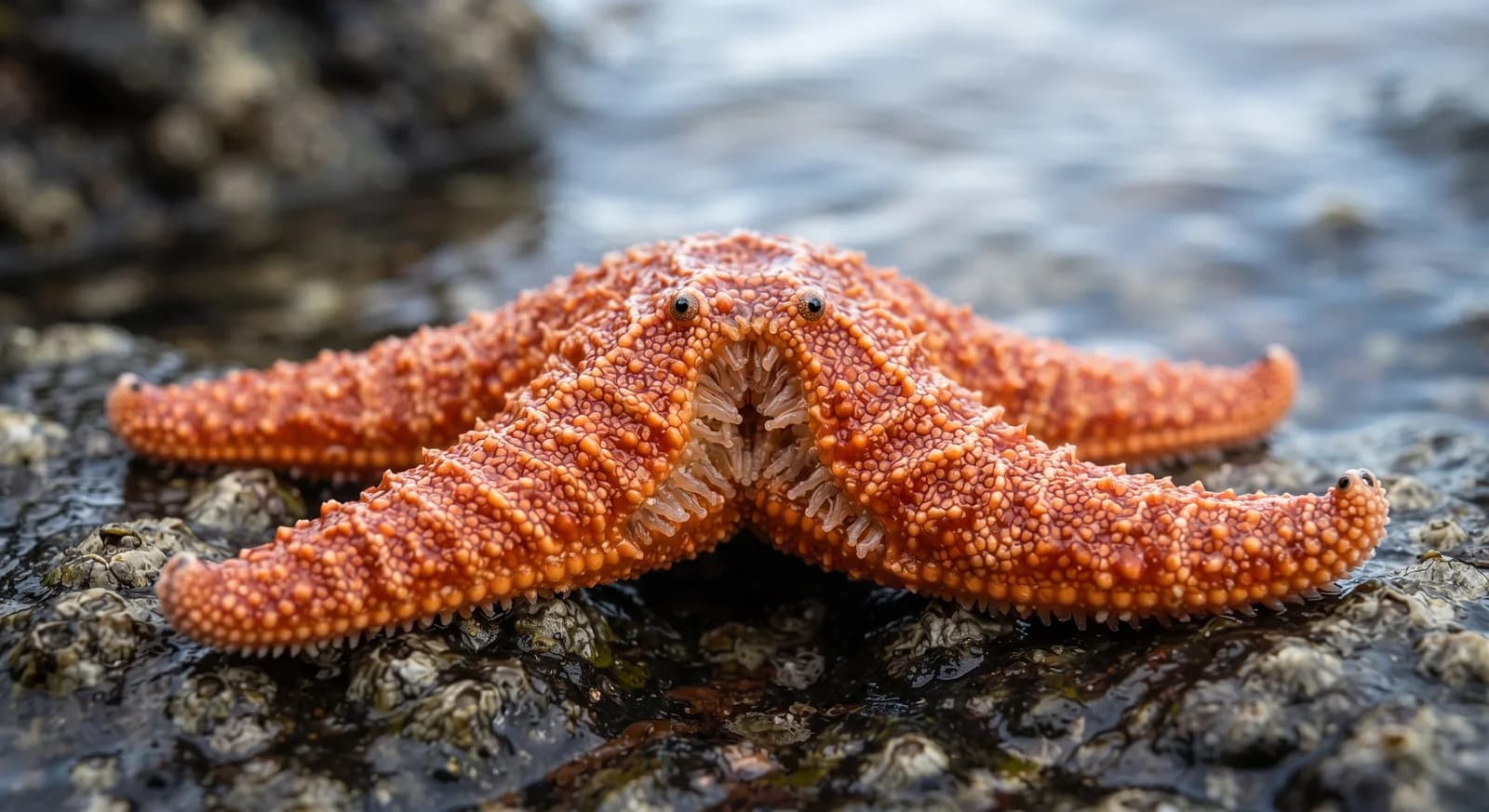
Common Starfish (Asterias rubens)

Starfish · Forcipulatida · Asteriidae

Common Starfish

Asterias rubens

Not Evaluated

It has not yet been assessed against the IUCN criteria.

Spotted something wrong?

It can regrow lost arms completely, a process that can take several months. It digests its prey by pushing its stomach out of its own body.

Size

10 cm – 52 cm

Life expectancy

7 years

Diet

Carnivore

Feeds mainly on other animals.
Activity

Nocturnal

Active mainly at night.

Social structure

Solitary

Lives and hunts alone, joining others only to breed.

Sighting difficulty

Unknown

Ocean
39countries45parks18dive sites2same family

AI-generated images: illustrations, not photographs.

Fun facts

  • It can regrow lost arms completely, and an arm with part of the central disc attached can regenerate a whole animal.
  • It digests its prey by pushing its stomach out of its own body.
  • It feeds mainly on mussels and other bivalve molluscs.
  • It is the most common starfish on European coasts, and also a problem for shellfisheries: it can decimate cultivated mussel and oyster beds.
  • It opens bivalves by exhaustion: it grips the two valves with hundreds of tube feet and pulls relentlessly until the prey's adductor muscle gives way, which can take hours.
  • And then it does not even open it fully: a gap of less than a millimetre is enough for it to push its stomach out through its mouth, slip it inside the shell and digest the prey within its own armour.
  • It regenerates arms with ease, and it is common to see arms of different lengths on a single individual.
  • It detects the presence of its prey by smell, and its prey likewise smell their predator: mussels respond to its scent by thickening their shells.
  • It has suffered episodes of mass mortality in the North Sea, and it is studied as a sentinel species for the health of the seabed.

Life cycle and biology

Skeleton type
Invertebrate - internal calcareous endoskeleton made of plates (ossicles)
Habitat and environment
Rocky, sandy and gravel bottoms of the North Atlantic, from the intertidal down to 650 m
Birth weight
A microscopic planktonic larva after external fertilisation
Size at birth
A microscopic planktonic larva that turns into a five-armed juvenile with short arms
Sexual maturity
Its 2nd year, on reaching ~5 cm across
Gestation / incubation
No gestation; several weeks of planktonic larval development after external fertilisation
Litter / clutch size
Millions of gametes released at each spawning

Sources consulted: MarLIN; SeaLifeBase; Diving Guru; EBSCO Research Starters; AnimalHub; Wikipedia (Common starfish); ScienceInsights; Plymouth Marine Laboratory (biology study)

Where to find it

Loading map…

Where to see it

Parks and dive sites where this species has been documented — showing 20 of 63.

Related species

Other species in the catalogue with the most in common with Common Starfish — same habitat, park, country, tags or family.

Shares a park
Shares a park
Shares a park
Shares a park
Shares a park
Shares a park

Keep exploring

Based on what we already know about common starfish.

Comments

Share an experience, a fun fact or a tip for seeing the common starfish.

Be the first to comment.

See full glossary
This page in other languages: Español · Deutsch · Français · Português · Italiano

The pins mark the parks and dive sites where its presence is documented.

See its range on the interactive map→
Doñana National ParkSpain
CalanquesFrance
Cinque TerreItaly
Alonissos and the Northern SporadesGreece
IchkeulTunisia
Majjistral ParkMalta
Port-CrosFrance
Pembrokeshire CoastUnited Kingdom
NorthumberlandUnited Kingdom
Cabrera ArchipelagoSpain
Scapa FlowUnited Kingdom
Farne IslandsUnited Kingdom
Lofoten (orcas)Norway
SaltstraumenNorway
Berlengas IslandsPortugal
St AbbsUnited Kingdom
Malin HeadIreland
Strýtan (hydrothermal chimney)Iceland
Cíes IslandsSpain
SesimbraPortugal
See all 45 parks
See all 18 dive sites
Near Threatened

Thornback Ray

Raja clavata

Near Threatened

Common Stingray

Dasyatis pastinaca

RabbitfishNear Threatened

Rabbitfish

Chimaera monstrosa

Sea LampreyLeast Concern

Sea Lamprey

Petromyzon marinus

Moray EelLeast Concern

Moray Eel

Muraena helena

European HakeLeast Concern

European Hake

Merluccius merluccius

CountriesUnited Kingdom
ParksDoñana National ParkSpain
TagsCarnivore
Carnivore
Nocturnal
Solitary
Ocean
Echinoderm

Europe28

Asia6

Africa5

United Kingdom
Spain
Italy
Portugal
Ireland
Croatia
Albania
Belgium
Bulgaria
Croatia
Cyprus
Denmark
Estonia
France
Gibraltar
Greece
Iceland
Ireland
Italy
Latvia
Lithuania
Malta
Monaco
Montenegro
Netherlands
Norway
Poland
Portugal
Romania
Slovenia
Spain
Sweden
Ukraine
United Kingdom
Georgia
Israel
Lebanon
Palestine
Syria
Türkiye
Algeria
Egypt
Libya
Morocco
Tunisia