Skip to content
WAnimals
  • Map
  • Species
  • Parks
  • Diving
Log inCreate account
WAnimals

The guide for travellers and animal lovers: discover, plan and share your wild adventures around the world.

Discover wildlife

  • Species
  • Ecosystems
  • Glossary
  • Tags

Explore places

  • Map
  • Countries
  • Parks
  • Diving

Plan experiences

  • Guides

Learn

  • Blog

Resources

  • About us
  • How we build our profiles
  • Help centre
  • Contact
  • Install the app

Follow us

Account

  • Log in
  • Create account

© 2026 WAnimals. All rights reserved.

Terms of servicePrivacyCookiesLegal notice
MapSpeciesParksDiving
  1. Home
  2. Species
  3. European Stonechat
European Stonechat (Saxicola rubicola)

Birds · Passeriformes · Muscicapidae

European Stonechat

Saxicola rubicola

Least Concern

The species is abundant and widely distributed; it faces no significant short-term risk.

Spotted something wrong?

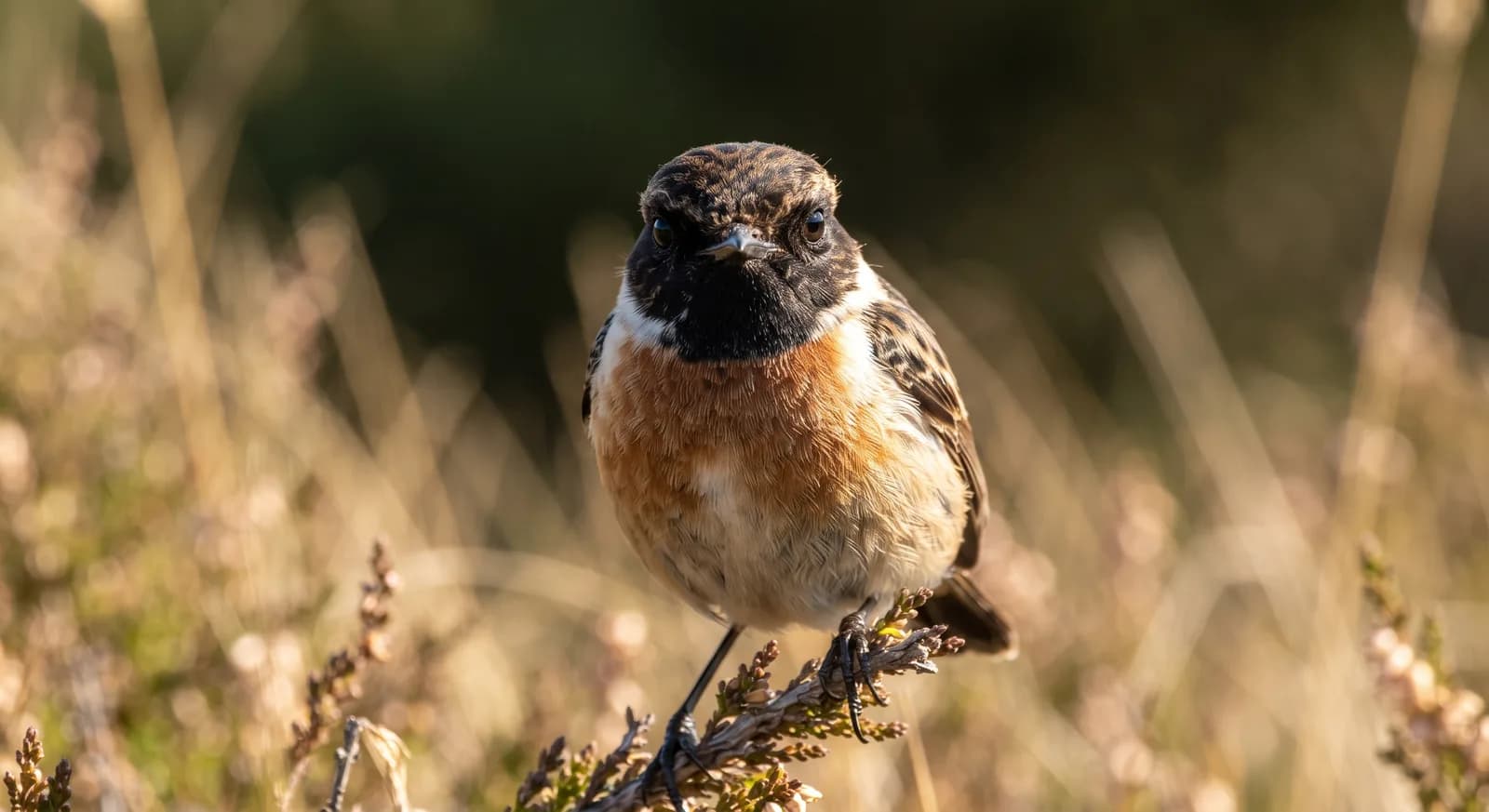
A plump bird with a rounded head and short wings and tail, slightly smaller than a sparrow. The male has a black head and throat, a striking white half-collar on the sides of the neck and an intensely orange breast. The female replaces the black with brown and has a far less marked collar.

Weight

15 g on average

Size

12 cm – 13 cm

Life expectancy

5 years
Diet

Insectivore

Feeds mainly on insects and other invertebrates.

Activity

Diurnal

Active mainly during the day.

Social structure

In pairs

Usually lives in pairs, sometimes for life.

Estimated population

Spain holds almost half the European population. The estimate in the Third Atlas cuts the breeding numbers by almost a million compared with the previous one

Grassland
46countries200parks14same family

AI-generated images: illustrations, not photographs.

Fun facts

  • GeneralIt watches from a high perch and drops to the ground to take insects.
  • Its call is a dry repeated click, "chac-chac", that sounds like two stones being knocked together: hence the name "saxicola", which in Latin means dweller among the rocks.
  • Its decline has two opposite causes acting at once: rural abandonment closes up the open spaces where it lives and agricultural intensification destroys those that remain.
  • Although it is monogamous, cases of polygamy have been described.

Life cycle and biology

Skeleton type
Vertebrate - internal bony skeleton (bird)
Habitat and environment
Low scrub, grassland and field margins
Gestation / incubation
13-14 days, by the female alone, starting from the laying of the last egg
Litter / clutch size
2-7 finely speckled bluish eggs, with up to three clutches a year between February and July

Sources consulted: SEO/BirdLife (ficha y III Atlas de las aves en época de reproducción en España) · IUCN Red List · Asturnatura · Barcelo-Serra y Gordo 2022, III Atlas · BirdLife International 2015, European Red List of Birds · Keller et al. 2020 · Bueno 1991, Ardeola 38

Where to find it

Best time: All year round; it is very conspicuous because it perches upright on top of bushes, fences and posts

Loading map…

Where to see it

Parks and dive sites where this species has been documented — showing 10 of 200.

Related species

Other species in the catalogue with the most in common with European Stonechat — same habitat, park, country, tags or family.

Same taxonomic family

Keep exploring

Based on what we already know about european stonechat.

Share an experience, a fun fact or a tip for seeing the european stonechat.
See full glossary
This page in other languages: Español · Deutsch · Français · Português · Italiano

The pins mark the parks where its presence is documented.

See its range on the interactive map→
Doñana National ParkSpain
Lake DistrictUnited Kingdom
CairngormsUnited Kingdom
Snowdonia (Eryri)United Kingdom
KillarneyIreland
Gran ParadisoItaly
VanoiseFrance
Stelvio (Stilfserjoch)Italy
EcrinsFrance
MercantourFrance
See all 200 parks
Spotted FlycatcherLeast Concern

Spotted Flycatcher

Muscicapa striata

Rufous-tailed Rock ThrushLeast Concern

Rufous-tailed Rock Thrush

Monticola saxatilis

Least Concern

European Pied Flycatcher

Ficedula hypoleuca

Least Concern

Blue Rock Thrush

Monticola solitarius

Least Concern

Moussier's Redstart

Phoenicurus moussieri

European RobinLeast Concern

European Robin

Erithacus rubecula

CountriesSpain
ParksDoñana National ParkSpain
TagsInsectivore
Insectivore
Diurnal
In pairs
Bird
Grassland

Europe40

Asia5

Africa1

Spain
Poland
Italy
United Kingdom
France
Greece
Albania
Andorra
Austria
Belarus
Belgium
Bosnia and Herzegovina
Bulgaria
Croatia
Czechia
Denmark
Estonia
Finland
France
Germany
Greece
Hungary
Ireland
Italy
Kosovo
Latvia
Liechtenstein
Lithuania
Luxembourg
Moldova
Montenegro
Netherlands
North Macedonia
Norway
Poland
Portugal
Romania
San Marino
Serbia
Slovakia
Slovenia
Spain
Sweden
Switzerland
Ukraine
United Kingdom
Armenia
Azerbaijan
Georgia
Russia
Türkiye
Morocco