Skip to content
WAnimals
  • Map
  • Species
  • Parks
  • Diving
Log inCreate account
WAnimals

The guide for travellers and animal lovers: discover, plan and share your wild adventures around the world.

Discover wildlife

  • Species
  • Ecosystems
  • Glossary
  • Tags

Explore places

  • Map
  • Countries
  • Parks
  • Diving

Plan experiences

  • Guides

Learn

  • Blog

Resources

  • About us
  • How we build our profiles
  • Help centre
  • Contact
  • Install the app

Follow us

Account

  • Log in
  • Create account

© 2026 WAnimals. All rights reserved.

Terms of servicePrivacyCookiesLegal notice
MapSpeciesParksDiving
  1. Home
  2. Species
  3. Field Grasshopper

One of the 2 grasshoppers on WAnimals
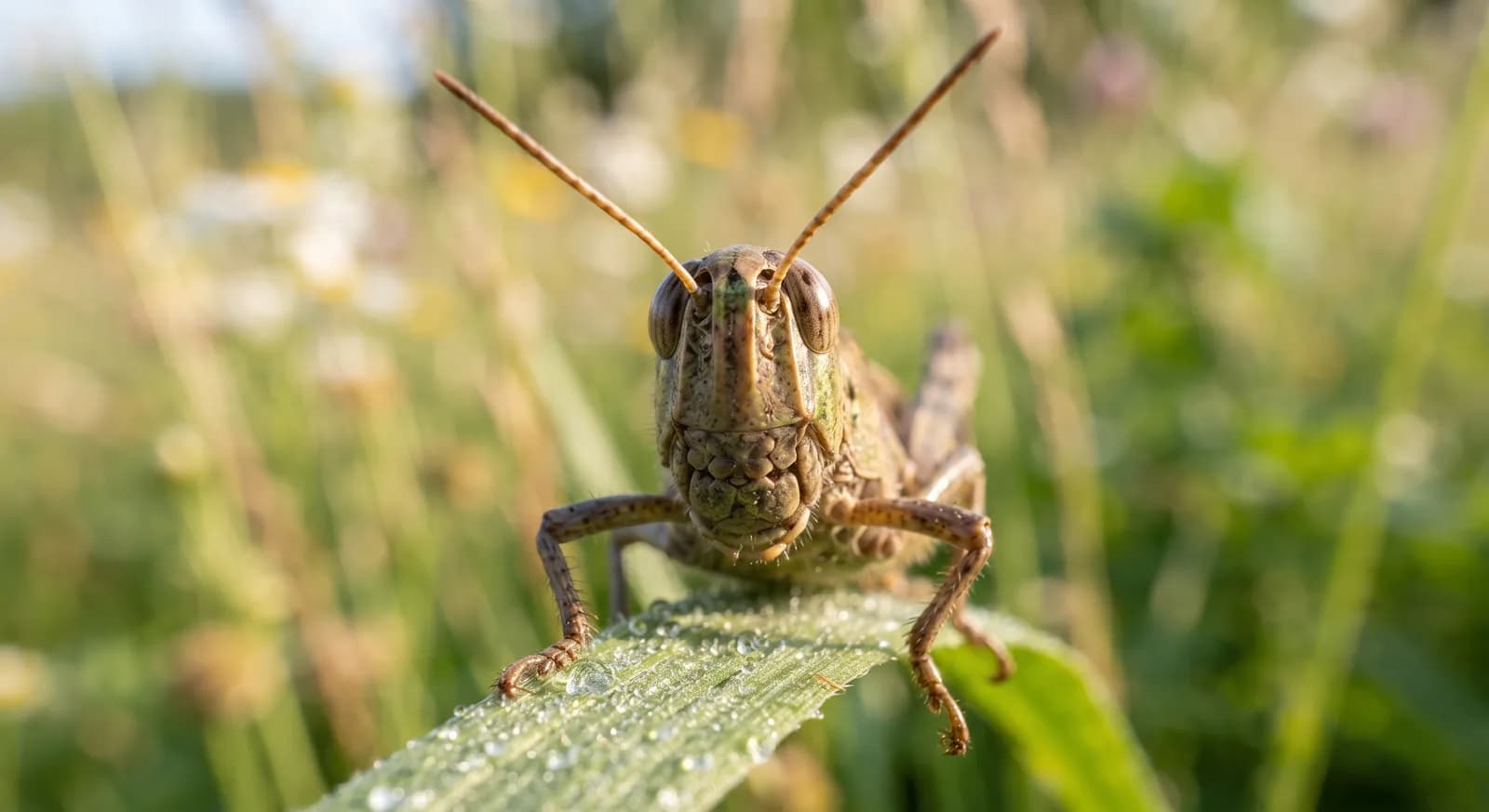
Field Grasshopper (Chorthippus brunneus)

Insects · Orthoptera · Acrididae

Field Grasshopper

Chorthippus brunneus

Least Concern

The species is abundant and widely distributed; it faces no significant short-term risk.

Spotted something wrong?

A small grasshopper of very variable colouring, from brown to green and reddish, extremely common in dry grassland and along path edges throughout Europe. It feeds on grasses, and its song — a series of short, dry chirps repeated over and over — is the background sound of summer.

Size

up to 2.5 cm

Diet

Herbivore

Feeds mainly on plants.

Activity

Diurnal

Active mainly during the day.
Social structure

Colony

Lives in large concentrations, often for breeding reasons.

Grassland
45countries153parks2same family

AI-generated images: illustrations, not photographs.

Fun facts

  • It stridulates by rubbing a row of tiny pegs on the inside of the hind femur against the edge of the wing, a different mechanism from that of crickets, which rub their two wings together.
  • Each grasshopper species has a song of its own, and many can be told apart reliably only by listening to them rather than looking at them.
  • Its colouring depends in part on the substrate the nymph grows up on, so that individuals of very different appearance live side by side in the same meadow.
  • It sings by rubbing its hind legs against its wings, a row of tiny teeth on the femur scraping against a wing vein; the result is a series of short, repeated chirps, characteristic of summer.
  • Each species in its genus has a distinct song, and in many cases that song is the only reliable character for telling them apart: they are morphologically almost identical.
  • It hybridises in the laboratory with closely related species, and the group is used as a model for studying the role of song in reproductive isolation.
  • It hears through its abdomen: its tympanal organs sit on the sides of the first abdominal segment, unlike those of the bush crickets.
  • It is one of the most abundant and widespread grasshoppers in Europe, and readily colonises disturbed ground.

Life cycle and biology

Skeleton type
Invertebrate - chitin exoskeleton (insect)
Habitat and environment
Dry grassland, verges, banks and disturbed ground

Sources consulted: Wikipedia (en): Chorthippus brunneus

Where to find it

Best time: From July to October, in dry, sunny grassland

Loading map…

Where to see it

Parks and dive sites where this species has been documented — showing 10 of 153.

Related species

Other species in the catalogue with the most in common with Field Grasshopper — same habitat, park, country, tags or family.

Shares a park
Shares a park
Shares a park
Shares a park
Shares a park
Shares a park

Keep exploring

Based on what we already know about field grasshopper.

Share an experience, a fun fact or a tip for seeing the field grasshopper.
See full glossary
This page in other languages: Español · Deutsch · Français · Português · Italiano

The pins mark the parks where its presence is documented.

See its range on the interactive map→
SarekSweden
PadjelantaSweden
HardangerviddaNorway
Lake DistrictUnited Kingdom
CairngormsUnited Kingdom
Snowdonia (Eryri)United Kingdom
KillarneyIreland
Picos de EuropaSpain
Ordesa y Monte PerdidoSpain
Aigüestortes i Estany de Sant MauriciSpain
See all 153 parks
Least Concern

Common Vole

Microtus arvalis

SwallowtailLeast Concern

Swallowtail

Papilio machaon

Least Concern

Rose-ringed Parakeet

Psittacula krameri

Painted LadyLeast Concern

Painted Lady

Vanessa cardui

Red Mason BeeLeast Concern

Red Mason Bee

Osmia bicornis

Least Concern

Spanish Sparrow

Passer hispaniolensis

CountriesSpain
ParksSarekSweden
TagsHerbivore
Herbivore
Diurnal
Colonial
Insect
Grassland

Europe40

Asia5

Spain
Sweden
Italy
United Kingdom
Finland
Poland
Albania
Andorra
Austria
Belarus
Belgium
Bosnia and Herzegovina
Bulgaria
Croatia
Czechia
Denmark
Estonia
Finland
France
Germany
Greece
Hungary
Ireland
Italy
Kosovo
Latvia
Liechtenstein
Lithuania
Luxembourg
Moldova
Montenegro
Netherlands
North Macedonia
Norway
Poland
Portugal
Romania
San Marino
Serbia
Slovakia
Slovenia
Spain
Sweden
Switzerland
Ukraine
United Kingdom
Armenia
Azerbaijan
Georgia
Russia
Türkiye