Skip to content
WAnimals
  • Map
  • Species
  • Parks
  • Diving
Log inCreate account
WAnimals

The guide for travellers and animal lovers: discover, plan and share your wild adventures around the world.

Discover wildlife

  • Species
  • Ecosystems
  • Glossary
  • Tags

Explore places

  • Map
  • Countries
  • Parks
  • Diving

Plan experiences

  • Guides

Learn

  • Blog

Resources

  • Help centre
  • Contact
  • Install the app

Follow us

Account

  • Log in
  • Create account

© 2026 WAnimals. All rights reserved.

About usHow we build our profilesTerms of servicePrivacyLegal notice
MapSpeciesParksDiving
  1. Home
  2. Species
  3. Zitting Cisticola
Zitting Cisticola (Cisticola juncidis)

Birds · Passeriformes · Cisticolidae

Zitting Cisticola

Cisticola juncidis

Least Concern

The species is abundant and widely distributed; it faces no significant short-term risk.

Spotted something wrong?

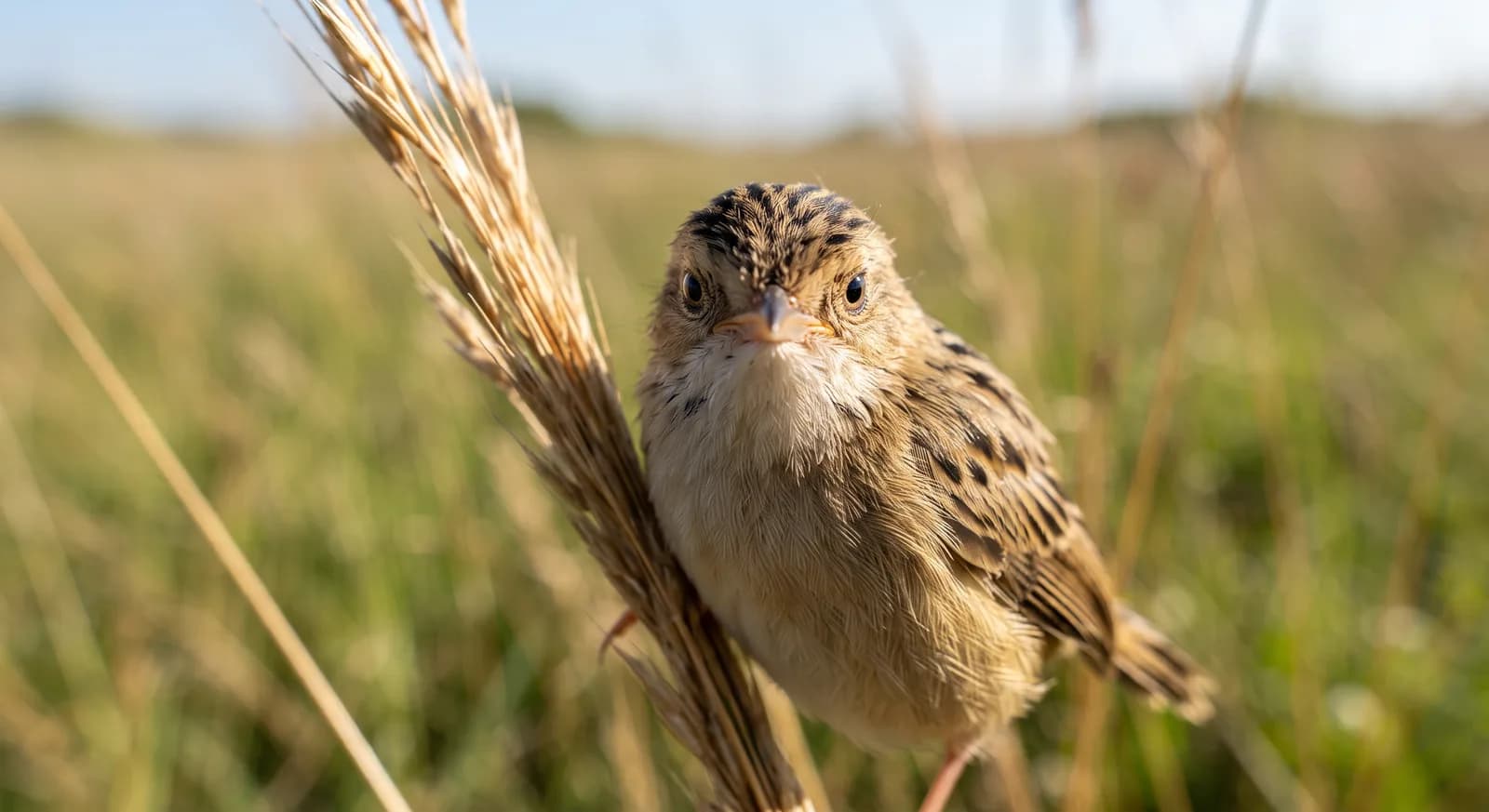
One of the smallest birds in Europe. A dark brown, heavily streaked back and crown, a reddish rump and pale underparts. Its undulating flight and its monotonous, repetitive song, given in flight and timed to its wingbeats, give it away long before its appearance does.

Weight

8 g – 12 g

Size

10 cm on average

Diet

Insectivore

Feeds mainly on insects and other invertebrates.
Activity

Diurnal

Active mainly during the day.

Sighting difficulty

Easy

Estimated population

Between 2.27 and 3.68 million mature individuals in Europe, with a stable trend. The Iberian breeding population is around 3.2 million, with the largest concentrations in Tierra de Campos, the Cádiz countryside and the Guadalquivir valley

FreshwaterGrassland
48countries42parks1same family

AI-generated images: illustrations, not photographs.

Fun facts

  • GeneralIt sews a purse-shaped nest among the grass stems with spider silk.
  • It is the only European representative of the family Cisticolidae, which brings together some 110 species, almost all of them African.
  • The male weaves the outer structure of the nest, an elongated pouch of grasses stitched together with cobweb, and the female finishes the inner lining; he builds several nests one after another to attract different females.
  • Its Spanish name is bewildering for a bird of ten grams, and the local vernacular names poke fun at it: Cienlibras (hundredweight) in Doñana, Tumbabarcos (boat-sinker) in Huelva or Esclafamuntanyes (mountain-crusher) in Valencia.
  • It is one of the smallest birds in Europe, and its Iberian folk names make fun of the fact: in Doñana it is called Cienlibras ("hundredweight"), in Valencia Esclafamuntanyes ("mountain-crusher") and in Huelva Tumbabarcos ("boat-toppler") or Bueyesito ("little ox"). It is very sensitive to cold: a cold snap can wipe out whole populations, as was documented in the Basque Country.

Life cycle and biology

Skeleton type
Vertebrate - internal bony skeleton (bird)
Habitat and environment
Damp grassland, rice fields and low reedbeds
Sexual maturity
The young are able to breed when only a few months old
Gestation / incubation
13 days, by the female alone
Litter / clutch size
4-7 eggs, white or bluish and often speckled. The chicks fledge at 15 days and are independent at 20

Sources consulted: SEO/BirdLife (ficha y III Atlas, Galarza 2022); IUCN Red List; Asturnatura; Galarza 1993, Ardeola 40(2); Tellería, Asensio y Díaz 1999, Aves Ibéricas II

Where to find it

Best time: All year round; it is an essentially resident species

Loading map…

Where to see it

Parks and dive sites where this species has been documented — showing 10 of 42.

Related species

Other species in the catalogue with the most in common with Zitting Cisticola — same habitat, park, country, tags or family.

Shares a park
Shares a park
Shares a park
Shares a park
Shares a park
Shares a park

Keep exploring

Based on what we already know about zitting cisticola.

Comments

Share an experience, a fun fact or a tip for seeing the zitting cisticola.

Be the first to comment.

See full glossary
This page in other languages: Español · Deutsch · Français · Português · Italiano

The pins mark the parks where its presence is documented.

See its range on the interactive map→
Doñana National ParkSpain
Peneda-GeresPortugal
CalanquesFrance
Alta MurgiaItaly
Danube DeltaRomania
IchkeulTunisia
PrespaGreece
Tablas de DaimielSpain
CamargueFrance
Ebro DeltaSpain
See all 42 parks
Greylag GooseLeast Concern

Greylag Goose

Anser anser

Black-winged StiltLeast Concern

Black-winged Stilt

Himantopus himantopus

Barn SwallowLeast Concern

Barn Swallow

Hirundo rustica

Least Concern

White-throated Dipper

Cinclus cinclus

Least Concern

Common Grasshopper Warbler

Locustella naevia

Least Concern

Collared Pratincole

Glareola pratincola

CountriesPortugal
ParksDoñana National ParkSpain
TagsInsectivore
Insectivore
Diurnal
Bird
Freshwater
Grassland

Europe35

Asia9

Africa3

Oceania1

Portugal
Spain
Italy
Greece
Türkiye
Albania
Albania
Andorra
Austria
Belarus
Belgium
Bosnia and Herzegovina
Bulgaria
Croatia
Cyprus
Czechia
France
Germany
Gibraltar
Greece
Hungary
Italy
Kosovo
Liechtenstein
Luxembourg
Malta
Moldova
Monaco
Montenegro
Netherlands
North Macedonia
Poland
Portugal
Romania
San Marino
Serbia
Slovakia
Slovenia
Spain
Switzerland
Ukraine
Armenia
Azerbaijan
Georgia
Israel
Jordan
Lebanon
Palestine
Syria
Türkiye
Algeria
Morocco
Tunisia
Australia