One of the 2 rails on WAnimals
Birds · Gruiformes · Rallidae
Water Rail
Rallus aquaticus
The species is abundant and widely distributed; it faces no significant short-term risk. See full glossary
Its body is flattened side to side, an adaptation that lets it slip between the dense vertical stems of a reedbed, and the origin of the English expression 'thin as a rail'.
Weight
92 g – 164 g
Size
23 cm – 28 cm
Lifespan
6 years
Diet
Omnivore
Combines animal and plant food depending on availability.
Activity
Crepuscular
Active above all at dawn and dusk.
Social structure
Solitary
Lives and hunts alone, joining others only to breed.
Sighting difficulty
Easy
Fun facts
- Its laterally flattened body lets it slip through dense reedbeds.
- It is heard far more often than seen, giving itself away with a high squealing call known as sharming.
- Its chicks feed themselves from as early as 5 days old.
Life cycle & biology
- Skeleton type
- Vertebrate - pneumatised bony skeleton (bird)
- Habitat & environment
- Dense reedbeds and well-vegetated wetlands of Europe, Asia and North Africa
- Birth weight
- Exact weight at hatching not found as a precise figure
- Size at birth
- Precocial, covered in black down with a whitish bill, able to feed itself at 5 days
- Sexual maturity
- 1 year
- Gestation / incubation
- 19-22 days
- Litter / clutch size
- 6 to 11 eggs per clutch
Sources consulted: AnAge (genomics.senescence.info); Animalia.bio; Wikipedia (Water rail); My Bird Buddy; BTO; Oiseaux-birds.com; Bird Spot; Birds of the World
Where to find it
See its range on the interactive mapBest time: All year round in dense reedbeds and rush beds; it is almost always detected by ear, from squeals that recall a pig.
Where to watch it
Parques y spots de buceo donde se ha documentado esta especie — se muestran 10 de 135 documentados.
Related species
Other species in the catalogue with the most in common with Water Rail — same habitat, park, country, tags or family.
Red-Knobbed Coot
Fulica cristata
Eurasian Coot
Fulica atra
 Least Concern
Purple Swamphen
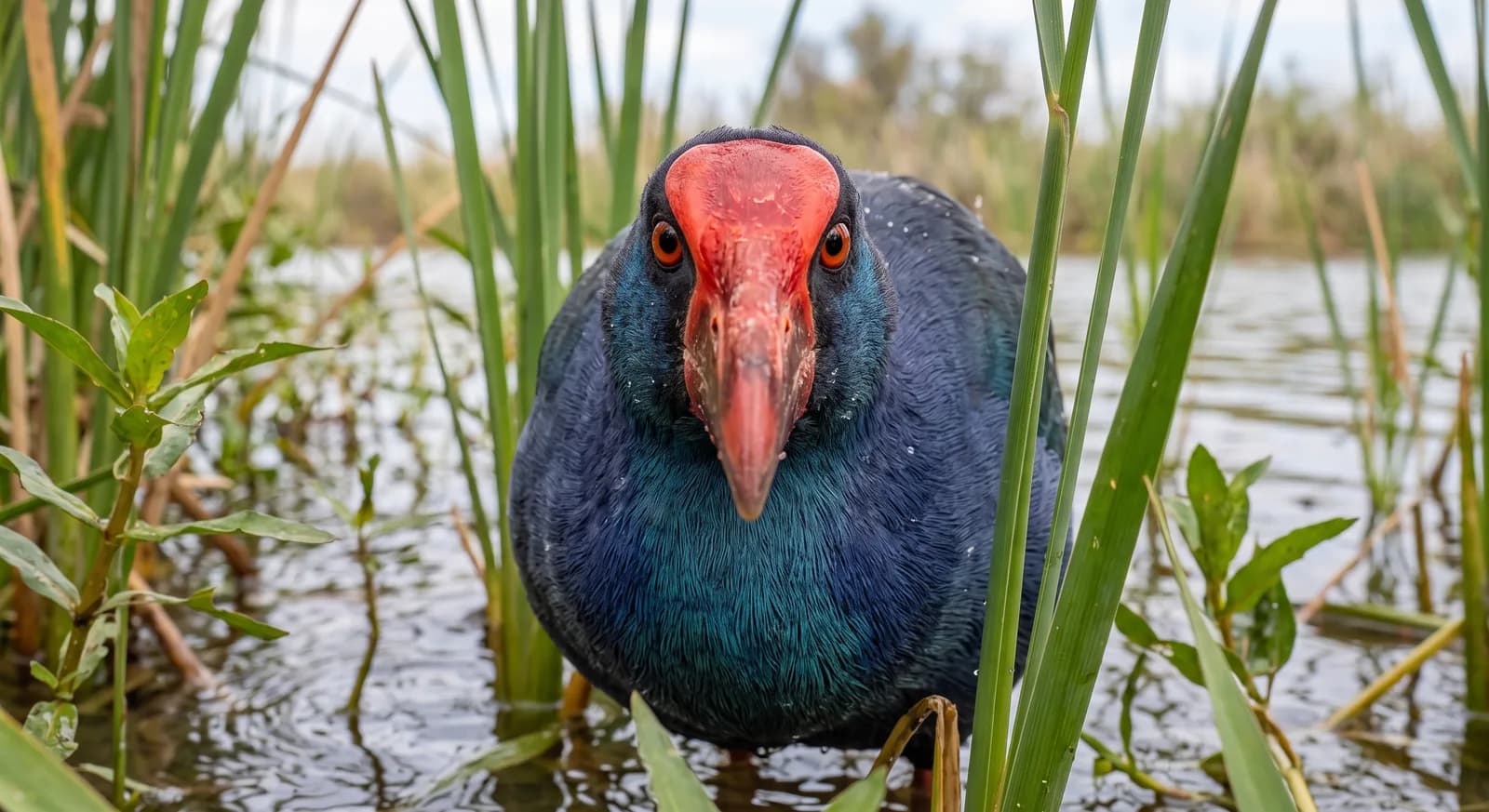
Porphyrio porphyrio
Common Moorhen
Gallinula chloropus
Ruddy Duck
Oxyura jamaicensis
Common Snipe
Gallinago gallinago
Keep exploring
Based on what we already know about water rail.
Comments
Share an experience, a fun fact or a tip for seeing the water rail.
Be the first to comment.