Skip to content
WAnimals
  • Map
  • Species
  • Parks
  • Diving
Log inCreate account
WAnimals

The guide for travellers and animal lovers: discover, plan and share your wild adventures around the world.

Discover wildlife

  • Species
  • Ecosystems
  • Glossary
  • Tags

Explore places

  • Map
  • Countries
  • Parks
  • Diving

Plan experiences

  • Guides

Learn

  • Blog

Resources

  • About us
  • How we build our profiles
  • Help centre
  • Contact
  • Install the app

Follow us

Account

  • Log in
  • Create account

© 2026 WAnimals. All rights reserved.

Terms of servicePrivacyCookiesLegal notice
MapSpeciesParksDiving
  1. Home
  2. Species
  3. Common Pochard

One of the 4 diving ducks on WAnimals
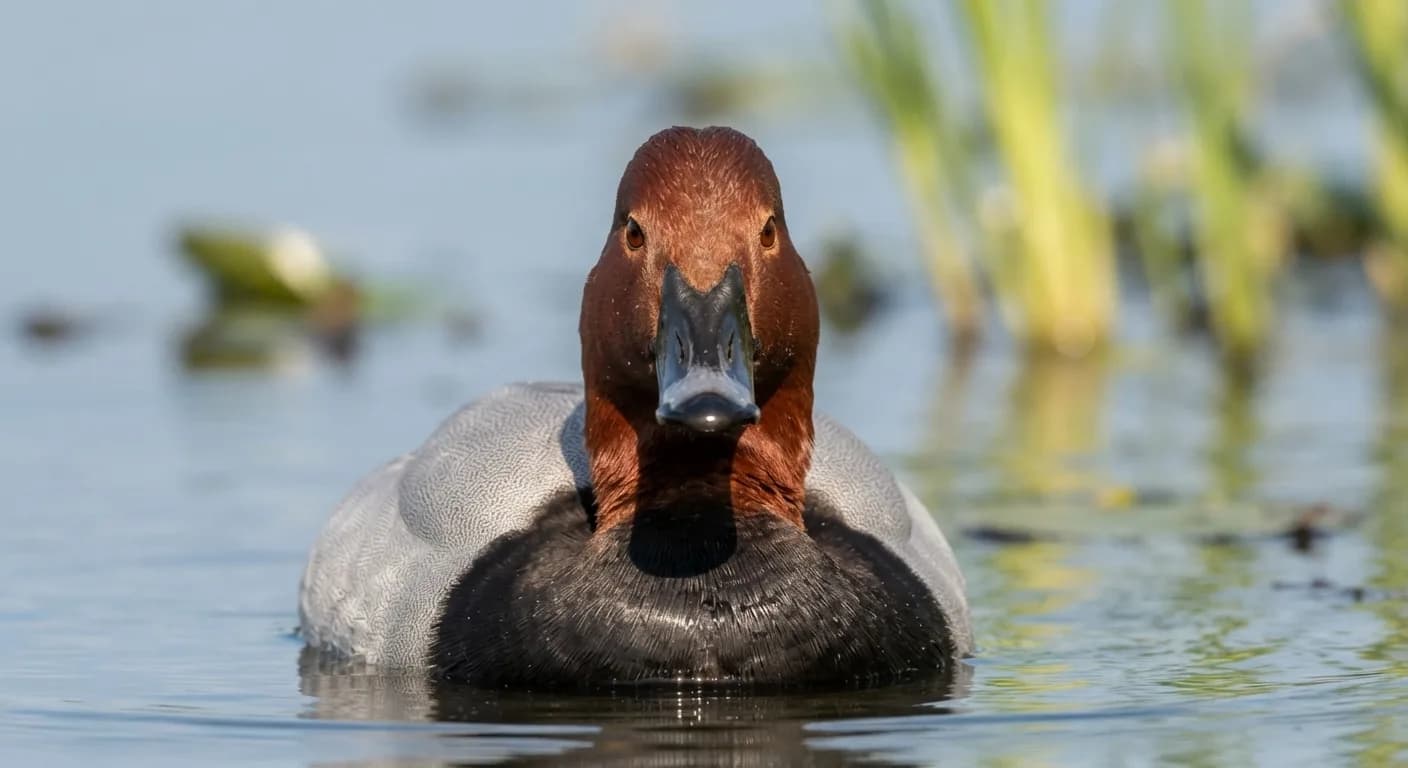
Common Pochard (Aythya ferina)

Birds · Anseriformes · Anatidae

Common Pochard

Aythya ferina

Vulnerable

At high risk of extinction in the wild over the medium term.

Spotted something wrong?

A typical diving duck of compact build, with a short tail, strong legs and a whirring flight, which swims with its body low in the water and its tail down. The breeding male has a reddish-chestnut head and neck, a greyish back and flanks and a black breast and stern. The bill is dark with a greyish band across it, and the eye is red. The head has a characteristic triangular outline.

Weight

823 g on average

Size

42 cm – 49 cm

Life expectancy

6 years
Diet

Omnivore

Combines animal and plant food depending on availability.

Activity

Diurnal

Active mainly during the day.

Social structure

In pairs

Usually lives in pairs, sometimes for life.

Estimated population

In Spain it is abundant but localised; it is the commonest and most widespread diving duck in the country

Freshwater
45countries108parks42same family

AI-generated images: illustrations, not photographs.

Fun facts

  • GeneralA diving duck that feeds on submerged plants 2-3 m down.
  • It went from Least Concern to Vulnerable in 2015 because of rapid declines across its range: it is a clear case of a common species collapsing without anyone noticing.
  • The causes of its decline in Russia are a revealing mosaic: steppe droughts, the abandonment of fish farms that served it as habitat, the hypereutrophication of lakes, the loss of black-headed gull colonies in its wetlands, and the spread of the invasive American mink and raccoon dog.
  • It is considered a potential vector of highly pathogenic avian influenza, and its genetic structure has been studied for that reason.

Life cycle and biology

Skeleton type
Vertebrate - internal bony skeleton (bird)
Habitat and environment
Deep lagoons, reservoirs and gravel pits
Birth weight
Precocial: born covered in down and leaves the nest within a few hours
Size at birth
Precocial: born covered in down and leaves the nest within a few hours
Sexual maturity
12 months
Gestation / incubation
24-26 days of incubation
Litter / clutch size
6-11 eggs per clutch

Sources consulted: IUCN Red List (reclasificado en 2015) · EUNIS - Agencia Europea de Medio Ambiente · SEO/BirdLife · Fox et al. 2020, Avian Research 11 (revisión del estatus en Rusia) · Liu, Keller y Heckel 2011, Ecology and Evolution · Directiva Aves · Linnaeus 1758 · Boie 1822

Where to find it

Best time: Mainly in winter, when the Spanish wetlands receive contingents from other latitudes

Loading map…

Where to see it

Parks and dive sites where this species has been documented — showing 10 of 108.

Related species

Other species in the catalogue with the most in common with Common Pochard — same habitat, park, country, tags or family.

Same taxonomic family

How to help

The common pochard is classified as vulnerable. Organisations such as the IUCN, WWF and the Wildlife Conservation Society work specifically on its conservation and that of its habitat; looking into their programmes is a good starting point if you want to get involved.

It's documented in 10 protected areas — one reason why protecting these places matters for its conservation.

Keep exploring

Based on what we already know about common pochard.

Share an experience, a fun fact or a tip for seeing the common pochard.
See full glossary
This page in other languages: Español · Deutsch · Français · Português · Italiano

The pins mark the parks where its presence is documented.

See its range on the interactive map→
Doñana National ParkSpain
Lake DistrictUnited Kingdom
CairngormsUnited Kingdom
Snowdonia (Eryri)United Kingdom
KillarneyIreland
RetezatRomania
BiałowieżaPoland
Danube DeltaRomania
TatraPoland
LahemaaEstonia
See all 108 parks
Least Concern

Whooper Swan

Cygnus cygnus

Ferruginous DuckNear Threatened

Ferruginous Duck

Aythya nyroca

Least Concern

Tufted Duck

Aythya fuligula

Least Concern

Goosander

Mergus merganser

Mute SwanLeast Concern

Mute Swan

Cygnus olor

Red-breasted MerganserLeast Concern

Red-breasted Merganser

Mergus serrator

CountriesPoland
ParksDoñana National ParkSpain
TagsOmnivore
Omnivore
Diurnal
In pairs
Vulnerable
Bird
Freshwater

Europe40

Asia5

Poland
United Kingdom
Hungary
Romania
Bulgaria
Netherlands
Albania
Andorra
Austria
Belarus
Belgium
Bosnia and Herzegovina
Bulgaria
Croatia
Czechia
Denmark
Estonia
Finland
France
Germany
Greece
Hungary
Ireland
Italy
Kosovo
Latvia
Liechtenstein
Lithuania
Luxembourg
Moldova
Montenegro
Netherlands
North Macedonia
Norway
Poland
Portugal
Romania
San Marino
Serbia
Slovakia
Slovenia
Spain
Sweden
Switzerland
Ukraine
United Kingdom
Armenia
Azerbaijan
Georgia
Russia
Türkiye