Birds · Anseriformes · Anatidae
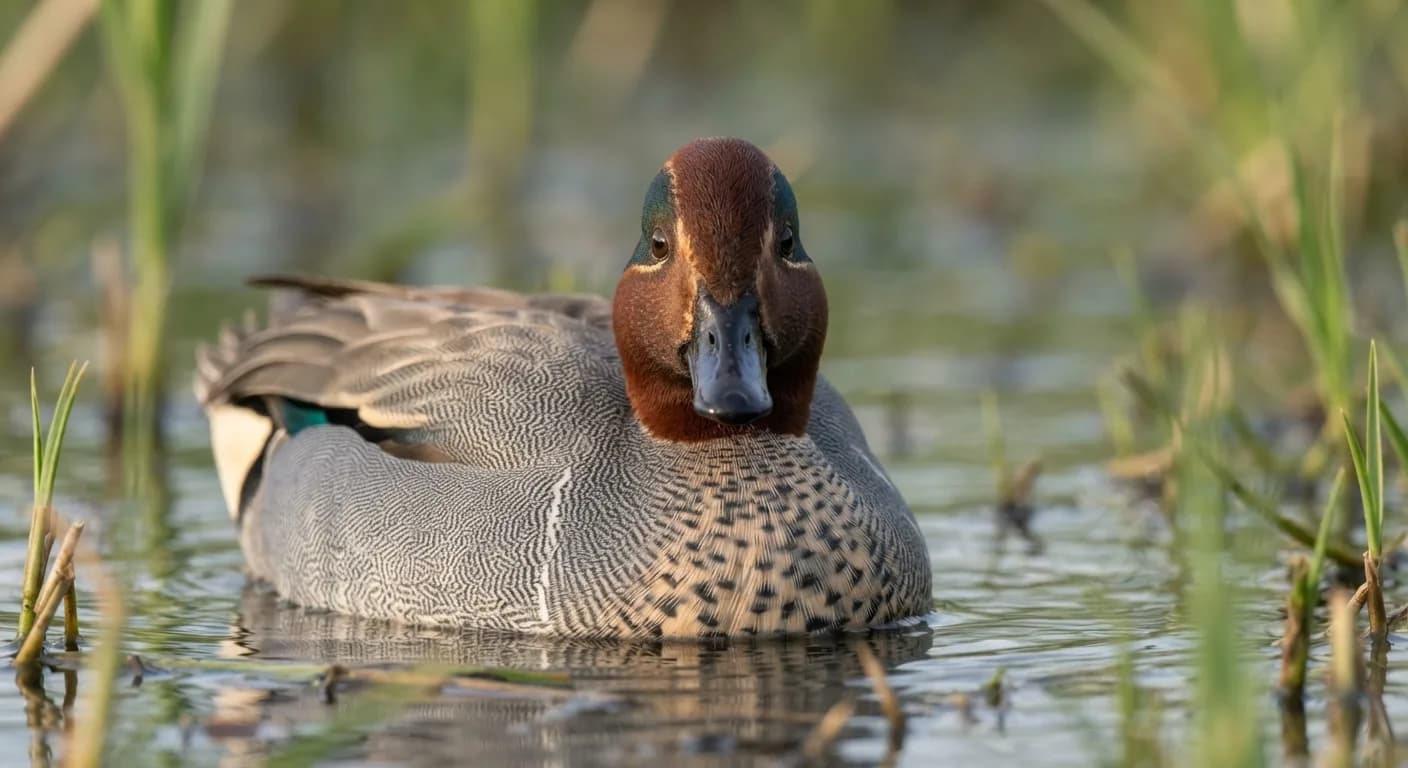
Anas crecca
The species is abundant and widely distributed; it faces no significant short-term risk.
The smallest dabbling duck of the Palaearctic. Compact in body and fast and agile in flight, it takes off almost vertically from the water. The male in eclipse looks very like the female, which complicates identification outside the breeding season.
Weight
342 g on average
Size
up to 38 cm
Life expectancy
15 years
Diet
Omnivore
Combines animal and plant food depending on availability.
Activity
Diurnal
Active mainly during the day.
Social structure
Colony
Lives in large concentrations, often for breeding reasons.
Sighting difficulty
Easy
Estimated population
Between 5.9 and 6.9 million birds worldwide. In Europe, 1.04-1.64 million, with an increasing trend. In Spain the winter average was 92,753 birds between 1997 and 2016
AI-generated images: illustrations, not photographs.
Sources consulted: Frontiers in Ecology and Evolution (datos morfométricos de anátidas europeas, material suplementario); IUCN Red List; Wikipedia; Boie 1822; Linnaeus 1758
Best time: Winter, when the northern contingents arrive at the Spanish wetlands
Parks and dive sites where this species has been documented — showing 10 of 156.
Other species in the catalogue with the most in common with Eurasian Teal — same habitat, park, country, tags or family.
Based on what we already know about eurasian teal.
Share an experience, a fun fact or a tip for seeing the eurasian teal.
Be the first to comment.
The pins mark the parks where its presence is documented.